Activity
Mon
Wed
Fri
Sun
Jun
Jul
Aug
Sep
Oct
Nov
Dec
Jan
Feb
Mar
Apr
May
What is this?
Less
More
Memberships
Max Business School™
264.9k members • Free
Successful Coaching
262 members • Free
Claw & Automate
1.5k members • Free
OpenClawBuilders/AI Automation
493 members • Free
Vibe Coding School
681 members • Free
Agency Growth
4.6k members • Free
Agency Owners
19.9k members • Free
Customer Funded Founders
464 members • Free
Business Builders Club
7.9k members • Free
12 contributions to AI Automation Society

6d •
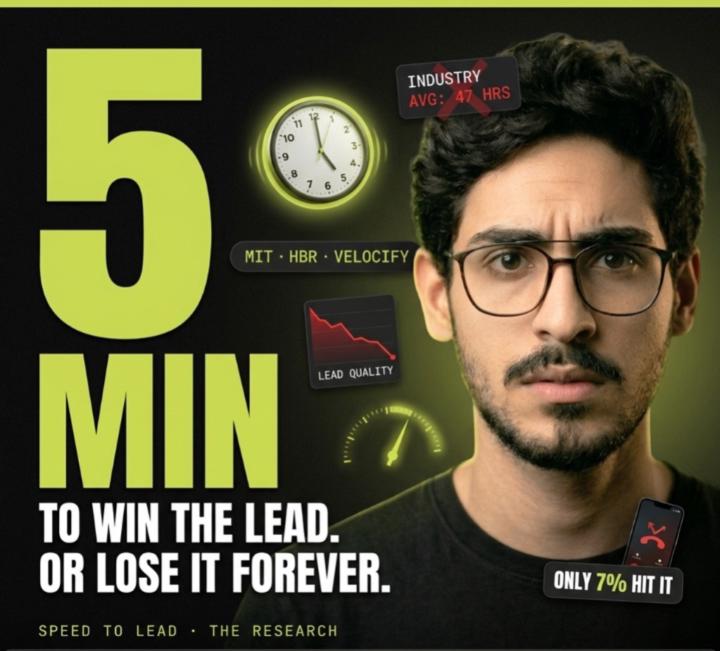
THE 5-MINUTE RULE — WHY MOST SERVICE BUSINESSES LEAK 30-50% OF THEIR PIPELINE WITHOUT KNOWING IT
I want to break down something that took me a year of building lead-response systems to fully appreciate. It's the most cited stat in sales, but almost nobody actually operates around it. The rule: respond to a lead within 5 minutes, or you've already lost most of the value. THE RESEARCH (NOT MY OPINION) This isn't a "I think" post. The numbers come from three different studies that have been replicated for over a decade: - MIT Lead Response Management Study: responding within 5 minutes makes you 100x more likely to even reach the prospect — vs. waiting 30 minutes. - Harvard Business Review: lead quality drops 80% after the 5-minute window passes. - Velocify analyzed 3.5 million leads: calling within 60 seconds led to 391% more conversions. And here's the gap nobody talks about: the average industry response time is 47 hours. That's 600x slower than what the research says wins. WHY IT MATTERS MORE IN 2026 According to Salesforce's State of Sales Report, 64% of consumers now expect real-time responses — up from 58% in 2023. Top performers are now targeting sub-60-second response times. Not because it's a flex. Because their buyers expect it. WHAT I KEEP SEEING I build AI lead-response systems for service businesses — mostly dental, home services, legal, and coaches. The pattern is identical every time: The business has decent leads. They're spending money on ads. They have a sales team. But the leads come in at the worst times — 9pm Tuesday, Saturday morning, lunch hour. Times when no human is sitting at the desk. So 30-50% of the pipeline goes to whoever answered first. Usually a competitor. THE TRADE-OFF NOBODY TALKS ABOUT Here's the part that took me longest to internalize: You don't fix the 5-minute rule by hiring more reps. Even if you tripled your team, you still wouldn't have 24/7 coverage. You'd just have more humans at the same desks. You fix it by separating the FIRST response from the FULL conversation. A simple AI agent that hits 5 minutes 24/7 — qualifies the lead with 4-5 questions, books the appointment, and only escalates the edge cases to a human team — captures the window. The human team takes over from there.
2
0
14d •
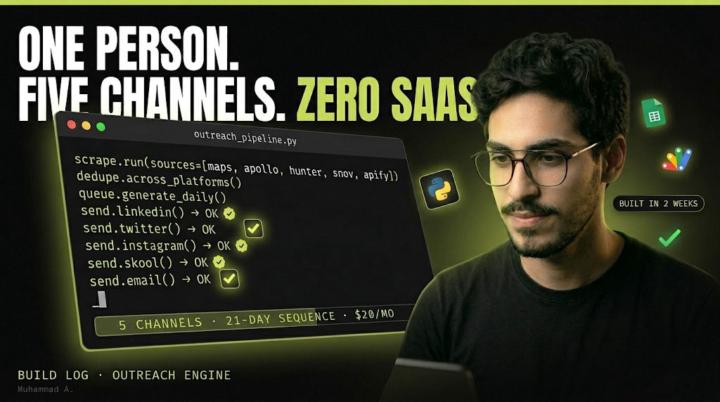
BUILD LOG — HOW I BUILT A 5-CHANNEL OUTREACH MACHINE AS A SOLO OPERATOR
This is a deep-dive post because I want to share the actual architecture not just "I automated outreach" vibes. For context: I build AI systems chatbots, voice agents, outreach automation for service businesses and agencies. Every system I build for clients gets tested on my own business first. Last 2 weeks I built the outreach system I'd been putting off for 6 months. Here's what's inside. THE PROBLEM Every outreach tool I tried had one of two flaws: 1. It sold me scale but gave me spammy templates that killed my sender reputation 2. It was a dashboard, not a system I still had to decide who to message, when, and what to say What I wanted was the opposite: a system that runs like a pipeline. Something that tells me every morning: "Here are 23 people to message today here's which channel, here's the context, here's the template." And dedupes across every channel so the same prospect never gets 5 messages from me in 3 days. THE ARCHITECTURE Three layers, all built on Python + Google Sheets + Apps Script. Layer 1: PROSPECTING Six scrapers running in parallel: - Google Maps (for local service businesses) - Apollo.io (for B2B contacts) - Hunter.io (for domain-based email discovery) - Snov.io (for additional email enrichment) - Apify (for Instagram/LinkedIn web scraping) - Serper (Google search API for long-tail discovery) Each feeds into its own raw sheet. Every lead gets a universal ID. Layer 2: ORCHESTRATION One master sheet that: - Pulls from all 6 scraper sheets - Dedupes across platforms (same person on LinkedIn + Twitter = one entry) - Tags with source, niche, platform readiness - Generates a daily queue: 15-30 people to message TODAY, split by channel - Tracks a 21-day follow-up sequence per prospect Layer 3: DELIVERY Four Apps Scripts (one per channel) that: - Read the daily queue - Pull the right template for Day 1 / Day 3 / Day 5 / Day 7 / Day 14 / Day 21 - Personalize based on niche and prospect data
17d •
WHY I STOPPED TELLING CLIENTS TO HIRE MORE SALESPEOPLE
I had this conversation 14 times last month. A service business owner comes to me, frustrated. "We're getting leads but not closing enough. Should I hire another rep?" Most consultants say yes. Most agencies say yes. Most business coaches say yes. I say no. Here's why. THE REAL PROBLEM ISN'T STAFFING A lead comes in at 8:47 PM. Your reps are offline. By 9 AM, that lead already talked to two competitors. One booked a call. The deal is dead before your team even starts their day. Now imagine hiring another rep. Then another. Then a sales manager. You've just spent $200K/year to cover 60% of the hours your leads actually come in. Nights. Weekends. Holidays. That's when your prospects are researching. Your human team is off. THE MATH NOBODY DOES Conversion drops 80% after the first hour of inactivity. Your first-response window isn't "business hours" — it's the first 5 minutes from when the lead converts. A human can't guarantee that. A system can. WHAT I ACTUALLY RECOMMEND Build an AI agent that handles first-contact 24/7: - WhatsApp, phone, email, website — one system, every channel - Qualifies leads while they're still interested - Books calls directly into your team's calendar - Escalates edge cases to a human when needed Your sales reps don't disappear. They get freed up to close qualified, pre-warmed leads instead of chasing cold ones. THE COUNTERINTUITIVE TRUTH Fewer reps + one AI system = more closed deals than 3x the headcount. Every service business I've implemented this for saw the same pattern: - Response time: hours → under 60 seconds - Booked calls: up 40-70% in the first 60 days - Headcount cost: flat or down BEFORE YOU HIRE Ask yourself: "Am I adding staff because I need humans, or because I haven't built the right system yet?" 9 times out of 10, the answer is the second one. What's your take, has anyone here hired more sales reps and regretted it later? Or built an AI system that let you stop hiring? I want to hear both sides, especially the specific numbers if you have them.

Jan 28 •
🚀 Looking to build an AI Automation team (Beginners welcome!)
I’m putting together a small group of people who are new to AI automation and actually want to build real systems for real businesses — not just watch tutorials. The idea is simple: - We form a beginner-friendly team - Each person focuses on ONE automation AI receptionist (that’s what I’ll be building) AI chatbots Automated LinkedIn posting Lead follow-ups, booking systems, etc. - We’ll: - Learn together - Share progress + templates - Help each other improve - Build things we can actually show to businesses ⚠️ No experience needed — just curiosity and consistency. If you’re new to AI automation and want to build something real instead of getting overwhelmed, comment or DM me and I’ll add you. Let’s grow together 🤝
0 likes • Jan 28
Interested
Jan 22 •
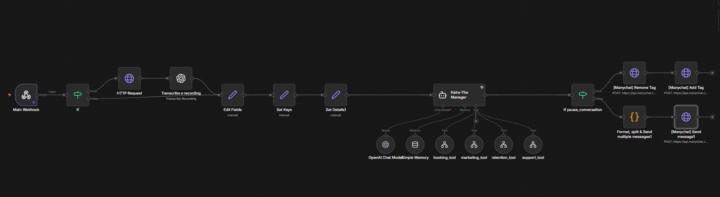
Just Shipped: Multi-Agent AI for Instagram DMs ( Voice + Text )
I just built a multi-agent AI system for Instagram that automates the entire customer journey from first DM to confirmed booking. Not a chatbot. An operations system. The problem: Brands are flooded with Instagram DMs: bookings, voice notes, support, promos. Humans can’t keep up, context gets lost, and revenue leaks. What I built: A multi-agent AI orchestration system that:• Handles text + voice DMs• Transcribes and understands voice notes• Classifies intent in real time• Routes messages to specialized AI agents• Maintains full conversation memory Agents • Booking • Support • Marketing • Retention All sharing context and handing off seamlessly. What’s live • Instagram DM automation (text + voice) • End-to-end booking + support workflows What’s next • Comment-to-DM automation • WhatsApp chatbot using the same agents and memory Results • 24/7 replies • <30s response time • ~80% less manual support • Built to scale 10× Built with OpenAI agents + Make / n8n + APIs. If you’re dealing with DM overload or building automation systems, happy to share details. @Nate Herk Check this out. I have also applied for the job also
0 likes • Jan 22
@Hicham Char Exactly! That’s why in this system, voice notes are transcribed first before routing to the agents. It keeps the handoffs smooth and keeps response times fast despite the usual voice latency.
0 likes • Jan 24
@Paul Irolla yes it is completely reliable and consistent if you want to test it letme know at automatewitharhum@gmail.com
1-10 of 12

@muhammad-arhum-9161
I Help Service Businesses and Agencies Book 10+ Calls/Month & SAVE 30–40 HRS/WEEK
Active 55m ago
Joined Jul 29, 2025
Powered by