Activity
Mon
Wed
Fri
Sun
Aug
Sep
Oct
Nov
Dec
Jan
Feb
Mar
Apr
May
Jun
Jul
What is this?
Less
More
Memberships
TT
Tianas Tea: She Rises Acadamey
52 members • Free
15 contributions to Tianas Tea: She Rises Acadamey

26d •
You Weren't Just Created, You Were Formed...
I woke up this morning to do a study on Isaiah 43, and verse 1 has me in a chokehold, as I think about the intentional creation and formation of who we are. "But now thus saith the Lord that created thee, O Jacob, and he that formed thee, O Israel..." — Isaiah 43:1 I stopped to look at the difference between the words creation and formation, because we sometimes use them interchangeably, but there's a major difference. God didn't just stop at creating us, but He formed us. In other words, He didn't just bring us into existence, but He began, shaping, developing, processing us for the journey ahead....and that is necessary in order for Him to use us. Here's the truth, God created you in a moment, but He forms you over a lifetime. Creation was His decision to bring you into existence. Formation is His ongoing work of shaping you into the woman He destined you to become. Creation speaks to your beginning; formation speaks to your becoming. Many of us celebrate the fact that we were created by God, but become frustrated by the process of being formed by Him. We want the promise without the process, the purpose without the pruning, and the calling without the crushing. Yet God's greatest work often happens in the seasons we least understand. Every disappointment, every closed door, every setback, every lesson, every victory, and every tear can become part of God's forming process. The very things you wish had never happened may be the tools God is using to develop your strength, deepen your faith, and reveal your purpose. The woman you are today is not the final version of who God has called you to be. You are still being formed, refined, molded and prepared. Like clay in the hands of a potter, God lovingly shapes every detail of our lives. He sees what we cannot see and knows what we cannot know. While we focus on the pain of the process, He focuses on the beauty of the outcome. Sis, trust the hands that are forming you. Trust the God who created you. The same God who called you into existence is committed to completing the work He started in you.

0 likes • 15d
I receive this word!!!
16d •
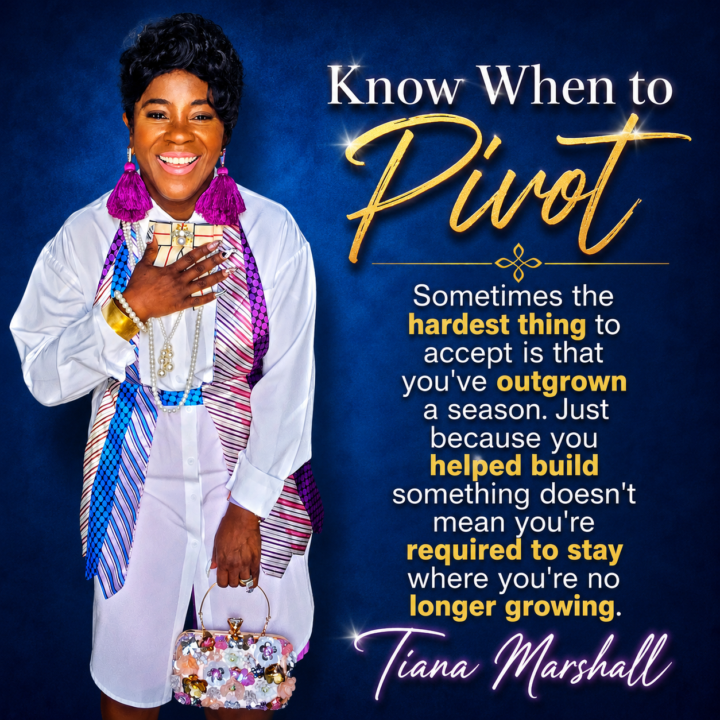
Know When to Pivot.
Too many women stay too long in places they've already stopped growing. We remain in relationships, friendships, careers, ministries, and environments out of loyalty, history, guilt, or fear of starting over. We convince ourselves that because we invested so much, we have to keep investing, even when the return is no longer growth, peace, or purpose. The truth is, growth often requires movement. There comes a time when staying becomes more dangerous than leaving. Just because God called you to a season doesn't mean He called you to stay there forever. Some assignments have an expiration date. Don't confuse loyalty with stagnation. Don't mistake familiarity for purpose. If you've stopped growing, stopped learning, stopped becoming, it may not be failure, it may be God's invitation to pivot. Your next season is waiting on your willingness to move. ✨ Sometimes the bravest thing you'll ever do is give yourself permission to outgrow what once grew you. #KnowWhenToPivot #GrowthMindset #ChooseYou #HealingJourney #PurposeDriven #WomenWhoGrow #FaithAndGrowth #PersonalDevelopment #TianaMarshall
0 likes • 15d
Absolutely l!!!!
May 16 •
What you say to your little you?
Dear Little Me, Girl, we got this. I know there were moments when you questioned yourself. Moments when you felt too small for the room, too different for the crowd, too emotional for the world, and too broken by what life handed you. I know there were nights you cried quietly because you didn’t know how things were going to come together. You smiled in public while fighting battles in private. You carried pain, disappointment, rejection, and pressure far beyond your age. But look at you. You kept going. You didn’t become hard, even after life tried to harden you. You didn’t stop loving, even after being hurt. You didn’t stop believing, even after prayers seemed delayed. And that right there is strength. Little girl, one day you’re going to realize that the things that made you feel different were actually the very things that made you powerful. Your voice, your compassion, your boldness, your tears, your heart for people, your ability to rise after every fall, none of it was accidental. God was building a woman who would survive storms without losing herself. There will be seasons where you outgrow people, places, and old versions of yourself. Don’t be afraid of that. Growth will require you to walk away from environments that can no longer hold who you are becoming. Keep growing anyway. You are not behind. You are not forgotten. You are not too much. And you are definitely not incapable. The woman you become will help other women heal. She will speak life into people. She will build. She will lead. She will create spaces where women feel seen, safe, and empowered. The very thing you once needed, you will become for others. So when fear whispers, when insecurity creeps in, when doubt tries to revisit your mind… Remember this: We survived every version of us that thought we wouldn’t make it. And we’re still here. Still standing. Still loving. Still building. Still becoming. Girl, we got this. Love always, The Woman You Grew Into 💕
0 likes • May 17
Yes!!!
Apr 13 •
PLEASE READ THIS...
Recently, I observed behavior from someone that really concerned me. I watched as they harshly interacted with someone, taking offense to something that was completely innocent, and in that moment, it became clear to me that they were still responding from a place of trauma. You can often tell where someone is in their healing by how they respond. When healing hasn’t taken place, trauma will speak for you. Scripture reminds us in Matthew 12:34 that “out of the abundance of the heart, the mouth speaks.” In other words, your words will eventually reveal what your heart is trying to conceal. The truth is, you can’t hide what hasn’t been healed, especially not from someone who walks with the Holy Spirit. He reveals what we try to cover. And that’s why it’s better to be honest about where you are in your healing process than to pretend you’re whole while still bleeding on others. Here’s the hard truth, Sis: your purpose will wait for you, but people won’t. People are not called to stand in the line of fire of your unhealed wounds while you chase purpose. Healing is not optional, it’s necessary. Because when you pursue purpose without securing your identity, your trauma responses will expose you, and your behavior will push people away before your purpose ever has the chance to impact them. I'm not trying to change you or judge you, I'm just offereing you wisdom. Don’t rush into purpose while neglecting healing. Take the time to become whole. Because when your identity is secure and your heart is healed, your purpose won’t just be something you do, it will be something you can sustain without hurting the very people you’re called to help. #Tianastea☕️ #itsteatime Tiana's Tea and Tiana's Tea Public Access

0 likes • May 2
Yes!!!!
Mar 24 •
The Blessing Is Assigned to Your Authenticity...
In Genesis 27, we see what happens when identity is unclear. people start striving for what was already assigned. But when you truly know who you are, you don’t have to lie, scheme, manipulate, or perform to receive what God has already placed on your life. Favor is not something you hustle for, it’s something you walk in when you are aligned. There is a grace, a commanded blessing, that comes with living in agreement with God’s purpose. Not a counterfeit version of you. Not a watered down version to be accepted. But the real you, the one God designed before the world ever shaped its opinions. And this is where many women are struggling. You don’t know who you are, so you start borrowing identities. You start performing. You start shrinking in some places and exaggerating in others just to fit expectations. You become who people applaud, who men desire, who culture celebrates, but somewhere in the process, you lose the woman God created. And here’s the truth you may not want to hear: God’s blessing is not attached to who you pretend to be. It is assigned to who you were created to be. So when you operate in a false identity, you may attract attention, but you will not sustain God’s favor. Because favor flows where there is alignment, not performance. Listen, Sis if you want the man God has for you, you cannot become a version of yourself that God never ordained just to keep him. The right man is not attracted to your mask, he is assigned to you authenticity. Stop striving. Stop performing. Stop negotiating your identity for acceptance. Because the moment you become who God called you to be, you won’t have to chase what’s yours, what’s yours will recognize you. #tianastea☕️ #itsteatime #KnowWhoYouAre #BiblicalIdentity #WalkInPurpose #WomenOfGod
1 like • Mar 24
I know for many years I made decisions and dealt with things all for acceptance from others.
1 like • Mar 24
I know without any doubt who I am
1-10 of 15
Active 14h ago
Joined Dec 19, 2025