Activity
Mon
Wed
Fri
Sun
Dec
Jan
Feb
Mar
Apr
May
Jun
Jul
Aug
Sep
Oct
Nov
What is this?
Less
More
4 contributions to AI Accelerator

Jul 15 •
🚀 New Video: Most Businesses Skip This Before Using AI
Point AI at a messy company and it doesn't clean the mess up — it runs the mess faster. That's why the demo looks impressive and the rollout is useless: the brief was vague, the doc was three years old, and nobody agreed on what "good" even means. The AI didn't fail; it did exactly what anyone would with bad inputs. After setting this up in dozens of companies, the fix is always the same boring groundwork. - The one rule. Clean inputs turn a week of work into an hour. Messy inputs give you confident, polished, wrong — at scale. The proposal agent we built sounded like generic AI until we fed it their past proposals and their best closer's voice. Same AI, we just changed what we pointed at it. - The three groups. Structure (get your info into a shape AI can read), Upkeep (keep it honest — a written standard, a decision log, a feedback loop), and Access (nothing locked in one person's head; one list of every tool and login). All three feed one source of truth every AI tool reads from and writes back to. - AI builds most of it for you. Point it at one person, let it interview them in plain English, and it writes their job up as a clean SOP — steps, rules, format. Do it across a few roles and you've mapped the company in days, not months. And a mapped workflow is one step from becoming an agent. My take: AI won't fix a messy company on its own — it gives you a real shot at organizing and scaling, ~10x faster. Do the boring groundwork first and it's a moat, because most of your competitors won't bother. 📎 Full guide PDF pinned below — the readiness checklist, all three groups, and the interview→SOP prompt to run this week. 👉 Which of the three is your company weakest on right now — structure, upkeep, or access? Drop it below. [Watch the video here ▶️]

1 like • Jul 16
Absolutely. AI will make a messy process, and anything else messy, a faster bigger mess
Jun '25 •
Howdy from Florida
Hello Everyone - I am learning from everyone all over the place - Happy to meet new AI nerd friends
1 like • Jun '25
@Andrii Oliinyk Sarasota
Jun '25 •
Hey
Hey my Name is Leon. I‘m Form germany und i wond to lern n8n. But my First question is, how can i Level up to Level 2 for the templates?
1 like • Jun '25
Welcome Leon !

May '25 •
🏡 Real Estate Automation – Part 1: Lead Follow-up + Enrichment + Handoff
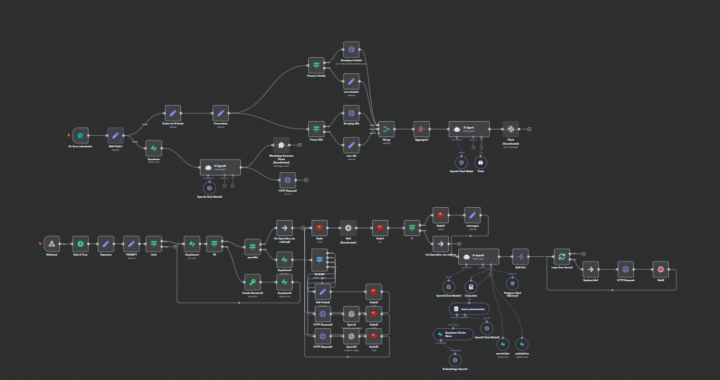
Hey everyone! This is the first post in a series where I’ll be sharing powerful automations built with n8n 🤖If you find it useful, I’ll keep them coming! 📌 Use case: Real Estate We built a smart workflow that activates when a client fills out a lead form. Here’s what it does: 1. Auto follow-up to engage the lead instantly 2. Enriches client data to give context (social, company, etc.) 3. Notifies the sales team with everything they need to act fast 💡 Why it matters? It saves time, improves response speed, and gives your team superpowers. 🚧 Coming next (in this same flow):A "pre-consultation agent" – an AI that handles basic questions and saving informations before the consultant jumps in. (Think of it like a smart buffer that filters, qualifies, and even educates the lead a bit.) 📸 Attaching the automation map so you can see how it flows.If you're curious about any of the steps or tools used – just ask! Would you use something like this? Want the next post to go deeper on the setup of the next automation? 👇 Let me know in the comments what you think and if you want it to be a "serie"!
1 like • Jun '25
This is bonkers !!! Very cool
1 like • Jun '25
yes definitely do more - show the workflow better please - any chance of posting the flow ? Thanks
1-4 of 4

@michael-hudlow-6344
CRM guy wanting to learn more on n8n to help and sell to clients
Active 126d ago
Joined Jun 16, 2025
Powered by