Activity
Mon
Wed
Fri
Sun
Aug
Sep
Oct
Nov
Dec
Jan
Feb
Mar
Apr
May
Jun
Jul
What is this?
Less
More
Memberships
Best Health Wellness
37 members • Free
4 contributions to Best Health Wellness

2d •
Give your body a chance- TRUST the Process!
Before you ever see changes in the mirror or on the scale, your body is already hard at work behind the scenes. Right now, deep inside your cells, your mitochondria are becoming more efficient at producing energy. These are your body's power plants, and every workout, every clean meal, every night of good sleep is teaching them to work smarter — burning fuel more effectively instead of storing it. Your muscles are becoming more metabolically healthy. That means they're getting better at pulling in and using blood sugar, becoming more insulin sensitive, and building the kind of tissue that keeps your metabolism strong for the long haul — not just today, but years from now. Your body is adapting from the inside out. New capillaries are forming to deliver more oxygen to your muscles. Your hormones are recalibrating. Your nervous system is learning new movement patterns. None of this shows up as a number, but all of it is progress. Not every victory shows up on the scale. Some of the most important changes happen at a cellular level, long before they ever show up anywhere you can see or measure. So keep showing up. Trust the process. Your body is doing more than you realize — it's rebuilding itself to work better for you every single day. #MetabolicHealth #Mitochondria #StrengthTraining #FatLossJourney #HealthyHabits #TrustTheProcess

1 like • 2d
Love this! It’s just what I needed to read after not loosing these past few days while doing everything right! How does the hormone changes from being healthier impact menopausal side effects?
3d •
Should you work out fasted? LADIES- trust me on this!
Exercise physiology research shows women's bodies respond very differently to fasted training than men's — and the science on why is pretty clear. Cortisol is already at its daily peak first thing in the morning. That's normal — it's part of what wakes you up. But when you add hard training on top of an empty stomach, your body isn't able to hit real training intensity without over-stressing itself. And without enough fuel available, the brain reads that as a shortage — so it shifts into conservation mode. For women, this matters more than most people realize. Much of sports nutrition science was originally built around male physiology — mostly young male athletes — even though that's not most of the population. Fasted training increases reliance on free fatty acids, and in women, that added cortisol interacts with estrogen, progesterone, and testosterone. Over time, that can affect thyroid function, resting metabolic rate, and even menstrual regularity — and it tends to get more pronounced heading into perimenopause, when baseline cortisol is already elevated. That's the physiology behind why you might feel exhausted mid-workout, shaky, or ravenous by 2pm. The fix isn't complicated — a small mix of protein and carbs before training helps stabilize blood sugar and blunt that cortisol spike. Think a banana with a little peanut butter, half a bagel, or oatmeal with berries, 30 minutes out. This isn't about willpower or "toughing it out." It's about giving your body what it needs to perform, preserve muscle, and keep your hormones working with you instead of against you!
0 likes • 3d
Such great info!
0 likes • 3d
@Heather Watkins 😆😆❤️❤️❤️
3d •
Hitting minimum protein - I didn’t workout
Do I have to hit my minimum protein goal if I didn’t workout? I had 80 grams instead of 100 grams. It was a sedentary day.
0 likes • 3d
@Heather Watkins great answer! I love learning about the why behind all of your points! And I love that u r a realist!
10d •
Healthy Snack Ideas
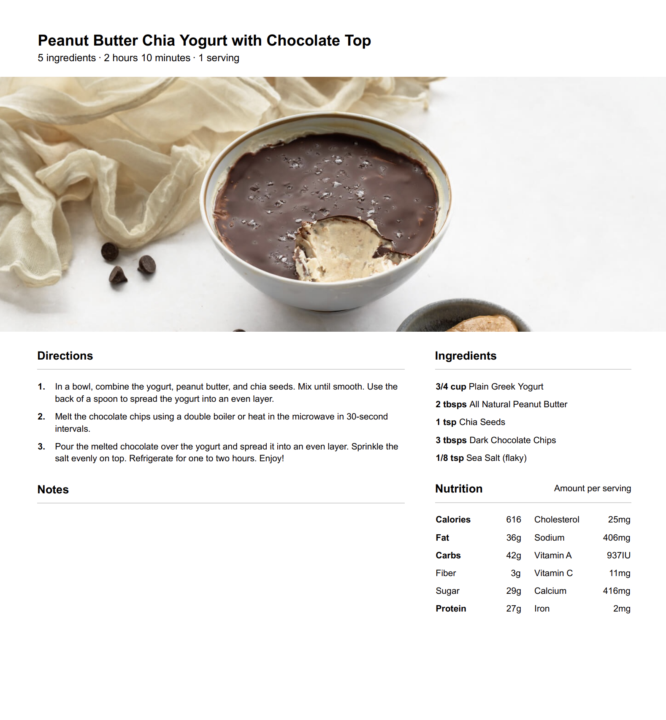
Here are 25 fun, healthy snack ideas to keep in your back pocket! Snacks don't have to be an afterthought — they're a chance to sneak in more protein, fiber, and nutrients into your day. Treat them as opportunities to support your goals, not setbacks that derail them. Enjoy!! 1.Peanut Butter Chia Yogurt with Chocolate Top 2.Chocolate Strawberry Peanut Butter Rice Cake 3.Greek Yogurt with Strawberries, Chocolate & Pumpkin Seeds 4.Apple Wedges with Peanut Butter & Chocolate 5.Banana with Creamy Peanut Butter Dip 6.Rice Cake with Yogurt & Berries 7.Triple Berry Protein Bowl 8.Peach Yogurt Popsicles 9.Peach Yogurt Parfait 10.Strawberry Chocolate Protein Yogurt Parfait 11. Avocado Rice Cake with Everything Bagel Seasoning 12. Grape & Cheese Skewers 13. Apple & Cheese Slices 14. Eggs, Almonds & Cheese Cubes 15. Cottage Cheese Crackers with Cucumbers 16. Cottage Cheese Crackers with Berries 17. Carrots & Guacamole 18. Hard Boiled Eggs & Grapes 19. Cucumber Tuna Bites 20. Chicken Salad on Apple Slices 21. Turkey & Apple Rice Cakes 22. Tuna & Cottage Cheese Salad Snack Box 23. Hummus, Meat & Cheese Snack Box 24. Ham, Carrots, Cheese & Banana Chip Box 25. Beef Jerky, Apple & Peanut Butter Every single one is protein-forward, easy to prep, and built to actually support your goals — not sabotage them. Pick a few, keep them on rotation, and stop letting snack time feel like the enemy.
1 like • 10d
Great suggestions!
0 likes • 10d
@Heather Watkins Is there a rice cake you recommend?
1-4 of 4

Active 16h ago
Joined Jul 1, 2026