Activity
Mon
Wed
Fri
Sun
Aug
Sep
Oct
Nov
Dec
Jan
Feb
Mar
Apr
May
Jun
Jul
What is this?
Less
More
Owned by Heather
Heather from Best Health Wellness Community Group!
Memberships
Skoolers
166.2k members • Free
60 contributions to Best Health Wellness

14h •
Carbs Are Your Primary Fuel Source — Here's the Science
Let's talk about carbohydrates, because they get such a bad reputation — and it's costing people their performance. Carbohydrates are your body's preferred and most efficient fuel source for exercise. They're broken down into glucose, stored in your muscles and liver as glycogen, and used to power everything from a heavy lift to a long run. Your brain runs on glucose too. Cutting carbs too low doesn't just hurt your workouts — it affects your energy, focus, and recovery. How much do you actually need? For most moderately active people, 3-5g of carbs per kg of bodyweight per day supports training and daily function. Athletes training at higher volumes may need more — up to 6-10g per kg on heavy training days. Before your workout: Your muscles store roughly 400-500g of glycogen (more in trained athletes), which is enough fuel for about 60-90 minutes of moderate-to-intense exercise. Eating a carb-containing meal 2-4 hours before training tops off those glycogen stores and ensures you're not running on empty. The 60-minute rule: Here's the key point: if your workout lasts under 60-90 minutes, your existing glycogen stores are almost always enough to fuel you through it — assuming you're eating carbs at your regular meals. You don't need extra carbs mid-workout. But if your session runs longer than that — think longer runs, extended strength sessions, or endurance training — your glycogen stores start running low, and performance drops off if you don't refuel. This is when extra carbs during your workout (think 30-60g per hour) actually matter. After your workout: Post-workout, your muscles are primed to replenish glycogen more efficiently than at any other time of day. Pairing carbs with protein within a couple hours of training supports both glycogen replenishment and muscle repair. The bottom line: If you're eating carbs at your regular meals throughout the day, you're almost always covered for workouts under 60-90 minutes. It's only when your training goes longer than that — or when you're doing back-to-back sessions — that you need to think about extra carbs specifically timed around your workout.
0
0
2d •
Give your body a chance- TRUST the Process!
Before you ever see changes in the mirror or on the scale, your body is already hard at work behind the scenes. Right now, deep inside your cells, your mitochondria are becoming more efficient at producing energy. These are your body's power plants, and every workout, every clean meal, every night of good sleep is teaching them to work smarter — burning fuel more effectively instead of storing it. Your muscles are becoming more metabolically healthy. That means they're getting better at pulling in and using blood sugar, becoming more insulin sensitive, and building the kind of tissue that keeps your metabolism strong for the long haul — not just today, but years from now. Your body is adapting from the inside out. New capillaries are forming to deliver more oxygen to your muscles. Your hormones are recalibrating. Your nervous system is learning new movement patterns. None of this shows up as a number, but all of it is progress. Not every victory shows up on the scale. Some of the most important changes happen at a cellular level, long before they ever show up anywhere you can see or measure. So keep showing up. Trust the process. Your body is doing more than you realize — it's rebuilding itself to work better for you every single day. #MetabolicHealth #Mitochondria #StrengthTraining #FatLossJourney #HealthyHabits #TrustTheProcess

0 likes • 1d
As estrogen and progesterone decline, a few things shift that directly affect the scale and how you feel: Estrogen and fat storage: Lower estrogen changes where your body prefers to store fat — shifting from hips/thighs to the midsection. This isn't about effort, it's biology. It's also why the scale can stay the same while your body composition is actually changing underneath. Cortisol sensitivity increases: Your body becomes more reactive to stress hormones during this transition. Poor sleep, high stress, or under-eating can spike cortisol more than it used to, which can cause water retention and make the scale look "stuck" even when fat loss is happening. Insulin sensitivity decreases: This is a big one. As hormones shift, your cells become slightly less responsive to insulin, meaning your body holds onto carbs and fat a little more readily than it used to. This is exactly why strength training and protein matter so much more now — they directly improve insulin sensitivity. Here's the good news: As you get healthier — building muscle, eating consistently, managing stress, sleeping better — you're not just managing symptoms, you're actually improving how your body regulates these hormones. Better insulin sensitivity, lower baseline cortisol, and more muscle mass all work together to ease hot flashes, mood swings, sleep issues, and yes, eventually, the scale too. SO KEEP DOING WHAT YOU ARE DOING!!!!
2d •
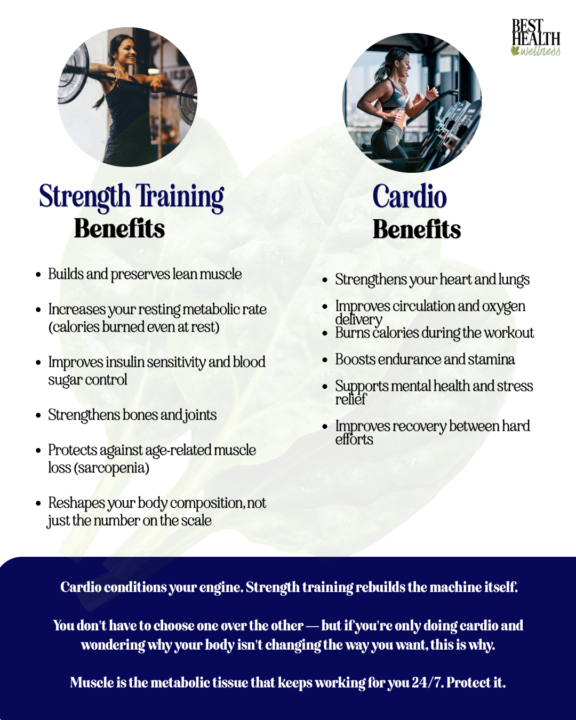
The Right Fitness Formula Isn't One-Size-Fits-All
A good fitness plan doesn't pick a side between cardio and strength — it blends them in the right ratio for where you are in life right now. Because the formula that worked for you at 25 isn't the same one your body needs at 40, 50, or beyond. In your 20s and early 30s: Your body recovers fast and hormones are on your side. More cardio volume works well here, and strength training builds the muscle foundation you'll rely on for decades. In your late 30s and 40s: This is when strength training needs to take the lead. Muscle mass starts declining, metabolism shifts, and hormonal changes begin. Heavy cardio without enough strength work can actually accelerate muscle loss. The formula flips — strength first, cardio as support. In perimenopause and menopause: Your body needs strength training more than ever to protect bone density, preserve muscle, and support a metabolism that's already working against you. Cardio still matters for heart health, but it should never come at the expense of lifting. Postpartum: Rebuilding core and pelvic floor strength comes first. Cardio gets layered back in gradually, once your foundation is solid again. The bottom line: There's no universal ratio. The right formula depends on your hormones, your age, your goals, and what your body actually needs to stay strong and functional for the next decade — not just the next 6 weeks. Your plan should evolve as you do. If it hasn't changed in years, it's probably time to reassess.
1
0
2d •
There is NO ONE thing.....
I get asked all the time... "Are chia seeds good?" "Should I drink lemon water?" "Is apple cider vinegar worth it?" "What's the best superfood?" My answer is almost always the same... None of those things matter much if you haven't mastered the basics. Your health isn't built on one food, one supplement, or one habit. It's built by the small things you do consistently every day. Before you worry about chia seeds or the latest wellness trend, ask yourself: ✔️ Am I getting enough quality sleep? ✔️ Am I eating enough protein? ✔️ Am I strength training at least 2–4 times a week? ✔️ Am I moving my body every day? ✔️ Am I managing my stress? ✔️ Am I drinking enough water? ✔️ Am I eating mostly whole, nutrient-dense foods? Those are the habits that move the needle. Then, once those foundations are in place, foods like chia seeds, berries, leafy greens, nuts, seeds, and supplements can become the "icing on the cake." Too many people spend their energy chasing the next health hack while ignoring the basics that have been proven to work for decades. Build your foundation first. Prioritize protein. Lift weights. Move every day. Protect your sleep LIKE A BOSS! Manage your stress. Eat real food most of the time. Health isn't created by one perfect food. It's created by thousands of good decisions that work together AND give yourself CREDIT for all the small things YOU DO- they add up! Master the basics first—the rest is just optimization! PROUD OF MY PEOPLE!
1
0

2d •
Hitting minimum protein - I didn’t workout
Do I have to hit my minimum protein goal if I didn’t workout? I had 80 grams instead of 100 grams. It was a sedentary day.
1 like • 2d
Protein isn’t just for fueling workouts. Your body is repairing muscle, supporting your metabolism, keeping you full, and helping preserve lean muscle tissue every single day—even when you don’t exercise. but- don’t stress about one day of hitting 80g instead of 100g. Consistency over time is what matters most. Just get back at it tomorrow! Nothing bad will happen!
1 like • 2d
I’m gonna tell the truth! The science No gimmicks! Healthy doesn’t just happen! We have to work for our health!!! But it’s worth it !!!
1-10 of 60

@heather-watkins-7613
I'm a Certified Nutrition coach, fitness enthusiast, & have spent over 25 years helping people understand how their bodies work for better health!
Active 5h ago
Joined May 31, 2026
Huntersville North Carolina