Activity
Mon
Wed
Fri
Sun
Aug
Sep
Oct
Nov
Dec
Jan
Feb
Mar
Apr
May
Jun
Jul
What is this?
Less
More
Memberships
4 contributions to 🌾 From Oven to Market

⭐
🔥
6d •
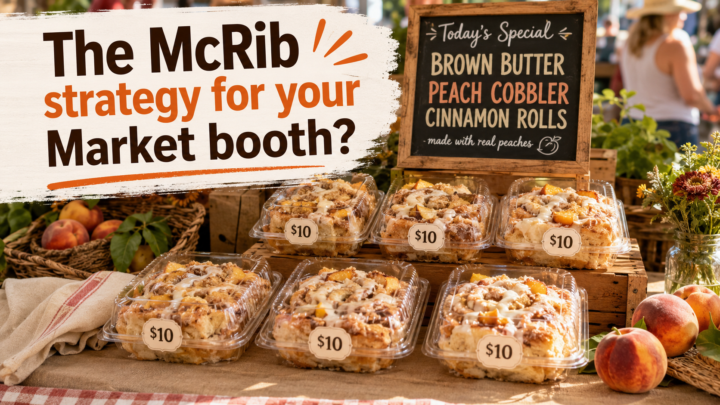
The McRib Strategy for Your Bread Booth
This week over in our sister community, Crust & Crumb Academy, we're all baking the same thing: Brown Butter Peach Cobbler Cinnamon Rolls. But I want to pull you market bakers aside for a minute, because there's a bigger lesson in this one than just a good roll. Not very often does a recipe come along that can make a name for itself, and make a name for you. This is one of those. https://bakinggreatbread.blog/2026/07/08/farmers-market-booth/ If you've ever wanted to see a line form outside your booth, people willing to spend real money, on a product that carries a fat margin, this is the kind of item that does it. A brown butter peach cobbler cinnamon roll, with the streusel and the frosting, is not a ninety-nine cent cookie. It's a showstopper, and people pay showstopper prices. Here's the strategy underneath it, and the big players run this same playbook every single year. McDonald's brings back the McRib. Starbucks rolls out the Pumpkin Spice Latte the minute the leaves start to turn. They don't do that by accident. A special item, available for a limited time, does four things at once. It creates urgency. It builds demand. It gives you perceived scarcity, get it now or wait. And it lets you charge a premium, because folks aren't comparing it to anything else on your table. That's the work a signature item does for your business. You're not just selling bread anymore. You're giving people a reason to show up on a specific Saturday, cash in hand, before it's gone. Now, one adjustment before you sell these. The cream cheese frosting we use at home needs refrigeration, and most cottage food laws won't allow that at a market table. Swap it for something shelf stable, a simple powdered sugar glaze or an American buttercream, so you stay legal. Always check your own state's cottage food list first, because those rules change line to line. And here's the good news. I've already added this one to Recipe Pantry Pro for you. It's scaled and ready to run, from a single batch of 12 all the way up to as many as your oven can turn out, with the batch math so you can price it for profit and know your numbers before you ever set up your table.

🔥
1 like • 6d
@Henry Hunter this link says this page cant be found
🔥
0 likes • 6d
The above link it McRib...not the other one
⭐
🔥
6d •
The one technique that keeps soft bread fresh for days: tangzhong
I’ve been going back and forth with one of our bakers this week about freshness. How do you keep your bread honest on the table when you can’t bake everything twelve hours before market? We talked about splitting the bake, leaning on the fridge, knowing which loaves ride two days and which ones don’t. But there’s another lever, and it’s one of the best-kept secrets in soft-bread baking. It’s called tangzhong, and once you start using it you’ll wonder how you ever sold dinner rolls without it. Here’s the short version of what it is. You cook a small amount of your flour with liquid into a paste before it ever touches the rest of your dough. That’s it. That little cooked paste is the whole trick. Why it matters: when you cook flour with water, the starch gelatinizes and locks in a lot more moisture than raw flour ever could. You fold that trapped water into your dough, and it stays in the crumb after baking. The bread comes out softer, fluffier, and it holds that softness for days instead of drying out by the second morning. For a market baker, that’s the difference between a roll that’s pillow-soft on Saturday and one that’s already going stiff. How to make it 1. Pull 5 to 10 percent of the flour out of your recipe. Just a small portion. 2. Whisk it together with liquid at 5 times its weight. So if you use 20 grams of flour, use 100 grams of liquid. Water works, milk works even better for enriched dough. 3. Cook it over medium heat, whisking the whole time, until it thickens into a loose paste. You’re looking for about 150 degrees, or the point where dragging the whisk leaves a line on the bottom of the pan. Takes a couple minutes. 4. Pull it off the heat and let it cool. Room temperature is fine, or press a piece of plastic right on the surface and stick it in the fridge. 5. Add it to your dough along with everything else. Since that flour is already carrying water, hold back a splash of your other liquid at the start and add it back only if the dough needs it.

🔥
1 like • 6d
I couldn't agree more.
⭐
🔥
8d •
Why Brown Butter Matters (and Why Nobody Talks About It)
You just watched something most bakers skip over. The butter went from pale and melted to foamy, then quieted down, turned amber, and started smelling like toasted nuts. That’s not just a color change. That’s chemistry. Here’s what’s happening. Butter is mostly fat, but it’s got milk solids suspended in it, the proteins and the milk sugars. When you heat it, the water boils off first. That’s the foam you saw, all that violent action. Once the water’s gone, those milk solids sink to the bottom of the pan and sit there in the hot fat. That’s where the magic is. Those milk solids brown. Not burn, brown. There’s a difference, and it matters. Browning is the Maillard reaction, the same thing that makes a good crust on bread or a sear on meat. It creates hundreds of new flavor compounds. Nutty, toasty, a little bit caramel-like. That’s not in regular butter. You have to make it. And you have to be careful at the end. The line between brown and burnt is about thirty seconds. You watch for the color to go amber, honey colored, not dark, and the smell to go nutty without turning acrid. The moment you hit that, off the heat. It keeps cooking in the pan for another few seconds after you kill the flame, so pull it early. Here’s where the freezer comes in. Once your streusel is mixed and firm from the cold, that temperature difference is your secret weapon. Cold streusel hitting a hot oven creates contrast. The outside crisps up fast while the inside stays clumpy. That’s the cobbler crumb texture. If you skip the freeze and go straight in warm, the butter melts too fast and you lose the bite. Five to ten minutes in the freezer while your rolls are finishing their proof, then scatter it on top right before they go in. That’s the move. Why does this matter for cinnamon rolls? Because that nutty, toasted flavor in the brown butter goes into your streusel, and the texture from the cold-to-hot contrast makes the whole roll taste and feel more sophisticated. It’s not just sweet anymore. It’s got depth and crunch. It’s the difference between a roll and a roll.

🔥
3 likes • 7d
And it can burn very quickly
⭐
🔥
8d •
Module 1.3: Your Anchor Loaf.
Every baker who makes a business out of this has one. The loaf you're known for. The one people drive across town to get. The one with your name on it. You might not know yours yet. That's fine. But you have to have one, because it's what turns a customer into a regular, and a regular into someone who brings their friends. In this lesson excerpt, I'll show you how to find yours.

🔥
5 likes • 8d
Love it! Very logical Less complicated for baker and consumer.
1-4 of 4

🔥
@mauvette-bailey-2545
From 1970s yeasted breads to modern sourdough artisan. Documenting a 56-year culinary journey one bake—and one photograph—at a time.
Active 7m ago
Joined Jul 5, 2026
Northern California
Powered by