Activity
Mon
Wed
Fri
Sun
Apr
May
Jun
Jul
Aug
Sep
Oct
Nov
Dec
Jan
Feb
Mar
What is this?
Less
More
Memberships
Automation Vault
120 members • Free
Ai Automation Vault
15.4k members • Free
Online Business Friends
88.6k members • Free
Creator Profits (Free)
17.6k members • Free
The AI Advantage
76.8k members • Free
Lead Generation Secrets
22.6k members • Free
AI Money Lab
62.2k members • Free
Hamza's Automation Incubator™
45.8k members • Free
AI Automation (A-Z)
144.6k members • Free
12 contributions to The AI Advantage

2d •
Hard truth…
Your life usually doesn’t fall apart all at once. It drifts. A little less focus. A little more distraction. A little more scrolling. A little less doing the things you know you should be doing. And over time, that adds up. I’ve learned this the hard way more than once. If you want to build something meaningful, you have to protect your focus like it’s your job. Because in a lot of ways… it is. Not every opportunity deserves your time. Not every opinion deserves your attention. Not every thought deserves to be followed. Stay locked in on what actually matters. That alone will put you ahead of most people. So, what are you focused on right now and what are you going to do this week to protect that focus at all cost?

1 like • 3h
for real thats hard and painful truth😅
3h •
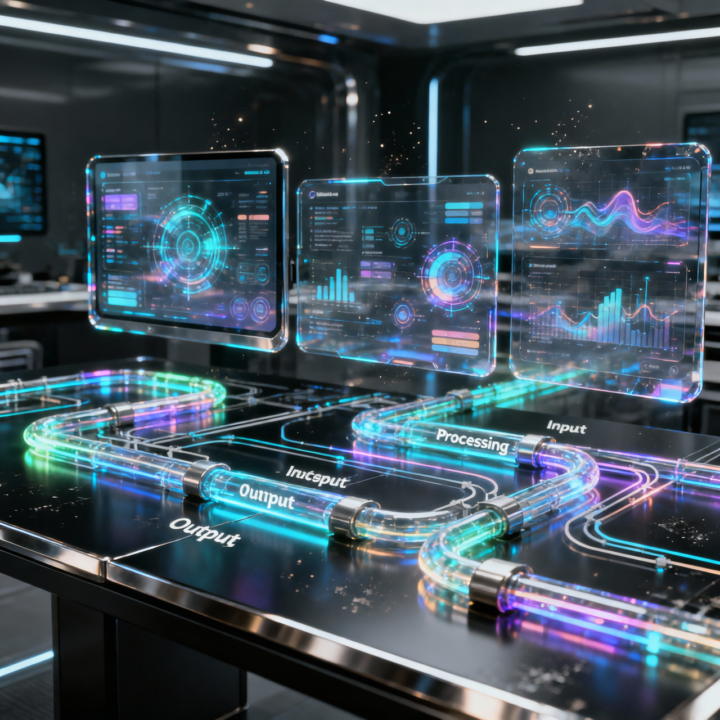
Learning AI Tools for the Long Term (Not Just the Update Cycle)
AI tools change fast. New features, new interfaces, new releases — it’s easy to feel like you’re always catching up. But long-term knowledge in AI doesn’t come from tracking updates. It comes from understanding what stays consistent beneath them. Most tools are just different interfaces over the same ideas: input → processing → output. Prompts, data flow, decision logic, and system behavior — these are the parts that transfer across tools, even as they evolve. If you learn the tool, you keep restarting. If you learn the pattern, you keep progressing. The goal isn’t to master every update. It’s to understand how AI fits into workflows — where it adds judgment, where it reduces effort, and where it needs structure. That’s what makes your knowledge durable. When a new tool or update comes out, do you feel like you’re starting over — or just upgrading something you already understand?
23d •
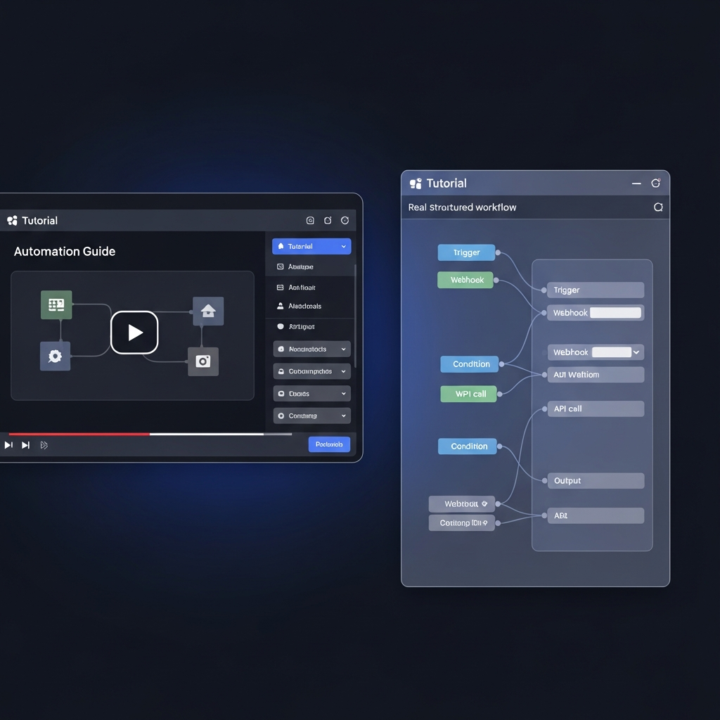
From Tutorials to Real Systems: How to Actually Learn Automation
Most people learn automation tools by consuming tutorials. They watch. They follow steps. They recreate the exact same demo. But real understanding begins when the tutorial ends. Tutorials show features. Workflows reveal thinking. To truly learn a tool, shift from “How does this work?” to: • What problem is this solving? • What is the trigger logic? • What data is being passed? • What breaks if this step fails? Hard concepts in automation (webhooks, API calls, conditional logic, data mapping) only become clear when you apply them to a real use case — even a small one. Don’t aim to understand everything at once. Break it down: Trigger → Condition → Action → Output. Build small. Test intentionally. Break it on purpose. Fix it. Document what you learned. Understanding comes from friction, not passive watching. When learning a new tool, do you move quickly into building your own workflow — or stay in tutorial mode longer than you should?
2 likes • 23d
@Morgan Page lol

23d •
🧭 The Confidence Gap, Why Fear Costs Time More Than Mistakes Do
Most of us think the biggest risk with AI is getting something wrong. But in practice, the bigger cost is getting stuck. Fear, hesitation, and perfectionism quietly inflate time-to-first-draft, increase meeting hours, and keep us doing work the slow way even when better options exist. Mistakes can be corrected. Avoidance turns into a permanent time tax. AI adoption becomes real when we build confidence, not as a personality trait, but as a workflow design. Confidence is a time strategy because it reduces friction, shortens cycles, and helps us move from “thinking about using AI” to actually reclaiming hours. ------------- Context: How Fear Turns Into Lost Hours ------------- The confidence gap usually does not look dramatic. It looks like small delays. We open the tool, we type a prompt, we delete it, we try again, then we decide we will just do it ourselves. We tell ourselves it is faster this way, but what is really happening is that uncertainty is steering the workflow. Fear shows up as over-checking. We draft with AI, then we read and reread, looking for what might be wrong, because we do not trust the output or we do not trust our ability to spot issues. That can be responsible, but it can also become unbounded. We do not know when we are “done checking,” so the time expands. Fear also shows up as meeting gravity. Instead of sending a draft, we schedule a call to “align.” Instead of proposing a direction, we ask for more input. We do this because we want safety, but the cost is time-to-decision and cycle time. Then there is the identity layer. Many of us have been rewarded for being competent, accurate, and reliable. AI introduces a new dynamic: we are working with a tool that can be brilliant and wrong in the same breath. That ambiguity can feel threatening. So we keep AI at arm’s length, and we keep doing things manually, not because it is best, but because it is familiar. The result is predictable. We miss the biggest time gains: faster starts, fewer blank pages, fewer revision loops, and cleaner handoffs. We remain in the “manual default,” and the week keeps feeling compressed.

1 like • 23d
fear weakens aot of people
Feb 13 •
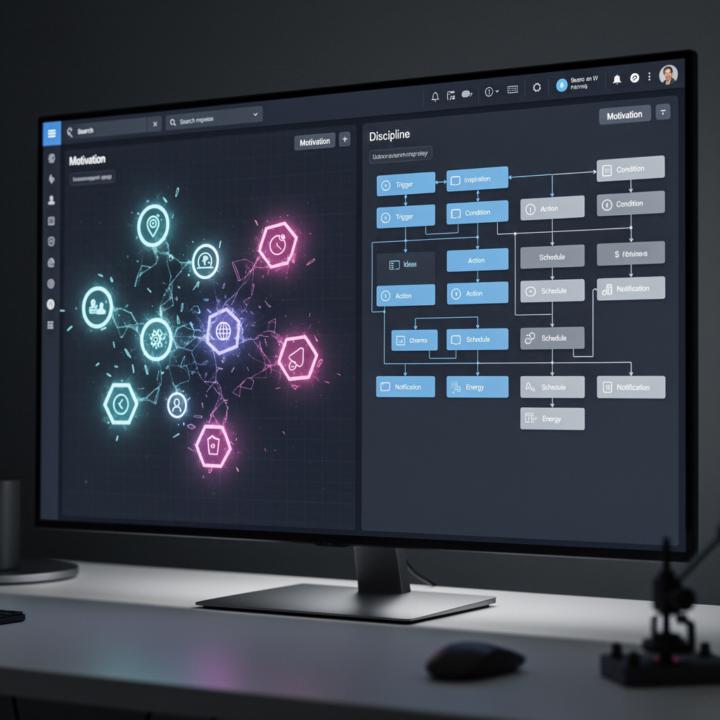
Discipline vs Motivation in Automation
Motivation gets you started in automation. New tools. New ideas. Big possibilities. Discipline is what builds working systems. Motivation connects tools. Discipline defines triggers, tests logic, fixes errors, and documents flows. Motivation feels powerful. Discipline creates reliability. Automation doesn’t reward excitement — it rewards consistency. Clear structure. Iteration. Refinement. If you rely only on motivation, you’ll keep rebuilding. If you build with discipline, your systems compound. When working on automation, do you depend more on motivation or discipline — and what has that produced in your results?
1 like • Feb 14
@AI Advantage Team personally i have been in a place to scale good workflow some with less or no mistake because 1) i dont rush into new tools i first understand the concept of a certain tool and this helps in understanding automation system ,, what workflow are you currently working on
1-10 of 12

Active 3h ago
Joined Jan 14, 2026
Powered by