Activity
Mon
Wed
Fri
Sun
Nov
Dec
Jan
Feb
Mar
Apr
May
Jun
Jul
Aug
Sep
Oct
What is this?
Less
More
How to Spot a Liar
11
$5/m
The Black Archive
12
$3/m
167 contributions to The Black Archive
Jul 19 •
The Uncertain Morning at Hanbury Street
In the narrow yard behind 29 Hanbury Street, where the brick walls held the night’s cold long after sunrise, Annie Chapman was found just after dawn on 8 September 1888. Her body lay close against the weathered wooden fence, arranged with such dreadful finality that it seemed impossible to imagine she had died anywhere else. The yard itself appeared to tell a complete story. Yet, as so often in the Whitechapel murders, certainty began to unravel the moment witnesses were asked to remember. The first cracks appeared in the evidence of Albert Cadosch, who lived next door. Rising early to use the privy, he recalled hearing a woman’s voice from beyond the fence at around 5:20 a.m. She uttered a single word — “No” — not loudly, not in terror, but firmly enough to fix itself in his memory. Moments later came the sound of something striking the fence: a dull, heavy thud that seemed insignificant at the time, but would later acquire a terrible significance. Then came Elizabeth Long. On her way to Spitalfields Market at about 5:30 a.m., she passed the entrance to Hanbury Street and noticed a woman she later identified as Annie Chapman speaking quietly with a dark-haired man. Nothing about the encounter seemed remarkable. There was no struggle, no raised voices, no urgency. It was the ordinary anonymity of East End life—a fleeting exchange between strangers that only became important because one of them would soon be dead. Against these recollections stood the measured opinion of Dr George Bagster Phillips, the divisional surgeon. Examining Chapman’s body at around 6:30 a.m., he concluded that she had been dead for at least two hours, perhaps longer. His estimate rested upon the accepted Victorian indicators of death: the cooling of the body, the onset of rigor mortis, and the effects of the unusually cold September morning. By his calculation, Annie Chapman had died well before either Cadosch or Long believed they had encountered signs of life. The contradiction has never been satisfactorily resolved. If Dr Phillips’s judgment was accurate, then both civilian witnesses were mistaken, their memories subtly reshaped by shock, routine, or the frailties of recollection. If Cadosch truly heard Chapman beyond the fence, and if Elizabeth Long really exchanged a passing glance with her only minutes later, then the surgeon’s confidence in estimating the time of death must itself be questioned—a reminder that Victorian forensic science was often less exact than later generations imagined.


0 likes • Jul 21
It’s all “about”, isn’t it? About 5:20, about 5:30, dead about two hours. Suddenly that tight little timeline starts to stretch and warp, and the killer doffs his hat and steps neatly through the gap.
Jul 15 •
Murder at Heath House
The mystery begins long before Simon Dale’s death. In his mind, Heath House was never merely a sprawling country mansion. He believed it concealed something older and stranger beneath its Georgian skin. As an architect, he became convinced the building preserved fragments of a medieval hall, perhaps even a site with connections to the Arthurian world that had increasingly consumed his imagination. Friends regarded the theories with varying degrees of affection and scepticism, but for Dale the house was a puzzle whose answers lay beneath floorboards, behind panelling and inside forgotten archives. Heath House was not simply where he lived; it had become his life’s unfinished argument. Against that romantic backdrop unfolded a family dispute of astonishing bitterness. Dale’s marriage to Baroness Susan de Stempel had ended, but the house remained the battleground. Ownership was contested, correspondence grew increasingly hostile and neighbours became accustomed to stories of arguments, accusations and legal manoeuvres. It was the sort of domestic conflict that seems peculiarly English: outwardly civil, inwardly corrosive, capable of lasting for years. When Dale was murdered in September 1987, the investigation naturally focused on those closest to that dispute. The subsequent trial brought moments that seemed almost too theatrical for fiction. Susan de Stempel cultivated an air of impatience towards the police investigation, often appearing openly dismissive of detectives’ conclusions. Her evidence from the witness box was equally striking, punctuated at one point by the exclamation, “Bollocks,” a moment that briefly cut through the solemnity of the proceedings. She also remarked that, at the time Simon Dale was killed, she had been at home watching an episode of Miss Marple. Yet, for all courtroom drama, the prosecution ultimately failed to persuade the jury beyond reasonable doubt, and Susan de Stempel was acquitted. Simon Dale’s murder remains officially unsolved.

1 like • Jul 17
book idea for you Higgins "a murder mystery where even the motive may be property law, Arthurian speculation or a hoard of gold that may never have existed." got Booker Prize written all over it!
1 like • Jul 17
“I was watching Miss Marple” is either the worst alibi imaginable or the most confident one. Miss Marple: “I shall know who did it presently. The liar always reveals themselves before the second tea.”
Jul 14 •
The Unquiet Archive
February, 1956. London had become a city of whispers. Coal smoke clung to the rooftops, muffling church bells and swallowing entire streets, while in Whitehall men spoke in lowered voices and checked twice before closing their office doors. For five years they had been ghosts. Guy Burgess and Donald Maclean had vanished in 1951, leaving behind half-drunk whisky, abandoned papers and a thousand contradictory theories. Murder. Kidnap. Defection. Everyone had a favourite. Taxi drivers, club bores and Cabinet ministers alike. Then, as abruptly as spectres materialising through fog, they appeared in Moscow. Not dead. Not imprisoned. Simply…waiting. The newspapers carried grainy photographs of two unmistakably English faces beneath Soviet skies. They looked oddly comfortable, as though they’d merely caught the wrong train and found themselves six time zones from St James’s. That was the true horror. Not betrayal, though there was plenty of that. It was the unbearable possibility that they had walked unnoticed through the corridors of power for years, smiling politely, attending dinners, sharing secrets, all while serving another master entirely. Suddenly every familiar face acquired a faint shadow. Every delayed answer suggested calculation. Every missing file hinted at invisible hands. London carried on, naturally. The buses ran. The milk arrived. The rain polished Whitehall into black glass. Yet something fundamental had shifted. The old certainty—that one could recognise one’s own countrymen by instinct—had dissolved like smoke. And somewhere, behind another respectable front door, another well-spoken gentleman might already be packing a suitcase, glancing at his watch, and wondering whether tonight was the night he, too, would quietly disappear.

1 like • Jul 14
It was social embarrassment at national scale: the old boys’ network discovering that one of its chief qualifications, “seems like one of us”, was not in fact a security clearance.
Jul 13 •
A Very British Disaster
Britain has always had an extraordinary talent for concealing its nightmares beneath a veneer of brisk competence. In the autumn of 1957, one such nightmare unfolded on the Cumbrian coast, where the great graphite heart of the Windscale nuclear piles burned with an invisible fury. There were no mushroom clouds, no shrieking alarms, no panicked stampedes. Instead, there were men in white coats peering at dials, clipped telephone conversations, and the curious insistence that everything was quite under control. Except, of course, it wasn’t. As the fire smouldered within the reactor, radioactive particles drifted silently across northern England, settling over fields and villages with all the ceremony of morning mist. Farmers milked their cows as they always had, while children cycled to school beneath skies carrying something altogether less innocent than rain. Then came the quiet harvest. Millions of litres of milk vanished into ditches and disposal pits, poured away under official supervision. It was an act performed with almost ecclesiastical solemnity, yet few outside the necessary circles were told why. The Cold War demanded confidence above candour. Britain was building an atomic future, and the story of that future could not include a reactor that had caught fire. There is something peculiarly British about Windscale. Not simply the accident itself, but the silence that followed. Files were stamped, conversations shortened, and uncomfortable truths wrapped in the comforting language of national security. The countryside carried on regardless. Sheep grazed. Buses arrived occasionally on time. The wireless played dance bands while invisible contamination settled into the soil. Perhaps that is what makes the story linger. Nuclear horror is usually imagined as spectacle, but Windscale belonged to an older tradition: the English ghost story. The menace was unseen, politely ignored, and left to haunt the landscape long after those who first encountered it had quietly closed the door behind them.

1 like • Jul 13
no monster, no explosion, just an invisible thing in the air and Whitehall quietly deciding that ignorance was the tidiest form of reassurance.
Jul 9 •
Noseybonk
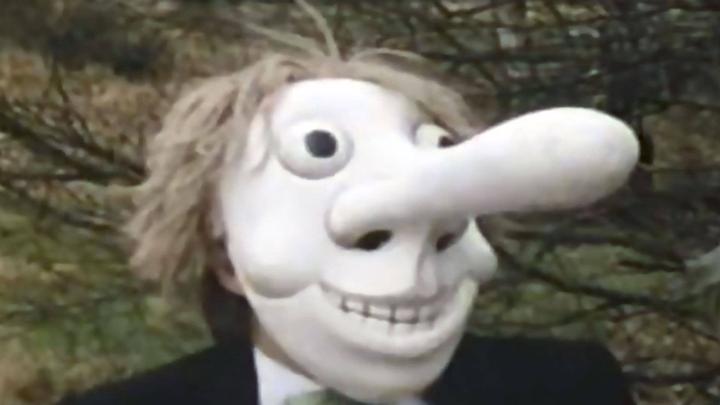
Mr Noseybonk belongs to that peculiarly British cabinet of televised horrors: not monsters designed to frighten, but those perfectly well-meaning creations that somehow slipped through a crack in the national psyche. He arrived courtesy of Jigsaw, a programme devoted to games, puzzles and gentle education, yet moved through it with the unnerving confidence of something that had wandered in from an altogether darker production. His costume was simplicity itself: dinner jacket, white gloves, an alabaster mask fixed in a grotesque rictus, and that extraordinary nose, jutting forward like a baleful compass needle. He never spoke. He never needed to. Silence can be infinitely more eloquent than menace. There is something profoundly unsettling about a figure whose only apparent motivation is boundless, wordless delight. He materialised in parks, shopping precincts and village greens with the inevitability of bad weather, observing the world through expressionless eyes while that impossible grin remained forever unchanged. Janet Ellis seemed unconcerned, but then she’s made of sterner stuff than most. What lingers is not terror in the conventional sense, but the uncanny. British children’s television once possessed an enviable confidence that young audiences could withstand oddness, melancholy and the occasional brush with the macabre. Nobody convened focus groups to determine whether Noseybonk might haunt impressionable minds. He was simply accepted as another eccentric visitor, as much a fixture of the landscape as milk floats, red telephone boxes or the Shipping Forecast. Perhaps that explains his remarkable afterlife. He endures not because he was overtly horrific, but because he resisted explanation. Like some smiling relic unearthed from the back room of a forgotten museum, he occupies that delicious territory where nostalgia shades imperceptibly into dread. We remember him with laughter, certainly—but there remains the faint, irrational temptation to glance over one’s shoulder, just in case that white face and grotesque smile are waiting patiently beyond the hedge, while he assembles an improvised nosegay.
1 like • Jul 10
Jigsaw trusted us to handle puzzles, puppets, mild education and the occasional visit from a grinning emissary from the void. I do wonder which producer first saw Noseybonk and thought, “Kids’ll love this,” rather than, “Good God, we’ve summoned something.”
1-10 of 167
@mark-vent-5077
You cannot live as I have lived and not end up like this!
Active 80d ago
Joined May 12, 2026