Activity
Mon
Wed
Fri
Sun
Mar
Apr
May
Jun
Jul
Aug
Sep
Oct
Nov
Dec
Jan
Feb
What is this?
Less
More
Owned by Mark
Build the stepping stones of self-control, spirit, health, and discipline—then launch into the life you were designed for.
Memberships
Real Estate Value Edge
32 members • Free
Community Creators Club
6.4k members • Free
Selling Online / Prime Mover
35.8k members • Free
OfferLab
9.6k members • Free
Affiliate Evolution
1.3k members • Free
Skoolers
190.1k members • Free
GC
Growthworks Community
24.1k members • Free
8 contributions to Real Estate Value Edge

3d •
Truths no one wants to hear.
🎯 Quick Appraisal Truth for Agents + Homebuyers When a lender engages an appraiser, that lender is the only client — not the agent, not the buyer, not the seller. That means the appraiser cannot share any part of the appraisal’s content — including value opinions, repair notes, or analysis — with anyone other than the authorized client (the lender). 👉 However… Realtors can still provide valuable information within context! Sharing relevant property data, repair documentation, sales that they found to support their listing price, or access details helps create a factual foundation — without crossing the confidentiality line. 🗝️ And a quick reminder: Please ensure all keys for all structures (garage, sheds, outbuildings, and additional units) are available at the time of the scheduled appraisal. Missing keys often lead to repeat visits — and yes, that can mean delays and additional fees. So when agents ask, “What repairs might be needed?”, the appraiser isn’t being evasive — they’re simply upholding federal law and USPAP regulations designed to keep the process professional, consistent, and secure. 🔒 👩⚖️ Legal & Professional References USPAP 2024 Edition Ethics Rule – Confidentiality Section (p. 7): “An appraiser must protect the confidential nature of the appraiser‑client relationship.” Definitions (p. 3): “Client: the party (or parties) who engage an appraiser in a specific assignment.” Record Keeping Rule (p. 11): “An appraiser must not disclose confidential information to anyone other than the client, parties authorized by the client, or as required by due process of law.” Equal Credit Opportunity Act (15 U.S.C. § 1691) – Establishes that the lender is the legal recipient of the appraisal report. Fannie Mae Selling Guide B4‑1.2‑01 (2025 Update) – “The appraisal report is delivered by the appraiser to the lender‑client; the borrower or agent should not contact the appraiser for status or results information.” Contact the loan processor/officer. The lender has appropriate channels to converstate with the appraiser. 99.9% of the time this is done in writing for a reason.

0 likes • 21h
Lots of great stuff. When you come up with 🧰 Realtor's Survival Kit coming in February. ⚖ make it so I can share it with my Realtor friends and I’ll try and link them to you.

1 like • 20d
Now you’re talking my language. Do the struggle on purpose.
21d •
When “Duplex” Isn’t Really a Duplex
One of our community real estate agents posed a great question today. This does not happen often - however, this is a perfect scenario of why knowing how appraisers can value a property for lending leads to an educational moment. Appraisal dilemma of the week:Assessor says “duplex.”City zoning says “single‑family.”The house still has two kitchens, two living areas, and separate entrances — but legally, it can’t be used as a duplex. When records and reality don’t match, the appraiser’s role is to cut through the noise and ground the analysis in what’s legally allowed today. The structure might look and function like a duplex, but if zoning doesn’t allow it — that limits both use and value. In appraisal practice, the first filter of highest and best use is legal permissibility. If the use isn’t permitted (and not legally nonconforming), everything else stops there. When zoning and assessor data differ, zoning wins every time. Any duplex layout without confirmed legal status is simply functional obsolescence under single‑family use — not a separate income‑producing unit. Summary Answer (From an Appraiser’s Standpoint) - Legal use trumps configuration in determining highest and best use. - The appraiser must confirm zoning and document any legal nonconforming status. - If duplex use isn’t permitted, the value must align with single‑family use, possibly adjusted for functional obsolescence. - Valuing it as a duplex without legal basis misstates the HBU and could mislead intended users of the report. - 💡 Bottom line:The market might see two units, but if the law says one, the appraiser must value it as one. 🔎 Curious how you’d handle this scenario? Drop your take below — would you factor in layout utility or strictly stay within legal use?
0 likes • 21d
😮 never thought about that. That's why we call the prose.
Jan 2 •
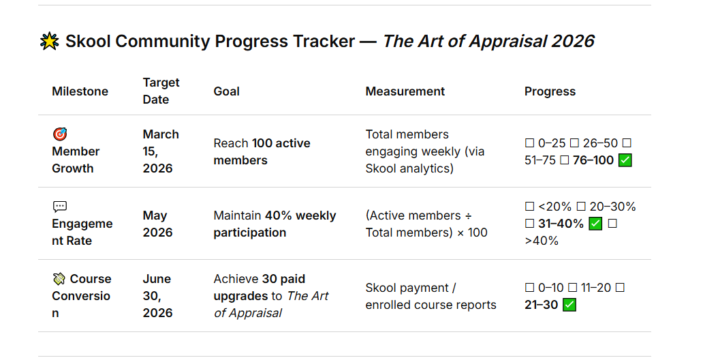
Progress Tracker: Because Community Exists to Grow us all
I'm posting the menu of classes separately. The first online module should be ready by Feb 1st and five more to follow very shortly thereafter.
1 like • Jan 3
Nice sheet. Goals are great to track.
Dec '25 •
Congratulations Randy Gibson
Randy is the definition of focus, grit, and follow‑through. As a solo agent, flipper, and mentor, he set a goal for himself for 2025 — and hit it, helping list or sell 30 deals! Crazy how life works sometimes...About three years ago, I appraised a home that was beautifully renovated — the quality, craftsmanship, and attention to detail were next level. Naturally, I had to find out who was behind that project. Fast forward to today — after countless phone calls, meet‑ups, solving problems side‑by‑side, and collaborating on multiple levels — Randy has become one of those rare people you’re lucky to have in your corner. 💪 Whether we’re working through business concepts, strategizing one of my flips, or prepping a new listing — he’s there. Randy’s passion for mentoring others and helping them grow their real estate businesses and investment portfolios truly sets him apart. Randy is the definition of community. Here’s to a phenomenal year of results and impact, and to many more ahead! 🙌

1 like • Jan 1
Way to commit and reach your goals
1-8 of 8
@mark-larm-6061
Build the stepping stones of self-control, spirit, health, and discipline—then launch into the life you were designed for.
Active 9h ago
Joined Dec 28, 2025
San Diego
Powered by