Activity
Mon
Wed
Fri
Sun
Aug
Sep
Oct
Nov
Dec
Jan
Feb
Mar
Apr
May
Jun
Jul
What is this?
Less
More
Memberships
The Atelier Hub
35 members • Free
The Cozy Makers Club
176 members • Free
Catherine's Sewing Room
884 members • Free
6 contributions to The Atelier Hub

🔥
3d •
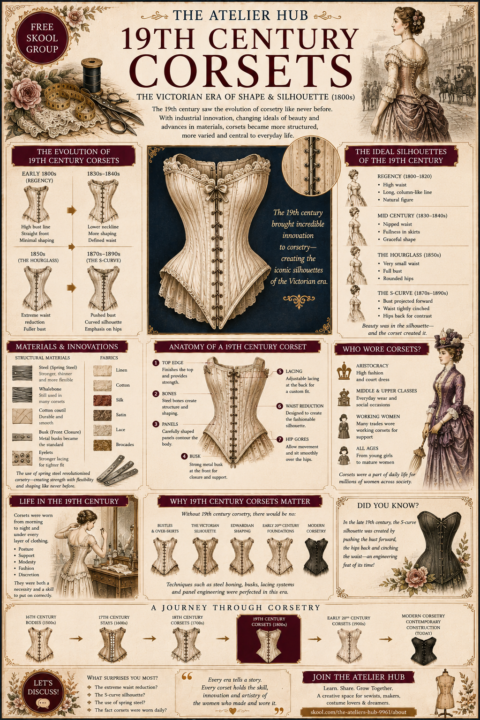
🪡 19th Century Corsets – Innovation, Craftsmanship & the Victorian Silhouette
As we continue our journey through the history of corsetry, we've reached perhaps the most recognisable era of them all the 19th century. When many people hear the word corset, this is often the image that comes to mind. Yet the Victorian corset was far from static. Throughout the 1800s, it evolved dramatically alongside fashion, technology and society itself. The century began with the elegant, high-waisted Regency silhouette, where corsets were relatively short and lightly structured. As fashions changed, so did the corset. By the mid-century, waistlines returned to their natural position, skirts became fuller, and corsets grew longer, offering increased shaping and support. One of the greatest developments of the Victorian era was the introduction of industrial manufacturing. Advances in metalworking transformed corsetry, introducing stronger steel busks and more reliable steel boning. These innovations allowed corsets to become both more supportive and more comfortable, while maintaining the fashionable silhouettes of the day. During this period, makers commonly worked with: 🪡 Cotton coutil and tightly woven cottons for strength 🪡 Linen and fine cotton linings 🪡 Flat and spiral steel boning 🪡 Steel busks for secure front closures 🪡 Hand-worked and later machine-set eyelets 🪡 Silk, satin, brocade and decorative trims for fashionable finishes The Victorian corset was also an extraordinary feat of pattern engineering. Carefully shaped panels, precise seam placement and graduated boning worked together to support the body while distributing tension evenly throughout the garment. It's important to remember that not every Victorian corset was designed for dramatic waist reduction. Everyday corsets were worn by women from many walks of life, providing support beneath clothing and helping garments fit as intended. Like modern bras or structured undergarments, they were practical foundation garments as much as they were fashionable ones. Many techniques used by modern corset makers continue to build upon Victorian innovations. From panel shaping and boning placement to busk installation and precision fitting, the craftsmanship of the 19th century still influences couture, bridal wear, historical costume and contemporary corsetry today.
1 like • 3d
Jeez. Those waists!!1! No wander women were always fainting back in the day. Smelling salts were a given with every outfit back then I think😂. Great shape the S but I can’t possibly imagine squeezing into a corset like that! I can’t barely handle my spanx😂😂
3 likes • 3d
@Paulette Ng drink at least your weight of water in oz. Per day and no snacking after dinner. Also keep an eye on sugars and simple carbs.(breads, pasta, chips etc…) I also found that eating lots of cabbage and adding lemon juice to my water helps shed weight. And of course getting some exercise in! I lost about 27lbs in the past 2 years. I put about 6 back on in the past year, but I can live with that😄. At 62 I can’t expect to look like when I was in my 20’s, 😂😂
🔥
14d •
16th Century Corsets, Bodies, Stays From The Tudor Era
🪡 The Origins of Corsetry: 16th Century Bodies & Early Stays 🪡 When many people think of corsets, they picture the dramatic hourglass silhouettes of the Victorian era. The reality is that the story begins much earlier. During the 16th century, structured garments known as "a pair of bodies" began appearing throughout European courts. These early foundations were not designed to create tiny waists or exaggerated curves. Instead, they were created to provide support, improve posture, and help achieve the fashionable silhouette of the period. One of the most surprising aspects of these garments is the shape they created. Unlike later corsets, the goal was a smooth, elongated cone shape through the torso. The bust was flattened rather than lifted, and the waist was not dramatically reduced. Structure and stability were the priorities. The materials used would also be familiar to anyone interested in historical sewing: 🌿 Reed 🌿 Cane 🌿 Rope 🌿 Buckram 🪡 Linen 🪡 Wool 🪡 Silk for wealthier households Rather than relying on steel, makers stitched natural materials into channels to create rigidity and support. Every garment was carefully constructed by hand, requiring skill, patience and an understanding of both materials and the body. What makes these early bodies so important is their influence on everything that followed. Without them, there would be no: ✨ 17th-century stays ✨ Georgian corsetry ✨ Victorian corsets ✨ Edwardian foundations ✨ Modern corsetry They represent the beginning of a centuries-long journey into garment structure and engineering. I'd love to hear from you: 🪡 What surprised you most about these early garments? 🪡 Did you know corsets originally created a cone-shaped silhouette rather than an hourglass? 🪡 Have you ever made a pair of bodies, stays or a historically inspired garment? 🪡 Which period of corsetry would you most like to explore next? Share your thoughts, questions and favourite historical examples below. Let's continue uncovering the hidden foundations of dress together.

1 like • 13d
I wonder how they got the fishy smell out of that baleen? I eat a lot of fish and boy, it’s definitely stinky business cleaning those pans and utensils. Thinking bones would have to be rubbed clean with some strong stuff. My mom used a lot of lemon to clean fishy dishes so maybe they did that back in the day too…
1 like • 12d
So true….
🔥
14d •
Holiday & Cleaning Mode, What's Been Happening ⛱️😁🪄🧵💫
I've been in ultimate holiday and then cleaning mode the last few weeks, and took my foot off the pedal a wee bit. It's been bliss in many ways as I've had chance to look at what I've been up to, and where I want to continue moving forward for The Atelier Hub sewers 🪡 Whilst enjoying much needed family time, our first long holiday as a family of 5, 3 little ones between 3 and 8, we made some awesome memories but my oh my the relentless cleaning and motherhood duties 🤭🫡🧹 Whilst I have also been secretly, tinkering and building in the background 😜 and have some plans I'm cooking up, so do stay tuned for what's coming. Tomorrow I get back onto my 🧵 sewing machine, and I look forward to sharing with you 🫶💫 Do share where you have been up to, any happy sewing plans or makes, fun memories or wins you would like to celebrate with the hub? Please holla below 👇 Sending smiles, Claire Amelia 🌱🌻🪡🧵 We're celebrating today, Happy Father's Day to all ✨

1 like • 13d
Welcome back. I totally understand vacationing with three little ones. Had 3 of my own and now I have three grandbabies all under 4. It’s an adventure for sure….they are always on!!😅😅 but you make the most wonderful memories and they grow up sooo fast. Family always comes first around here…but I do sneak in my sewing, crocheting, and other crafting every free minute I get😜
🔥
Jun 2 •
Closing Off May's Accountability Sewing 🪡
In May, we discussed each week what sewing projects we've been working on. Time to divulge, keep us guys updated and share your projects. Let's hear what you have all been up to; @Valerie The French Sewing Bee you discussed making swimming costumes, did you complete and get the pictures sent off? @Debra Verrall has been busy with her own skool sewing group preparing sew a longs, how did they go Debra? Would love to hear. @Jane Harbison busy filming sewing grandpa shirts, did you complete the filming? If so, please do share with the other sewers in the group 'Discipline Deep Dives'. @Nancy Poekert has been sewing with fleece, how did the repairs and jackets come along? @Christy Steiger dared to play with bias cut, relining and altering. Was your daughter happy with the outcome? @Jan Appleton did you manage to get on your sewing machine in the month of May? Please share your wins. A small snippet of some of the fabulous sewers in The Atelier Hub. To all hub members, let's hear how your sewing has gone the past month of May, before I enquire what you're up to next 🪡 Sending smiles, Claire Amelia 🧵🥰

1 like • 21d
@Nancy Poekert you sound just like me. I always like challenging myself without using patterns. That means lots of imperfections and seam ripping, but im getting better everyday and feel much prouder of my original projects
🔥
Apr 13 •
📌 WELCOME TO THE ATELIER HUB
Hello & welcome in. 🧵 I am so grateful you are here. This is a space I have wanted to create for a long time, somewhere that finally feels right for makers like us. A place that doesn't start at the beginning. A place that meets you in the beautiful, complicated middle of this craft we call sewing. Whether you are a dressmaker, a bridal maker, seamstress, a tailor, a corsetiere, an upcycle maker, a costumier, furnishings.. or someone who crosses every single sewing discipline day, this studio is yours. The Atelier Hub was built on one simple belief; that sewers grow best when they grow together. That when we share our knowledge, our discoveries, our creative crises & our wins across every discipline, the whole community becomes richer for it. This is not a teaching space. There are no tutorials here, no step by step guides, no back to basics but we can share our sewing techniques to support growth across our disciplines.. What there is, is a room full of serious, passionate, experienced makers from all over the world, & me standing alongside you as your sewing ally whenever the project gets hard, the client gets difficult or the creative well runs dry. I have been sewing for over 20 years. I am still learning. I suspect you are too. That is exactly why we are all here. Now it's your turn; come & introduce yourself 👇 I'd love to know: 🧵 Your name & where you are in the world ✂️ How long you have been sewing 📌 Your main discipline or the one you are most curious about right now 🌟 One thing you are currently making or dreaming of making There are no wrong answers. There is no judgement in this studio. The studio is open. Welcome to your sewing crew. 🧵 Claire Amelia Founder, The Atelier Hub
1 like • 21d
@Claire Amelia ok my bad the movie was called “ Creature from the Black Lagoon” lol
1 like • 21d
If i find the costume ill post it later… it one of the few i kept😅
1-6 of 6
@mariangela-remetz-1696
Retired , mom, and Nonna (grandma) love sewing ,crocheting & general upcycling crafts. Also dabble with collaging and oil pastel painting.
Active 8h ago
Joined Jun 14, 2026
New Jersey