Activity
Mon
Wed
Fri
Sun
Aug
Sep
Oct
Nov
Dec
Jan
Feb
Mar
Apr
May
Jun
What is this?
Less
More
Owned by Claire
For sewers past the beginners stage, who love their craft. Learn across every sewing discipline. Worldwide & free to join. A hub for those who sew ✂️
Memberships
Whole Foods Community
149 members • Free
Machine Knitting Hub
21 members • Free
Claude Code Club
6.7k members • $9/month
The Flemish Ardennes Life
64 members • $1/month
Retro Riches Archive
92 members • Free
Empire Creator Lab
694 members • Free
ViralGen Academy
95 members • Free
AI Automation Syndicate
957 members • Free
Pinterest Skool
5.5k members • $9/month
47 contributions to The Atelier Hub

🔥
6h •
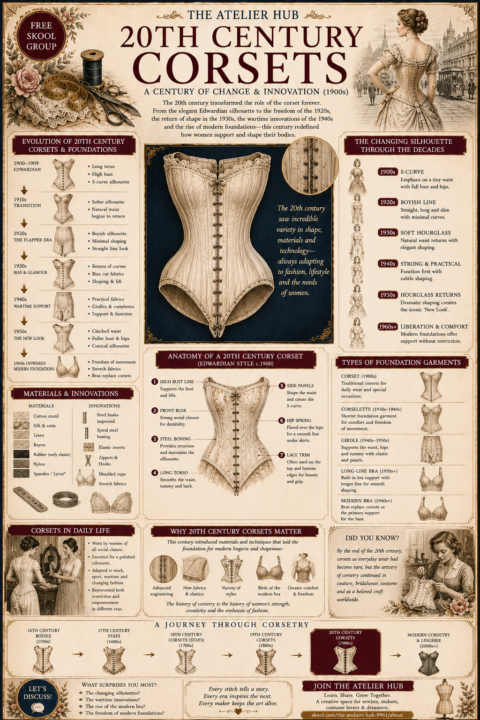
20th Century Corsets – A Century of Reinvention 🪡
As we reach the final chapter in our historical corsetry journey, it's fascinating to see just how dramatically foundation garments changed throughout the 20th century. Unlike previous centuries, where silhouettes evolved gradually, the 1900s brought rapid social, technological and cultural change, and corsetry evolved alongside it. The Edwardian Years (1900–1910) The century opened with the elegant S-bend corset, designed to create the fashionable "health corset" silhouette. These corsets encouraged an upright posture with the bust pushed forward and the hips gently back, creating the distinctive S-shaped profile that defined Edwardian fashion. The 1910s & 1920s As women's lives changed, so did their clothing. The First World War brought practicality to everyday dress, and by the 1920s fashion had shifted dramatically. The fashionable silhouette became long, straight and youthful. Rather than shaping the waist, foundation garments were designed to smooth the body and minimise curves beneath the loose-fitting dresses of the Jazz Age. For the first time in centuries, many women no longer wore heavily boned corsets every day. The 1930s & 1940s Fashion embraced softer, more natural lines. Corsetry didn't disappear—it adapted. Lightweight corselettes, girdles and foundation garments became increasingly popular, offering support without the rigidity of earlier corsets. Advances in textiles and manufacturing allowed garments to be lighter, more comfortable and better suited to modern lifestyles. During the Second World War, practicality and resourcefulness influenced every aspect of clothing, including foundation wear. The 1950s With Christian Dior's famous "New Look," structured foundations returned to fashion. Nipped waists, full skirts and beautifully sculpted silhouettes relied on carefully engineered undergarments, including waist cinchers, longline bras and girdles. While different from Victorian corsets, they shared the same purpose, creating shape through thoughtful construction.
🔥
1 like • 5h
@Paulette Ng what I am here for !!! hahaha I'm in a local pub, waiting for one of my girls, whilst working and there's a sign ... £5 tea and cake (whilst I'm supposed to be good)
🔥
1 like • 4h
@Paulette Ng that's what I thought, so I obviously got it ... white chocolate and passion fruit cake with a pot of tea yum yum that's Yorkshire for you hahaha
🔥
3d •
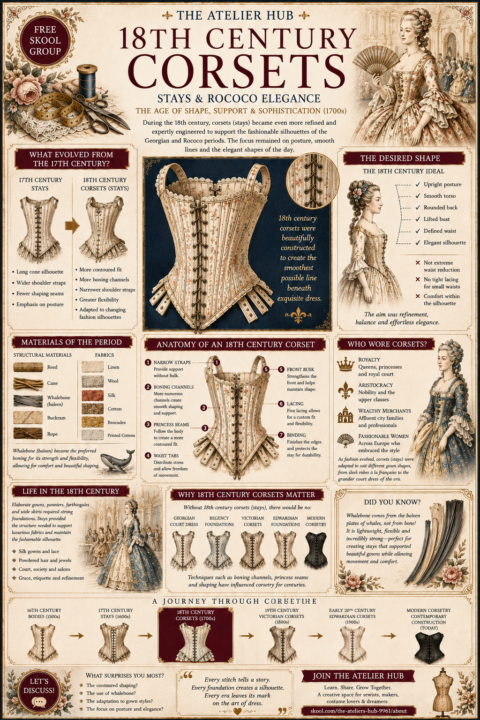
🪡 18th Century Corsets – The Age of Elegance & Engineering
As we continue our journey through the history of corsetry, we arrive in one of the most recognisable and technically fascinating periods of fashion history—the 18th century. Often associated with the grandeur of the Georgian and Rococo eras, 18th-century corsets (commonly referred to as stays) were an essential part of a woman's wardrobe. They weren't simply undergarments; they were the foundation upon which every fashionable gown was built. By this time, corsetry had become a highly specialised craft. Makers had refined centuries of knowledge into garments that offered remarkable support while allowing women to carry the wide skirts, panniers and luxurious fabrics that defined the period. Unlike the dramatic hourglass silhouette that many people associate with Victorian corsets, the ideal shape of the 18th century was one of balance and elegance. The aim was to create: ✨ An upright posture ✨ A smooth, elongated torso ✨ Gentle bust support and lift ✨ A beautifully proportioned silhouette that complemented the elaborate gowns of the era One of the defining features of 18th-century stays was their incredible construction. They were often made using: 🪡 Linen or silk outer fabrics 🪡 Strong linen foundation layers 🪡 Baleen (commonly called whalebone) for flexible support 🪡 Carefully stitched boning channels 🪡 Hand-worked eyelets for lacing 🪡 Waist tabs that allowed movement while maintaining structure Every stitch served a purpose. Every panel contributed to the overall fit. These garments were masterpieces of engineering as much as they were works of dressmaking. What makes this period especially interesting is how influential it remains today. Many of the techniques we use in modern corsetry, boning channels, multiple fabric layers, precise pattern shaping and careful distribution of support, have their roots in the craftsmanship of the 18th century. For anyone interested in couture, bridal wear, historical costume or advanced dressmaking, studying these garments offers valuable lessons in structure, balance and precision.
🔥
1 like • 2d
@Paulette Ng omg sound like me!! same the gardening and clearing the playhouse 😆💥 we got this!!
🔥
0 likes • 6h
@Jane Harbison bra's definitely are, with the wire right on the rib cage, with a corset the shape goes down the body, rather than across like the wire, which I personally think is better for us. You can buy a standard size, just make sure measurements fit yours, as nothing in our clothing is ever regulated so sizes mean nothing!
🔥
1d •
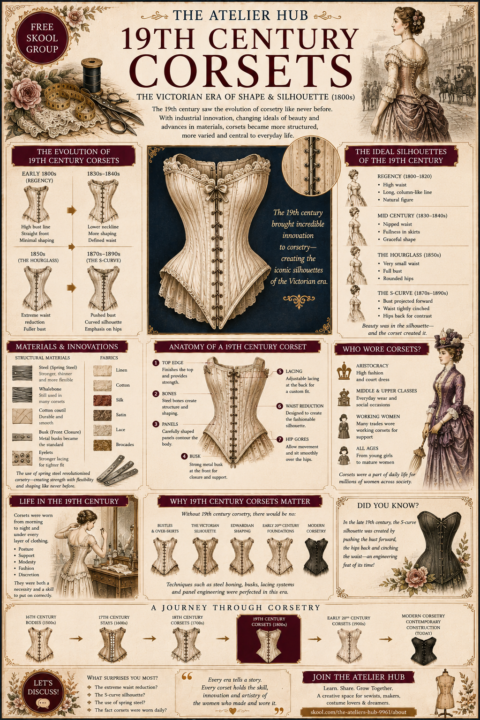
🪡 19th Century Corsets – Innovation, Craftsmanship & the Victorian Silhouette
As we continue our journey through the history of corsetry, we've reached perhaps the most recognisable era of them all the 19th century. When many people hear the word corset, this is often the image that comes to mind. Yet the Victorian corset was far from static. Throughout the 1800s, it evolved dramatically alongside fashion, technology and society itself. The century began with the elegant, high-waisted Regency silhouette, where corsets were relatively short and lightly structured. As fashions changed, so did the corset. By the mid-century, waistlines returned to their natural position, skirts became fuller, and corsets grew longer, offering increased shaping and support. One of the greatest developments of the Victorian era was the introduction of industrial manufacturing. Advances in metalworking transformed corsetry, introducing stronger steel busks and more reliable steel boning. These innovations allowed corsets to become both more supportive and more comfortable, while maintaining the fashionable silhouettes of the day. During this period, makers commonly worked with: 🪡 Cotton coutil and tightly woven cottons for strength 🪡 Linen and fine cotton linings 🪡 Flat and spiral steel boning 🪡 Steel busks for secure front closures 🪡 Hand-worked and later machine-set eyelets 🪡 Silk, satin, brocade and decorative trims for fashionable finishes The Victorian corset was also an extraordinary feat of pattern engineering. Carefully shaped panels, precise seam placement and graduated boning worked together to support the body while distributing tension evenly throughout the garment. It's important to remember that not every Victorian corset was designed for dramatic waist reduction. Everyday corsets were worn by women from many walks of life, providing support beneath clothing and helping garments fit as intended. Like modern bras or structured undergarments, they were practical foundation garments as much as they were fashionable ones. Many techniques used by modern corset makers continue to build upon Victorian innovations. From panel shaping and boning placement to busk installation and precision fitting, the craftsmanship of the 19th century still influences couture, bridal wear, historical costume and contemporary corsetry today.
🔥
0 likes • 6h
@Mariangela Remetz the spandex, little tip, I do not advise under evening wear, especially when fitting the garment and using spandex to shape underneath, just thought I would mention as you've got some bridesmaids coming up!! and I can digress more if you would like.
🔥
0 likes • 6h
@Jan Appleton they're back in style, boxed corsets, ones that squish into your waist !! but because we don't wear, we're all expanding eekkk
🔥
2d •
Welcoming Our Newest Members Here At The Atelier Hub
Welcome welcome our latest sewers 🫶 @Victoria Arya @Glenna James Really happy you are here for our real building sewing group!! Busy day sewing my way, attaching lace onto a bodice, what's your latest sewing projects? Would love for a big welcome from all, and don't forget to introduce your sewing over on the welcome post 🪡🧵

🔥
1 like • 2d
@Jane Harbison
🔥
0 likes • 2d
@Glenna James enjoy the hub
🔥
Apr 13 •
📌 WELCOME TO THE ATELIER HUB
Hello & welcome in. 🧵 I am so grateful you are here. This is a space I have wanted to create for a long time, somewhere that finally feels right for makers like us. A place that doesn't start at the beginning. A place that meets you in the beautiful, complicated middle of this craft we call sewing. Whether you are a dressmaker, a bridal maker, seamstress, a tailor, a corsetiere, an upcycle maker, a costumier, furnishings.. or someone who crosses every single sewing discipline day, this studio is yours. The Atelier Hub was built on one simple belief; that sewers grow best when they grow together. That when we share our knowledge, our discoveries, our creative crises & our wins across every discipline, the whole community becomes richer for it. This is not a teaching space. There are no tutorials here, no step by step guides, no back to basics but we can share our sewing techniques to support growth across our disciplines.. What there is, is a room full of serious, passionate, experienced makers from all over the world, & me standing alongside you as your sewing ally whenever the project gets hard, the client gets difficult or the creative well runs dry. I have been sewing for over 20 years. I am still learning. I suspect you are too. That is exactly why we are all here. Now it's your turn; come & introduce yourself 👇 I'd love to know: 🧵 Your name & where you are in the world ✂️ How long you have been sewing 📌 Your main discipline or the one you are most curious about right now 🌟 One thing you are currently making or dreaming of making There are no wrong answers. There is no judgement in this studio. The studio is open. Welcome to your sewing crew. 🧵 Claire Amelia Founder, The Atelier Hub
🔥
0 likes • 3d
@Glenna James that sounds great Glenna, do share you creative sewing in the hub for support 🫶 will you be having to adjust the pattern for your measuring?
🔥
0 likes • 3d
@Glenna James fab, when you come to it, holla. I'll be discussing self measuring this month 🥰
1-10 of 47

🔥
@claire-amelia
Creative engineer. 20+ years sewing. Founder of The Atelier Hub where serious sewers gather. 🧵 Co-Founder of Makers Growth Hub - coming soon 💸
Active 4h ago
Joined Apr 13, 2026
England, UK.