Activity
Mon
Wed
Fri
Sun
Jun
Jul
Aug
Sep
Oct
Nov
Dec
Jan
Feb
Mar
Apr
May
What is this?
Less
More
Owned by LynnMarie
From survival into self. A space for women to step out of survival and into their power. Break the patterns! Set the boundaries! Reclaim your voice!
Memberships
7 contributions to Rooted In Home

Feb 21 •
“What Actually Creates Healing?”
What has actually helped you heal — not just cope? I’ve been thinking about this lately. There’s a big difference between coping and healing. Coping helped me survive.Healing required me to slow down, feel, and build capacity. In this community, I’m here to deepen real healing — not just collect tools. So I’m curious: What has genuinely shifted something for you? Not advice.Not theory.But something that created real internal change. I’ll go first: For me, it was learning to regulate my nervous system before trying to fix my emotions. Once my body felt safe, my thoughts softened. Would love to hear what’s worked for you.

🔥
1 like • Mar 9
I experienced a repressed memory that forced me to look deeper into my pain. It opened wounds I didn't even know I was carrying and I had to work on healing from it rather than just finding new and harsher ways of coping.
Mar 7 •
Listening to Anxiety
Anxiety is often treated like an enemy — something to silence, suppress, or push away. We tighten around it, try to distract ourselves from it, or judge ourselves for feeling it at all. But what if anxiety is not simply a problem to fix? What if it is a message trying to reach you? Anxiety is the body’s way of raising a flag. It appears when something inside us senses uncertainty, danger, misalignment, or unmet needs. Sometimes it comes from very real circumstances in the present. Other times it is an echo from past experiences where the body learned that it needed to stay alert in order to stay safe. Instead of immediately trying to quiet anxiety, a different approach is to investigate it. Pause for a moment and notice where it lives in your body. Is it in the chest, the stomach, the throat, the jaw? Anxiety often shows up as tension, tightness, or a restless energy that wants to move. Then ask it a question: What are you trying to tell me? If anxiety had a voice, it might speak in ways that surprise you. It might say, “Slow down. You are carrying too much.” Or perhaps, “Something here does not feel safe.” It might whisper, “You need rest,” or “You need support.” Sometimes anxiety is simply asking to be acknowledged. Like a child tugging at a sleeve, it becomes louder when ignored and softer when listened to. Giving anxiety a voice does not mean obeying every fearful thought. It means becoming curious about the signal underneath the noise. Beneath anxiety there is often a deeper request: protection, honesty, boundaries, reassurance, or change. When we investigate anxiety instead of fighting it, something shifts. The body begins to feel heard. The nervous system slowly learns that it does not have to shout to get attention. Anxiety is not always the truth — but it is always information. And when we are willing to sit with it, ask questions, and listen carefully, we often discover that what it is truly asking for is not control… but care

🔥
0 likes • Mar 9
Anxiety usually sits in my throat and chest. I have learned to sit with these feeling and explore them before working towards grounding myself back to the present. A lot of times anxiety hits as a reminder of something from the past for me but when it's something new, I like to be aware so I can prevent it from happening again rather than listening to it more intently.
Feb 12 •
Normalizing “I’m Not Okay.”
Many of us were raised to prioritize comfort — not our own, but everyone else’s. “Hi, how are you?” “I’m fine.” Even when we weren’t. We learned the social scripts early. Keep it light. Don’t make it awkward. Don’t burden anyone. Keep moving. But here is something I am learning in real time: Sometimes the most regulated thing we can say is, “I’m not okay.” Not because we lack capacity. Not because we can’t push through. Not because we are weak. But because pushing through what hurts without acknowledging it is how we stay in cycles. For a long time, I believed strength meant endurance. Now I understand strength also means awareness. Today, I am not okay with what has been present in my life. Not in a dramatic way. Not in a collapsing way. In a clear way. There are dynamics I can see now that I could not see before. Patterns I tolerated. Energies I absorbed. Moments where I minimized myself to avoid discomfort. And I am done cycling through the aftermath of unconscious behavior — mine or anyone else’s. “I’m not okay” is not a breakdown. It’s a boundary with reality. It is the nervous system saying: Something needs attention. Not suppression. We don’t heal by pretending. We heal by noticing. And sometimes the most powerful shift begins with a simple, honest sentence: I’m not okay. And that’s allowed. — If this resonates, you’re not alone. You don’t have to perform wellness here. Follow along for grounded conversations about capacity, boundaries, and rebuilding from awareness. #RootedReflection #NervousSystemHealing #EmotionalMaturity #BreakingCycles #BodyAwareness #HealingInRealTime #BoundariesAreHealthy #YouAreAllowed #RegulatedNotReactive #RootedAtHome

🔥
1 like • Feb 12
@Snider Dawn this is such a common thing too. We do it every day. Someone's says how are you? I'm good, I'm fine, I'm ok, rarely are we honest and say I'm struggling, things aren't ok, I am not fine. Mainly because we were taught that we would be a burden to others, but also because people don't know how to respond to anything other than I'm fine. It makes them uncomfortable, which in turn, makes you feel like you did something wrong by being honest and sharing your true feelings. Most definitely, we need to Normalize Not Being Okay. 💜
Feb 8 •
Survivor’s Flashbacks — a body perspective
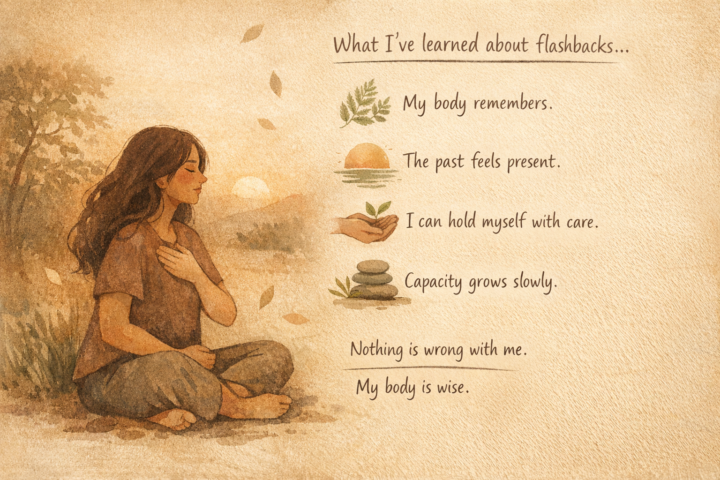
Survivor’s Flashbacks — a body perspective For a long time, I didn’t have language for what was happening to me. I just knew that sometimes my body would react before my mind had a say. I’ve learned that what many of us call flashbacks aren’t about remembering the past. They’re about the body responding to something that once felt overwhelming. The body doesn’t experience time the way the mind does. When something in the present echoes the past—even quietly—the nervous system can respond as if it’s happening again. Not because something is wrong. But because the body learned how to survive. How this showed up for me My flashbacks weren’t always visual. Often they were: - a sudden drop into anxiety or emptiness - a feeling of leaving my body or the room - tightness in my chest, throat, or belly - a strong urge to run, hide, or go numb There wasn’t always a story attached. The body was speaking first. Grounding — meeting the body where it is What I’ve learned is that grounding isn’t about forcing myself to calm down. It’s about helping my body orient to now. In those moments, I return to sensation: - feeling my feet make contact with the floor - noticing the support beneath me - placing a hand on my body and reminding it, gently:I’m here. I’m safe right now. Sometimes I name what I can see or feel. Sometimes I just stay with one steady sensation. The body doesn’t need explanations. It needs presence. Building capacity — the deeper work Over time, I learned that the work isn’t only what we do during a flashback. It’s how we build capacity between them. Capacity is the ability to stay with sensation without becoming overwhelmed. I built mine slowly by: - practicing grounding when I was already regulated - noticing my body in small, everyday moments - resting when my system signaled overload - learning the early cues before overwhelm took hold As my capacity grew, my flashbacks softened. They became shorter. Less intense. Easier to come back from.
🔥
0 likes • Feb 8
@Snider Dawn THIS! It took a long time to understand what it was that was happening to me as well. I used to try to numb from flashbacks but with grounding and work they have become easier.
🔥
1 like • Feb 8
@Snider Dawn You and me both. I often wonder how it is that I am still here.
Feb 3 •
🌊 Water Journey Information Session (Free) - Sunday 8th 7pm
This short gathering is a welcoming space to learn more about the 30-Day Water Journey and how the month of February — Compassion & Softening will unfold. We’ll talk about: - What the Water Journey is and how it works day-to-day - How you can participate at your own pace - What community sharing looks like (and what it doesn’t have to be) - How water, compassion, and gentleness guide this month’s practices There is no commitment required—come listen, feel into it, and ask questions if you’d like. Quiet presence is just as welcome as conversation. 🌙 Open to all. Free to attend. 👉 Zoom Link: https://queensu.zoom.us/j/96676950705?pwd=2NQnSAcMVlHXFBT8AaLyQ5LKg3EMYl.1
🔥
1 like • Feb 7
This sound very interesting.
1-7 of 7

🔥
@lynnmarie-flynn-8335
Helping women break toxic patterns, build boundaries, and reconnect with their self-worth.
Move from survival into a life that feels like yours.
Active 3h ago
Joined Jan 30, 2026
Peterborough Ontario