Activity
Mon
Wed
Fri
Sun
May
Jun
Jul
Aug
Sep
Oct
Nov
Dec
Jan
Feb
Mar
Apr
What is this?
Less
More
Memberships
AI-Smart CEOs with Wendy
2.5k members • Free
Your First $5k Club w/ARLAN
26.4k members • Free
The Authority Engine
39 members • Free
Skool Scale Camp
4.8k members • Free
LinkedIn Strategy Lab
272 members • Free
3 contributions to The Authority Engine

🔥
18d •
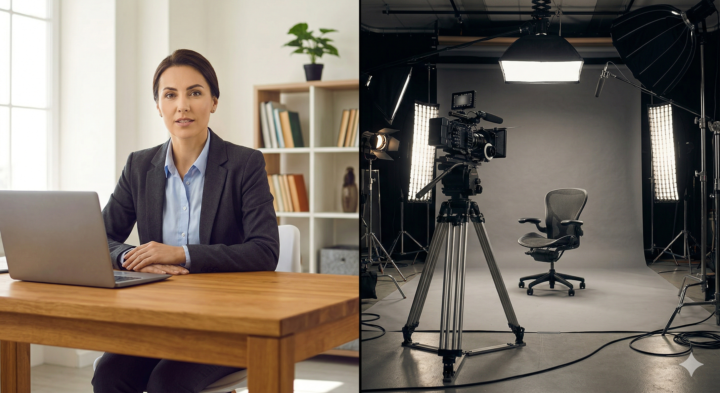
Face-to-cam or full production? Here's the actual rule.
It's the question I'm asked more than almost any other. And the answer is rarely what most coaches expect. Your prospect doesn't care how polished the video looks. They care whether you seem like someone who understands their problem. A beautifully produced video with the wrong message loses to a simple face-to-camera clip that names the exact frustration your ideal client was feeling. That said, there is a floor. Here it is: Audio first - always. Muddy audio signals amateur. Clean audio signals professional. A £30 lapel mic and a duvet behind you beats a ring light and the MacBook's built-in microphone every time. Lighting second. Your face must be clearly visible with no harsh shadows. Natural window light is usually enough. Everything else is optional until you're consistently generating inbound enquiries and you want to remove any remaining friction. The coaches and consultants I see stuck on this are almost always using production quality as a proxy for readiness. "Once the setup is perfect, then I'll start." The setup is never the problem. The message is. One face-to-camera video that speaks directly to a real client challenge will do more for your inbound pipeline than any fully produced video on a topic nobody is searching for. Get the message right first. Then improve the packaging. Reply below with where you stand right now - full production setup, face-to-camera only, or still waiting for the right moment. I'll give you a direct read. 👇

1 like • 18d
@Des Dreckett I have all the kit and a bright room to get started but lack the knowledge to do so.
1 like • 17d
@Des Dreckett Ive booked a call now. Thanks
🔥
20d •
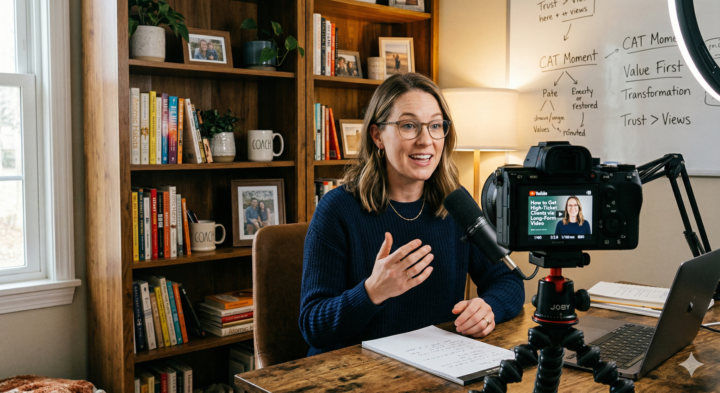
Shorts get the views. Long-form gets the clients.
We've known this for a while, but it's worth saying out loud again in 2026 because the noise around Shorts is louder than ever. Here's what's actually happening. Someone searching YouTube for help with their coaching business isn't scrolling for entertainment. They're on a mission. They're evaluating who knows what they're talking about. And a 10-15 minute video that answers the exact question they just typed in does something a Short never can, it builds the kind of trust that makes them want to reach out. One well-placed video targeting a real CAT Moment, a Challenge, Aspiration, or Transformation your ideal client is actively searching for, can still be generating inbound enquiries six months after you published it. Without you touching it. That's not a content strategy. That's an asset. Shorts have their place. But if you're a coach or consultant and your goal is qualified inbound leads - not views, long-form is still where the work gets done. What's your experience been? Are you seeing long-form convert better than short-form, or has something shifted for you recently?
1 like • 18d
I really need to take YT more seriously to grow my coaching work
🔥
22d •
Why YouTube Is the Only Platform That Actually Works for Coaches and Consultants
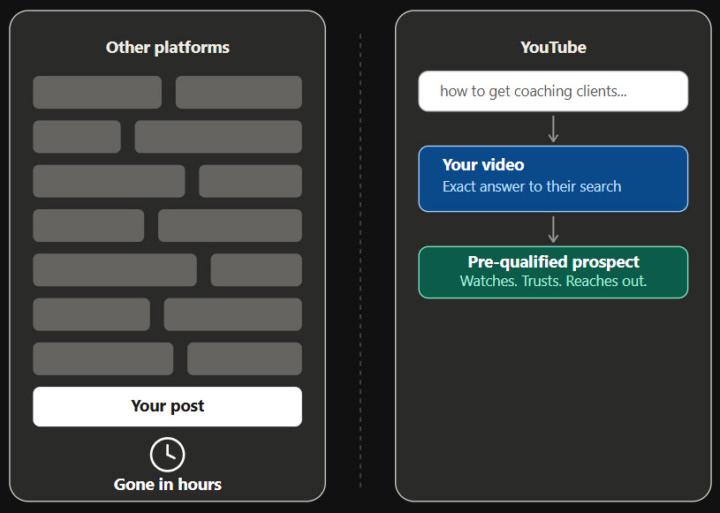
Let's be honest about something. Most of us have spent months - maybe years - posting on LinkedIn, Instagram, or Facebook. We've written the posts, shown up consistently, got the likes. And then waited for the enquiries that never quite came. That's not a you problem. That's a platform problem. Those platforms were built for entertainment and connection. They're not built for the way coaches and consultants actually sell. The content disappears in hours. The algorithm rewards volume. And the people scrolling past your post? They're not looking for help. They're just... scrolling. YouTube is completely different. It's a search engine. People arrive with a specific problem they want solved. They type in exactly what they're struggling with — and if your video answers that question, they find you. Not because you paid for an ad. Not because you posted three times a day. Because you made the right video, once, and it kept working. That's the bit most coaches don't realise. A well-placed YouTube video doesn't expire. It ranks. It gets recommended. Six months after you uploaded it, someone you've never met finds it, watches the whole thing, and books a call. That's not a theory. That's how this works. The Authority Engine is built around one idea: that a coach or consultant with genuine expertise should be able to use YouTube to generate inbound enquiries - without going viral, without building a massive audience, and without spending 20 hours a week on content. Six focused hours a month. The right videos, targeting the right search terms, at the right CAT Moment - the exact Challenge, Aspiration, or Transformation your ideal client is already searching for. One metric. Inbound enquiries from people who already know they want to work with you. If that's what you're here for, you're in the right place.
2 likes • 20d
Insightful, Linkedin does now does feel like an advertisement board. Im interested in seeing the benefits of YouTube for my coaching work.
1-3 of 3

@loraine-mckoy-4172
Transformational Coach · Speaker · Author - It Is TIME. Coaching R.E.N.E.W.A.L.™ framework, Founder of Rewritten@7. RD, Athena Network Manchester.
Active 2d ago
Joined Mar 26, 2026
Manchester Uk