Activity
Mon
Wed
Fri
Sun
Mar
Apr
May
Jun
Jul
Aug
Sep
Oct
Nov
Dec
Jan
Feb
What is this?
Less
More
Memberships
Peptide Price
9.3k members • Free
OPTIMIZE & THRIVE
3.8k members • Free
8 contributions to Peptide Price

1d •
Mots-C optimization
To get the most out of MOTS-C, it should be taken in a fasted state, ideally 2 to 4 hours before your first meal. So what are the 8-to-5 crowd doing? Pushing their first meal to 10 a.m.?
0 likes • 1d
@Derek Pruski any advice on this?
1d •
5-amino, KPV and GHK-Cu
Is anyone stacking 5-Amino, KPV, and GHK-Cu? I’m looking for real-world input on dosing protocols, cycle length, timing (fasted vs fed, morning vs night), and any precautions or side effects to watch for.
0 likes • 1d
@Derek Pruski can you weigh in please?

1d •
Mot c
Im wanting to explore mot c in my research., not sure what size bottle to get in order to last 1 month and what would be the amount of bac water to add and what's a good dose to is ty
1 like • 1d
You need to decide whether you’re running it five days on and two days off, or straight through all seven days. I’m planning to start at 500 mcg and gradually increase to 1,000 mcg. If you use Derek’s calculator, the cycle timing section really simplifies the process and takes the guesswork out. It’s a great tool.
1 like • 1d
@Suzanne DeAmaral Nhut Le’s comments below are spot on. If you plan of running 1000mcg a day for 5 on 2 off you’ll need 2 vials of 10mg

🔥
4d •
🧪 New Update: Reconstitution Calculator Just Got Stupid-Simple
I was getting the same questions over and over — in the community, on TikTok, in DMs — about how to reconstitute peptides. So I rebuilt the calculator on PeptidePrice to make it as simple as humanly possible. If you mess this up, you probably shouldn't be researching peptides. 😂 Here's how it works: Step 1: Type in your peptide and the vial size (e.g., BPC 10mg). Step 2: It auto-fills the BAC water amount using the "add a zero" method — 1mg of peptide = 10 units of BAC water. So 10mg auto-fills to 1mL, 20mg to 2mL, 30mg to 3mL. Above 30mg, it caps at 3mL because that's all those little vials hold. You can always adjust this manually if you prefer different math. Step 3: Enter your dose (MCG or MG). Step 4: Pick your syringe size — 0.3mL, 0.5mL, 1mL insulin syringe, or 3mL peptide pen cartridge. Hit calculate and it shows you exactly how many units to draw to, with a visual of the syringe. Plus it tells you doses per vial, concentration, volume per dose, and total peptide. The blend calculator is where it really shines. Select your blend (like the Glow Blend — GHK-Cu 50mg / TB-500 10mg / BPC 10mg), and it auto-fills all the peptide amounts and BAC water for you. You can dose by total blend OR by individual peptide. So if you want 2mg of GHK-Cu per dose, it'll calculate exactly how much TB-500 and BPC you're getting per injection along with it. Doses per vial, total peptide, everything. The advanced calculator is still there for those of you who've been using it. This new simplified version just pops up by default now. On mobile, you can find it under Resources → Reconstitution Calculator. Try it out here: peptideprice.store/calculator Just wanted to make sure this was accessible for everybody new to the research space. Appreciate you guys. 🤝 Full Demo: https://vimeo.com/1163858079/4d3e2eaf2f?share=copy&fl=sv&fe=ci

1 like • 4d
I love it, great work!
🔥
7d •
Your Mitochondria Are Working Harder — Are You Keeping Up?
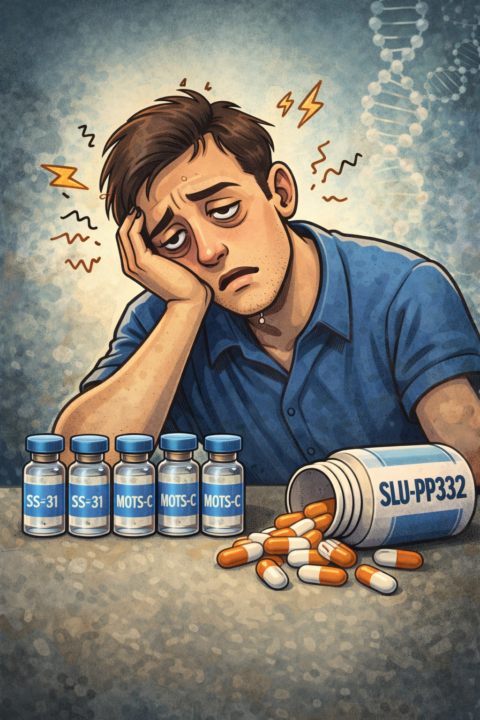
Let me walk you through something that almost nobody is talking about in the peptide space right now. If you push mitochondrial output hard without supporting antioxidant systems, you can create more stress than benefit — even though you’re using “energy-boosting” compounds. This came up while I was researching higher-dose SLU-PP-332 and looking deeper at mitochondrial up-regulation. Almost no one talks about this part. Make sure to read the whole post because it will benefit you in understanding oxidative stress and how to mitigate it. Let me break it down simply. You have tiny power plants inside every single cell in your body. They're called mitochondria. Their job is simple — take the food you eat and the oxygen you breathe and turn it into energy. The better they work, the better you feel. More energy. Faster recovery. Sharper thinking. That's the whole game. That's why mitochondrial peptides are so popular in research right now. Compounds like SS-31 and MOTS-C are designed to do two things: make your existing power plants run better, and tell your body to build brand new ones. At low doses, individually, these compounds are generally well-tolerated in research. Your body can handle the modest increase in output without much issue. But here's where it gets interesting. When You Start Stacking, The Math Changes The whole point of combining SS-31 with MOTS-C (or adding SLU-PP-332 on top) is synergy. You're not just nudging one pathway — you're pushing multiple mitochondrial pathways at the same time. More efficiency. More new mitochondria. Significantly more total energy output. That's the goal. And it works. But every power plant produces exhaust. At low individual doses, the exhaust is manageable. Your body has a built-in cleanup crew that handles it no problem. When you stack these compounds and really push mitochondrial output, you're now running way more power plants at way higher capacity. The exhaust — called reactive oxygen species (ROS), basically tiny molecular wrecking balls — scales up fast. And if your cleanup crew can't keep pace with that new volume of exhaust, it starts piling up inside your cells. That's called oxidative stress. And it can quietly undo the very benefits you're chasing.
0 likes • 7d
🔥
1-8 of 8

Active 3h ago
Joined Jan 27, 2026