Activity
Mon
Wed
Fri
Sun
Aug
Sep
Oct
Nov
Dec
Jan
Feb
Mar
Apr
May
Jun
Jul
What is this?
Less
More
Memberships
Builder’s Console Log 🛠️
2.6k members • Free
AI SAAS Builders (Workshops)
5k members • Free
AI MVP Builders
2.9k members • Free
Vertical AI Builders
10.1k members • Free
AI Software Builders: MakerAI
3.4k members • Free
Builders by Buildy.ai
3.9k members • Free
Ai App Builders-Lite
6.9k members • Free
The AI Advantage
126.6k members • Free
Chase AI Community
72.3k members • Free
14 contributions to AI Automation Society

1d •
Security Resources for AI Founders: The Essential Reading List
So I get asked fairly regularly for a starting point on this stuff, and up until now I've just been sending people individual links as they come up in conversation. This is my attempt to put all of it in one place, because most of what gets written in the security space is aimed at enterprise teams with dedicated security staff, not a solo founder shipping an AI product who just wants to understand what they're actually dealing with. That said, everything below seeks to be non technical enough to be useful to somebody without requiring in depth security knowledge, and would be a great resource to bookmark and keep on hand while building out applications. 1. The OWASP LLM Top 10 (genai.owasp.org) If there is one document worth reading before you ship anything with an AI component, this is it. OWASP has been producing security guidance for developers since 2001, and their Web Application Top 10 became the industry standard for traditional web security. In 2023 they released a version specifically for LLM applications, updated again in 2025, covering the ten most critical vulnerabilities specific to AI powered products. Prompt injection sits at number one on that list, which on its own should tell you something. It doesn't need to be read cover to cover, but even skimming the names and one line descriptions should give you a meaningful vocabulary for understanding what your product is and isn't exposed to. Also worth noting: they released an Agentic Applications Top 10 in 2026 specifically for founders building with autonomous AI agents. If this is applicable to your build, I would definitely give that document a further look into as well. 2. Georgia Tech's Vibe Security Radar (scp.cc.gatech.edu) Launched in May 2025 out of Georgia Tech's Systems Software and Security Lab, the Vibe Security Radar does something nobody else was doing at the time: actually tracking CVEs directly traceable to AI generated code. Researcher Hanqing Zhao's reasoning for building it was straightforward: "everyone is saying AI code is insecure but nobody is actually tracking it."
0 likes • 4h
@Chetan Mishra Glad to help! Whats equally shocking is that now with AI coding tools, the door has opened for non technical folk to build apps with virtually zero technical know how. Of course, this also means that security awareness is also zero, and AI is far from good at handling security. Appreciate the reply!
Jun 9 •
Cybersecurity Fundamentals Every AI Founder Should Know Before Launch
From what I’ve personally observed, it seems to me that though most AI founders seem to be technical enough to bring their software products to life, but not quite technical enough to know what they are actually exposing when they use AI tools both build and ship quickly. With security debt, the unfortunate reality is that this particular knowledge gap often means that when these issues come into the limelight, it's usually because something backfires publicly post launch. The worst part about this is that AI founders in specific are none the wiser, as during the build process it's often assumed that the security layer will be taken care of out of the box; though it's worth noting that this is an area that most AI code generators cannot seem to perfect, especially in 2026. That being said, here are some important fundamental baseline ideas that I think are critical for any AI founder to keep in the back of their mind, both as they build and refine their projects. This list was deducted after my many experiences talking and working with non technical founders across the board, and will go a long way in ensuring you are shipping something safe and secure! 1. Your LLM Is Not a Security Boundary To begin, this is the singular most important mindset shift that most people need to bake front and centre into their minds as soon as absolutely possible. Most assume that AI tools are built with their best interests in mind out of the box; that such tools will build whole and complete products that are functional and air tight all around. Sadly however, as mentioned above security in specific is one of the main pitfalls when it comes to building with AI code generators. Because of this, this is an imperative rule to keep in the front of your mind as you build out each and every single app element on your builds. Thus, the tools that you expose in effect define your attackers blast radius; that is, any parameter that the model in question uses MUST be treated as attacker controlled input. Often, founders will wire up their AI to databases, APIs, and critical admin functions and then assume that the model's instructions will hold throughout. However, in the event of a full fledged cyber attack (or even smaller incidents for that matter, as vulnerabilities tend to compound the more abundant they are), this is rarely the reality. Thus, prompting with security front and center should be imperative to your development process.
3
0
Jun 2 •
Lovable Apps Have a Security Problem Nobody's Talking About
To preface, I run a security auditing service that seeks to address the technical debt that comes from building with AI tools in order to give founders additional peace of mind prior to shipping. That said, last week I scanned a total of 8 lovable built apps, since I noticed that with the Lovable platform specifically that its vulnerabilities always seemed to be structured in the same exact way across different apps. Furthermore, many of these products had actual user bases and live billing mechanisms in place, and thus the data that these apps were handling were particularly important. That out of the way, these are 5 of the most common findings that I came across among almost all of the Lovable built applications that i have audited thus far: 1. 8/8 apps had at least one HIGH severity finding; though, typically within a short 10-15 minute window, I was able to source multiple (even within some of the better built products, same idea). Many of these findings were able to be sourced with fairly rudimentary tooling. For instance, almost all of the apps I scanned seemed to have secrets of all kinds baked right into the front end; accessible through DevTools alone. Things ranging from JWTs, API keys, etc etc. However, it gets worse: 2. 7/8 apps had a hardcoded supabase token sitting in the front in JS bundle sitting in plain sight. This being the code that your browser actually downloads first before loading your app, what this means is that anyone can open devtools on their local machine, and search for this directly within the sources tab with next to no effort. This key, plus an unprotected database means that anybody online can utilize this to grant themselves direct read/write access to your data without even being logged in. 3. 7/8 apps had no rate limiting mechanisms configured on login. What this means is that there is absolutely nothing stopping someone from attemptions thousands of password guesses on any account that they choose. Configuring an automation tool to cycle through common password lists to target specific users is simple, and what this means is that anyone can access any account they desire by running said scripts overnight. So thus, rendering user passwords completely useless as safeguarding mechanisms. Furthermore, on these same apps there was a complete absence of other such mitigation methods (ie: CAPTCHA trigger, account lockout/slowdown mechanisms), so this confirms that anybody can log in wherever they choose to on these sites completely under the radar.
0 likes • Jun 6
@Mark Mark Of course man!
1 like • Jun 6
@Zane Phillips Exactly, if anyone is going to launch absolutely anything (especially if leaning heavily on AI) then security is an absolute top priority. Many of these code generators use flawed templates, and are trained on poor quality code. Frankenstein all of that together, and you have one hell of a security disaster to be on your hands. So definitely, security should be the top priority, I would firmly argue even at the cost of speed.
May 19 •
The 30 minute security checklist I run on every AI built app before it goes live
If posts like these are not allowed on here, then please forgive me mods. I have been lurking on this page for some time now, and know that many people on here building apps with use of AI tools (Claude/Lovable/Cursor, etc.). I have just seen many of the same security issues within the apps that I have audited thus far, and figured that a quick PSA styled post would be unequivocally beneficial :) That said, I have been auditing apps built with AI tools such as Cursor/Bolt/Lovable for quite some time now, and I have always noticed that the same security issues keep coming up in various different domains. With respect to AI generated code more broadly, regardless of the platform or medium that you choose to utilize in your vibe coding journey, I have noticed across the board that many of the exact same issues keep popping up all around. Citing what I have personally rendered from all of this, here is the exact checklist that I have distilled down and run myself on every build that I have encountered. This whole sequence takes ~30 to pull off end to end, and doesn't require any fancy tooling or deep technical knowledge; most of this is extremely rudimentary, yet high ROI all around. Security headers check: ~2 min (securityheaders.com) This check is one that is fairly straight forward to pull off, all you need is your live site link and access to the above URL. Running the check, what you are looking for is any grade above B; anything less than this from a security standpoint is a huge issue. In this case, improperly implemented headers mean that you are leaving your app open to a whole slew of possible exploits that simply do not need to happen; things such as clickjacking, content injection and cross site scripting attacks all become radically easier to pull off without any headers present to pose as a resistance layer. The fix here is most always a simple one line patch in your config, and given the risk that improperly configured headers pose, this is quite possibly one of the simplest yet high ROI patches that you could implement to galvanize your apps security. In my experience, missing X-Frame-Options and CSP headers seem to be the two most frequently overlooked in AI output.
0 likes • May 25
@Jade Williams It's unfortunate without a doubt, also seems to be the one area that AI is not quite yet up to speed with too. So all together, a pretty unfortunate reality for many builders in 2026 (and beyond, I'm certain).
0 likes • May 25
@Jade Williams Anytime!

May 14 •
Day#4 - Workflow Automation
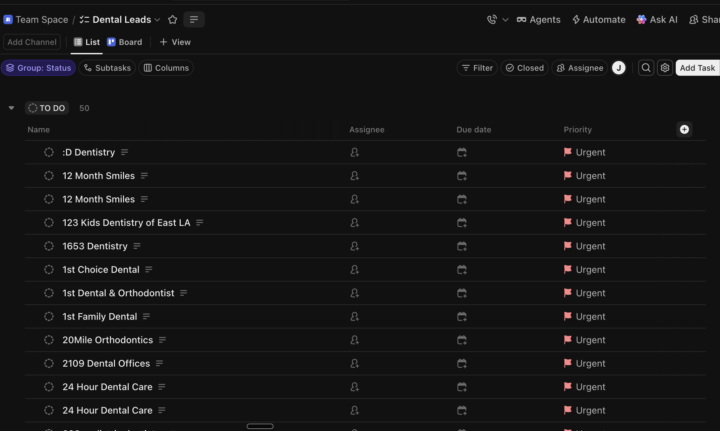
What you deployed - scheduled dental client leads workflow, pushed to github and deployed on trigger.dev #AISChallenge
0 likes • May 15
@Joel Crasta Good stuff man, so then the scraper is pulling and storing contact details automatically per practice?? Also, how are you handling access control on the ClickUp side, is it just you or are there other team members with access to this data??
0 likes • May 15
@Joel Crasta At the stage your at currently that makes complete sense, though once you start adding team members ClickUp's permission model is definitely worth giving a quick look, as you'd want to ensure that not everyone has visibility into the full contact list just by default. Is this workflow just for your own prospecting or are you building it out as a service for clients eventually?
1-10 of 14

@kj-hutchinson-9324
24 🇨🇦 | Security Researcher & Consultant [COMMISSIONS OPEN]
Active 4h ago
Joined May 14, 2026
Canada
Powered by