Activity
Mon
Wed
Fri
Sun
Feb
Mar
Apr
May
Jun
Jul
Aug
Sep
Oct
Nov
Dec
Jan
What is this?
Less
More
Memberships
Content Academy
13.7k members • Free
Di-Maccio Art Academy
4.1k members • Free
The Book Club
384 members • Free
Synthesizer
33.8k members • Free
Notion Wizards
5.4k members • Free
𝙂𝙊𝙊𝙎𝙄𝙁𝙔 🍓🐛🦋🌈⭐️🩷
9.5k members • Free
Magnetic Memberships
3.6k members • Free
The Stronger Human
25.3k members • Free
The Game
654 members • Free
16 contributions to 𝙂𝙊𝙊𝙎𝙄𝙁𝙔 🍓🐛🦋🌈⭐️🩷
5d •
How do you fight "bad habits"
I lately realized that a vice can be useful or destructive to the life you want. Gaming enslaves some yet empowers others. By this definition, a true vice is harmful to you. Therefore I follow a distinct process to figure out whether a vice or any other habit is truly a vice, or not. The process is simple: Validate: - look at evidence, anecdotes and science Evaluate: - does it serve or waste you? Test: - stop it entirely for a week or so I know we all have our own ways to clean our vices I use Notion to organize this process and give it a more ‘gamified’ feel. How about you?
3 likes • 5d
@Mike Ruiz it is! I literally have my business revolving around notion🔥
11d •
Wear Horse Blinders🐴
In my experience, committing to one clear aim creates more meaning than chasing many. When my body, mind, and "soul" pull me towards the same direction, I can feel meaning emerging from any practice. "Clarity, can carry you really far, if you know where to deploy it." The real issue now tons of options, and if only they were of any good See we’re surrounded by liars and ai slop telling us who we should become. It has become yet another religion for the modern man, and unsurprisingly, it's detached from reality, and cannot be adapted to various situations. The solution is quite simple, Instead of fighting "the dark forces of slop". We need to filter things intelligently: 1 Validate: find out if it's worth it? 2 Research: strip the hype, find the costs. 3 Test: Try it out yourself 4 Document: keep a record, for ideas die after being tested. Now we have it, close mindedness is solved, and a mental clutter is solved I use a simple Notion template i called "Truth Test System" I think it's really cool and it works for me. But the simple framework should be enough
3
0

Nov '25 •
How do you filter information?
The way we trust information echoes back to how we dealt with it as clueless beginners. At some point, every "leader" I trusted eventually collapsed in my eyes. "Who do I even listen to now?" So I built a simple notion system I called "Truth Test" based on what helped me solve this problem back then, it works like that: 1 Claim: Who said it? Where did I hear it? 2 Research: Quick searches, science articles, real testimonials... 3 Response: Actionable (proceed), Nuanced (note it), Useless (drop it) 4 Self Experimentation: I’d test it for a couple of days, keeping what works, and trashing what doesn't. This has helped me pick the right habits, routines, and info sources without blind trust, or drowning in cynicism. Comment if you want the ready to use notion template It's completely free until December :)

0 likes • Nov '25
@Lévis Côté Tremblay So the takeaway is "everyone else uses this Meta word so it must be gospel I should repeat". You haven’t shown how this "meta" concepts actually helps anyone level up or solve a problem. Do you have a real example beyond buzzwords and ellipses.
1 like • Nov '25
@Lévis Côté Tremblay So deep and important you couldn't bother explain it yourself but had AI do the job :D ? Blame this long dash "—" it told me, my friend
Nov '25 •
Mind your Inspirations
By nature, we are the most imitative creatures in the known world. We’re drawn to role models, but there’s a massive distinction. The fool idolizes the model and copies surface actions, like Andrew Tate’s hard fans. The wise draws energy, drive, and blueprints to pursue their own goals. Historically, many kung fu styles were modeled on animals’ movements and instincts. Even Alexander the Great aspired to be like a fictional character (Achilles) In short, inspiration comes in many forms. To choose an individual to model your life after, is not about copying them. But rather stealing their energy and translating it into your own action. So here is a simple method to keep in mind, when choosing an Inspirational character: 1. Whilst picking the character you want to embody. Focus on traits, habits, energy, and mindset, not just fame or wealth. 2. Don’t worry if they aren't good teachers. You are seeking inspiration. 3. Let your model evolve. I started with John Singer Sargent for art, and later switched to Kim Jung Gi for his insane ability to mirror imagination on paper. Growth demands change. 4. Mind the flaws, for humans naturally have them. Extract energy but avoid destructive traits, just because a "character" is cool. 5. Limit yourself to 1-2 models per life aspect. Too many dilute focus. Narrow attention to grow holistically. Here’s my 2025–2026 lineup (which I'll likely keep for 2026): - Art: Kim Jung Gi - mastery, flow, play. - Entrepreneurship: Sam Ovens - clarity, structure, relentless execution. - Philosophy: Friedrich Nietzsche & Miyamoto Musashi - critical thinking, courage, and deep reflection. - Writing: Alan Watts, Naval Ravikant - precision, concision, and piercing insight. - Physical training: Artem Shirokov - Mutant like strength and power. Pro tip: Reverse engineer. Study routines, mistakes, breakthroughs, and adapt them into your own way. Modeling is a shortcut in life. You’re not trying to become them. But to amplify dormant parts of yourself, and gain clarity.
1
0
Nov '25 •
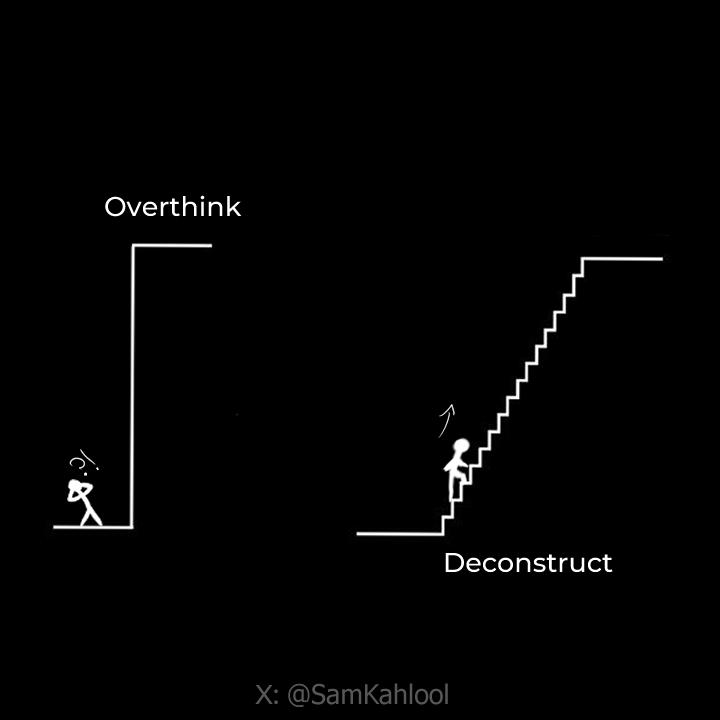
Cut up a skill, to level up faster
After writing on the nature of games as components of Life (and how to level up) To recap: the idea was that one ought to cut up a skill to make progress, you can't level up as a concept, you can only track progress on the tangible. People asked me: "How do I actually break down a skill?" So I say: "Let Me Cook" STEP 1: IDENTIFY CORE COMPONENTS Write down any skill you want to pursue. Could be writing, art, even confidence... Then break it down to sub categories. Drawing becomes: Anatomy, Light, Perspective, Gesture, Composition, Color Writing becomes: Hook, Story-telling, Compression, Articulation, Clarity If a sub category can be cut up further, do it (IF necessary) Note: Do not overcomplicate it, get a broad picture of what make you progress in a skill. STEP 2: FIND LVL 0 & LVL 100 Basically, find people who represent the extremes of a skill, this is subject to change, you simply want to get clarity, it's fine if you drop by 1 or 2 levels as you realize there was a "better" master. In Articulation: - Level 0 = "gobble gobble" - Level 100 = Jordan Peterson / J.F.K In Anatomy: - Level 0 = "can't even draw a front body" - Level 100 = Seung Eun Kim / TenTen Masters exist in every field. Find them. Study their work. STEP 3: MAP YOUR POSITION For each component, assess honestly: - What can I do that beginners can't? - What can masters do that I can't? This gap = your training roadmap. STEP 4: CREATE MEASURABLE MILESTONES Not "get better at X", "Write 21 hooks this week" "Send 140 DMs this week", "Draw 350 gestures this week" Each milestone needs: - Speed: How fast? - Quality: What does success look like? - Accuracy: Can you repeat it 8/10 times? - Reps: How many practices to get there? - Feedback: How many times will I send my work (to receive advice & critique) STEP 5: TRAIN FEW AT A TIME This is the biggest advice a friend (and anatomy monster) gave me: "Focus on a couple of aspects (that work together), and practice them for a 2-4 weeks"
1-10 of 16
@kahlool-o-3393
Artist. Writer. Systems builder.
Gamifying life is my passion
Check out my "Clarity Machine" to hack your behavior (on the link)
Active 2h ago
Joined Oct 24, 2025
INTJ
Powered by