Activity
Mon
Wed
Fri
Sun
Nov
Dec
Jan
Feb
Mar
Apr
May
Jun
Jul
Aug
Sep
Oct
What is this?
Less
More
Peptide Rebels
178
$15/m
The Iron Forge Brotherhood
63.1k
4.9
Free
Prep Coach Academy
83
$20/m
Simple Wellness Community
143
5.0
$27/m
Reta Unfiltered Inner Circle
4.1k
5.0
$37/m
🌶️ Peppin with Rachel✨
1.1k
Free
The Peptide Learning Hub
1.4k
5.0
Free
Exploring Peptides Community
23.6k
5.0
Free
1 contribution to Orion Peptides

Jul 1 •
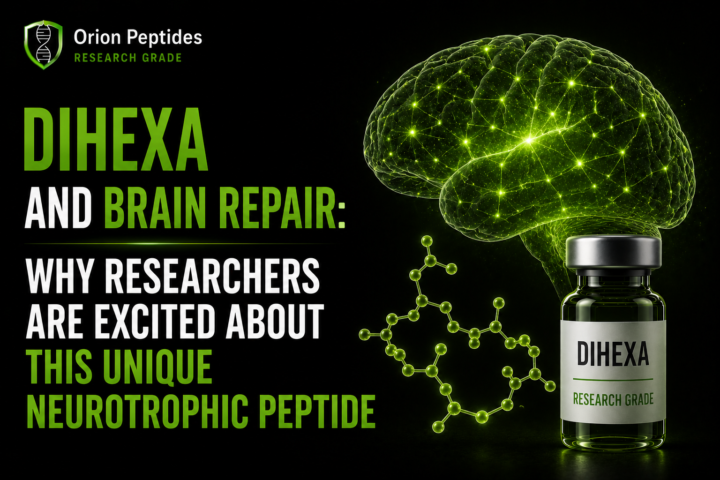
Dihexa and Brain Repair: Why Researchers Are Excited About This Unique Neurotrophic Peptide
When people think about brain recovery, they usually focus on the obvious things: rest, sleep, good nutrition, and time. While those factors are undoubtedly important, neuroscience research has shown that recovery isn't simply about waiting for the brain to heal itself. It's about whether the brain receives the right molecular signals to begin repairing damaged neural networks in the first place. This is where Dihexa has captured the attention of researchers. Unlike many compounds being investigated for cognitive health, Dihexa isn't simply studied for increasing neurotransmitters or stimulating brain activity. Instead, it appears to work much further upstream by interacting with some of the body's most important neurotrophic signaling pathways. For researchers interested in neuroplasticity, brain repair, and cognitive resilience, that makes Dihexa one of the more fascinating investigational peptides currently being explored. What Exactly Is Dihexa? Dihexa is a small synthetic peptide originally developed through research at Washington State University. Interestingly, it wasn't created from scratch. Researchers designed it from a small fragment of angiotensin IV, a naturally occurring peptide produced during the breakdown of angiotensin II, one of the body's hormones involved in blood pressure regulation. While angiotensin IV had already shown intriguing effects within the brain, researchers modified its structure to produce a compound that was considerably more stable and capable of crossing the blood brain barrier. That structural change opened the door to studying entirely new mechanisms involved in neuronal repair. Brain Repair Isn't Just About Neurons One of the biggest misconceptions about brain recovery is that damaged neurons simply regenerate on their own. In reality, successful repair depends on an enormous communication network involving specialized signaling molecules known as neurotrophic factors. These molecules don't directly rebuild neurons.

0 likes • Aug 22
I been trying to use it but can’t figure out the reconstitution
1-1 of 1

@juan-estrada-3276
Focused on growth, fitness, and continuous learning. Always looking to improve, explore new ideas, and connect with like-minded people.
Active 3h ago
Joined Aug 18, 2026