Activity
Mon
Wed
Fri
Sun
Aug
Sep
Oct
Nov
Dec
Jan
Feb
Mar
Apr
May
Jun
What is this?
Less
More
Memberships
The Atelier Hub
33 members • Free
Machine Knitting Hub
21 members • Free
zaneteknits
2.2k members • Free
Sound More French
211 members • Free
The Sound More French Café
103 members • $39/month
1 contribution to The Atelier Hub

🔥
9d •
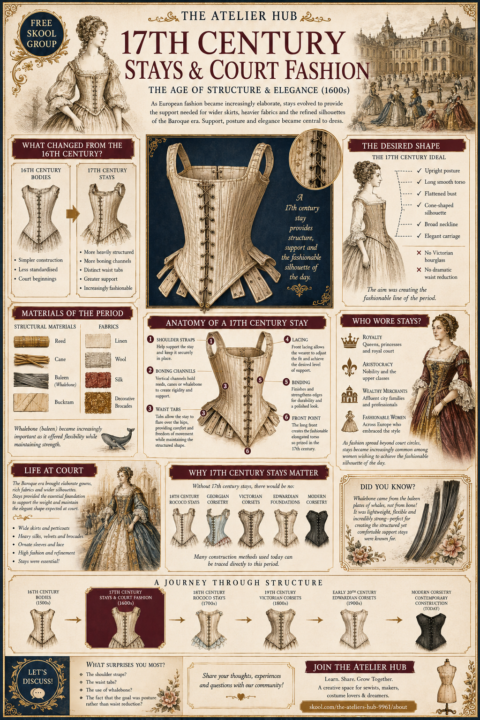
🪡 17th Century Stays, Corsets & Court Fashion 🪡
As we continue our journey through the history of corsetry, we arrive at a fascinating period where structure, elegance and craftsmanship became increasingly intertwined. By the 17th century, the earlier "pair of bodies" had evolved into what we now recognise as stays. These garments were becoming more refined, more structured and increasingly important to fashionable dress throughout Europe. One of the most common misconceptions about historical corsetry is that it was always about creating a tiny waist. In reality, the fashionable silhouette of the 1600s was very different. The goal was a long, smooth torso, upright posture and a cone-shaped silhouette that supported the elaborate gowns of the Baroque period. Rather than emphasising curves, stays helped create a controlled and elegant line beneath clothing. The construction itself was becoming increasingly sophisticated. Makers used materials such as: 🌿 Reed 🌿 Cane 🌿 Buckram 🐋 Baleen (commonly known as whalebone) 🪡 Linen 🪡 Wool 🪡 Silk and decorative brocades One particularly important development was the growing use of baleen. Despite its name, whalebone wasn't actually bone at all. It was a flexible material taken from the baleen plates of whales, offering the perfect balance between strength and movement. This made it ideal for creating the support required by increasingly elaborate garments. The 17th century also saw the widespread use of features we still associate with corsetry today: ✨ Boning channels ✨ Lacing systems ✨ Structured shaping ✨ Waist tabs for movement ✨ Reinforced construction techniques For anyone interested in historical costume, dressmaking, tailoring or couture, studying stays offers valuable insight into how garments achieve shape and support. Many techniques used in modern corsetry can trace their origins directly back to this period. As makers, it's easy to focus on the outer garment, but these hidden foundations are often where the real engineering takes place. I'd love to hear from you:

1 like • 9d
Yes, I always thought corsets were for tiny waists too... Lol 😂 You learn something new every day 🌞
1-1 of 1
@joy-green-3817
Living in France with hubby for 4 years & have 2 Jack Russell pups
I hand knit, machine knit, crochet & cross stitch. Trying to improve my French 🙂
Active 33m ago
Joined Jun 14, 2026
Prissac