Activity
Mon
Wed
Fri
Sun
Aug
Sep
Oct
Nov
Dec
Jan
Feb
Mar
Apr
May
Jun
Jul
What is this?
Less
More
Owned by Josh
Life, Mindset, Business, and AI-driven Growth by Sarah & Josh Holladay
Memberships
Skoolers
163.4k members • Free
AI Bits and Pieces
816 members • Free
AI Automation Society
427.5k members • Free
Brendan's AI Community
26.1k members • Free
AI Automation Agency Hub
329.5k members • Free
4 contributions to AI Bits and Pieces

🔥
6d •
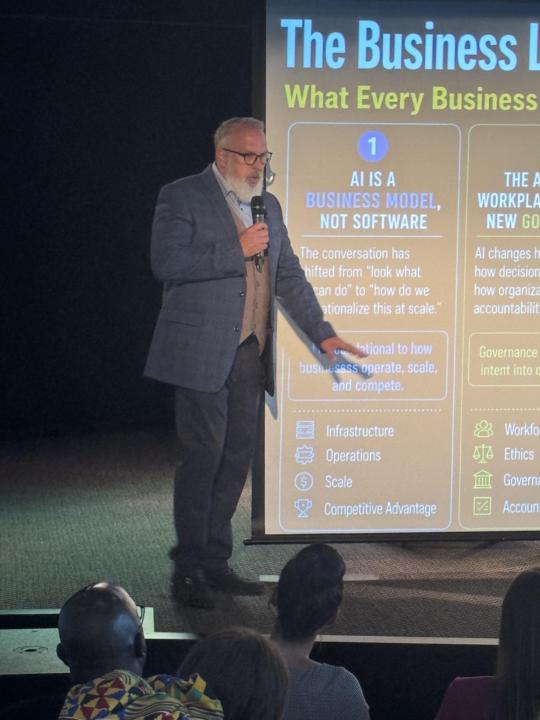
🎤 Speaking to 125 Small Businesses with NFL Great Led to an AI OS Deal
🏈 My friend @Herman Moore called me, former NFL wide receiver, Detroit Lions. "I'm speaking tomorrow to 125 small business owners. Want to join me and talk about AI?" One day's notice. I built one slide with five points. My strategy, let the room decide which ones we went deep on based on body language and reaction. No fixed script, just reading the energy and following it. Herman worked that stage right alongside me. Great public speaker, no surprise there given his career. We had an easy back-and-forth in front of the audience. 25 minutes on stage. Plain English, no hype. Here's what those 25 minutes turned into: - 12 post talk conversations - 5 leads - 2 solid appointments Results: 1. The Deal: AI OS. A 50-hour build. Not a prototype, not a pilot. A real system going into a real business. 2. The Opportunity: AI Executive Coaching. One business wants me in the room at the executive level as a fractional CAIO, not as a vendor they call when something breaks. 3. The Second Opportunity: Enterprise AI Enablement. AI opportunity mapping, then AI education for their front office professionals. Now here is the important part. I didn't walk in with just a polished pitch. I walked in with the practical AI knowledge that I get from AI Bits and Pieces, and advanced development knowledge from AIS+, and AI for Life where I learn to build complex and trending AI solutions. This is where I: try new things, explore advanced ideas, learn from other professional builder, sharpen the saw, ...and stay ready for that moment you may not expect. If it sounds like a full time plus job... it is. However, this is what enables me to walk in with one slide, a friend who trusted me enough to hand me a mic, and 125 people willing to listen for 25 minutes.

4 likes • 6d
@Michael Wacht absolutely love this post today Michael. Thank you. Inspiring. A wealthy person once said, "If you are not in the right place right now, then there must be something you don't know." Knowing comes from study. Knowing comes from knowledge. Knowing comes from understanding and seeing where things fit and don't fit. Knowing comes from experience. Knowing comes from doing. Knowing comes from seeing feedback from what you do, you know, that word RESULTS. This was a blessing for me today, your words, sitting in my email box. Thank you. And, like you said regarding being ready. Sometimes too, (regarding a message like this) we can also move forward when we feel that things are driving us in different ways. :)
🔥
May 4 •
AI Bits & Pieces is now 700 members strong!
We just crossed 700 members in AI Bits & Pieces, and I want to take a moment to say thank you. When this community started, the idea was simple: AI is becoming a life skill. For the AI Curious. For the AI Beginner. For the AI Enthusiast. For the AI Practitioner. For the business owner. For the person simply trying to keep up. For everyone. AI is becoming part of how we think, write, plan, research, learn, create, and make decisions. And for many people, the hardest part is not understanding every technical detail. The hardest part is knowing where to start. That is what AI Bits & Pieces is here for. A place to learn without feeling behind. A place to ask basic questions without judgment. A place to see real examples, practical workflows, and honest tool testing. A place where curiosity matters more than credentials. As the community grows, the goal remains the same: help people build practical AI fluency one step at a time. You don't need to learn everything by tomorrow. Just steady progress. Some members are brand new to AI. Some are using it every day. Some are building workflows, automations, content systems, or businesses. And some are simply trying to understand how this technology fits into their work and life. All of that belongs here. I also want to recognize and acknowledge everyone on the leaderboard! You are the people who continue to show up, comment, ask questions, share examples, and make this feel like a real learning community. That participation matters more than most people realize. Content helps. Tools help. But people make the community useful. So thank you for being here, whether you joined at member 7, member 70, or member 700. We are still early. And we are building AI fluency together, one bit and piece at a time.

1 like • May 4
Well deserved! @Michael Wacht
🔥
Mar 12 •
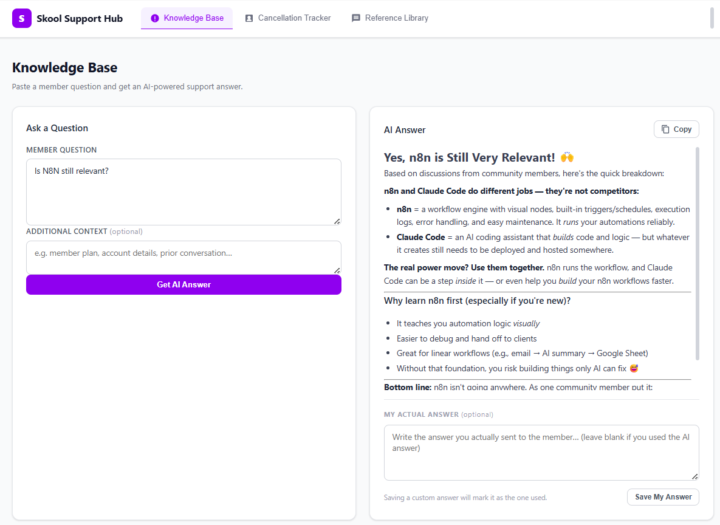
😬 I Was Nervous to Try Claude Code. I Was Wrong to Be. First App Done!
Let me be honest with you. When I first heard people talking about Claude Code — this AI tool that supposedly builds apps for you — my reaction was somewhere between curious and skeptical. Not dismissive. I follow AI closely enough to know that things are moving fast. But nervous. Because I've been burned before by tools that promised to be easy. I'm not a developer. I understand how software works — databases, logic, tables, if-then statements — but I can't write code. I'm a business owner who runs a Skool community, and my day is full enough without adding "learn to code" to the list. So I sat on Claude Code for a while. Watched others talk about it. Told myself I'd try it "when I had time." You know how that story usually ends. 🚀 What Finally Made Me Try It The tipping point was Nate Herk, founder of AIS+. I religiously watch his videos and the new series on Claude Code is fantastic. One video turned into five, five turned into an entire evening of watching a non-developer build real, working tools with nothing but plain English prompts. I couldn't stop watching. And underneath the fascination was a very specific frustration that had been quietly building for weeks. I was copy-pasting the same answers to member DM questions for the tenth time that week. I had no clean system for tracking what questions members were asking. And my templates were scattered across three different Google Docs I could never find quickly enough. Nothing was broken exactly. It was just... exhausting. And watching Nate easily build apps in Claude Code made me realize this was exactly the kind of problem software was supposed to solve. I just hadn't believed I was the kind of person who could build that software. Low code or no code apps using Lovable sure, but a real app - a bridge to far. Nate's videos changed that belief. So I decided to test it. 💡 What I Expected vs. What Actually Happened
1 like • Mar 13
@Michael Wacht , wow. Love this. Every few days I'm experieriencing these, "this can't be real" moments. It's happening. We are the ambassadors.
🔥
Mar 8 •
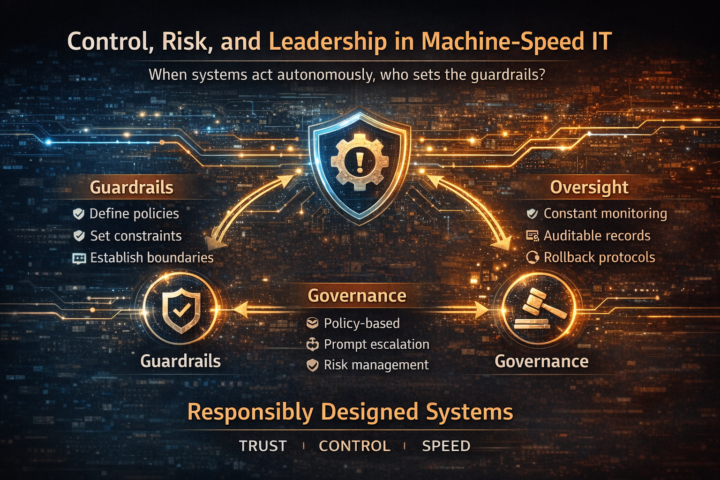
🔐 How AI will Transform Enterprise IT: Part 3 — Control, Risk, and Reluctance
The technical shift to machine-speed IT is already underway. The real challenge will not be computing power, infrastructure, or even AI capability. The challenge will be trust. As systems begin to operate autonomously — coordinating with other systems, making operational decisions, and executing tasks — organizations must answer a fundamental question: How much control are we willing to delegate to machines? 🔐 The Control Question For decades, enterprise processes have relied on human checkpoints. Approvals. Reviews. Manual overrides. Exception handling. These checkpoints exist not only for accuracy, but for accountability. Autonomous systems challenge that model. When decisions occur at machine speed, the traditional approach of reviewing every step becomes impossible. Instead, organizations must shift from transaction oversight to policy oversight. Executives will increasingly define: - What systems are allowed to do - What constraints must never be violated - What thresholds trigger human intervention In other words, leadership moves from approving actions to designing guardrails. 🔐 The New Risk Model Autonomous systems introduce a different kind of risk. Not necessarily worse risk — but faster risk. When machines coordinate decisions across infrastructure, finance, security, and operations, errors can propagate quickly if governance is poorly designed. This makes several capabilities essential: - Clear operational policies - Strong monitoring and audit trails - Immediate rollback mechanisms - Transparent system behavior Trust will not come from removing oversight. It will come from redefining oversight. 🔐 Where Leaders Will Hesitate Despite the advantages, organizations will naturally resist autonomy in several areas. Financial transactions. Regulatory compliance. Customer-facing decisions. Strategic reporting. These domains carry reputational, legal, and financial consequences. Leaders are conditioned to maintain direct involvement.
1 like • Mar 10
Apprecitate this article, @Michael Wacht . Thank you. I opened my eyes and will help me better help my client. Thank you.
1-4 of 4

@josh-holladay-7943
Founder @ FusionLoop: AI Readiness Audit, AIOS. | GET MY BOOK: oneloop.fusionloop.io | Join: https://www.skool.com/inspirations-to-grow-9615
Active 3h ago
Joined Mar 6, 2026
Oakley, Idaho
Powered by