Activity
Mon
Wed
Fri
Sun
Jun
Jul
Aug
Sep
Oct
Nov
Dec
Jan
Feb
Mar
Apr
May
What is this?
Less
More
Memberships
Clief Notes
29.1k members • Free
5 contributions to Clief Notes

👑
⭐
Mar 2 •
Who's here? Drop your intro.
Tell us three things: 1. What you do (job, industry, student, career-changer, whatever) 2. What brought you to Clief Notes 3. One thing you're trying to figure out right now related to computing or AI I'll respond to every single one. And read each other's intros too because the person who's stuck on the same problem as you might already be in this thread. I'll go first I am Jake, I have been working in tech for 15 Years, building with Generative AI for 3 Years straight now! Excited to teach and learn! That's it. Simple, scannable, gives you data on who's joining and what they need, and keeps the feed clear for content that retains people past week one.

1 like • 1h
Hey All! I'm John. My background is in corporate finance, sales ops, and commercial analytics. I discovered Clief Notes in search of a structured approach to unlocking AI's potential. My immediate interest is in gtm or rev ops as an operator and aspiring independent consultant. Nice meeting everyone and see you all out there in the community!

23h •
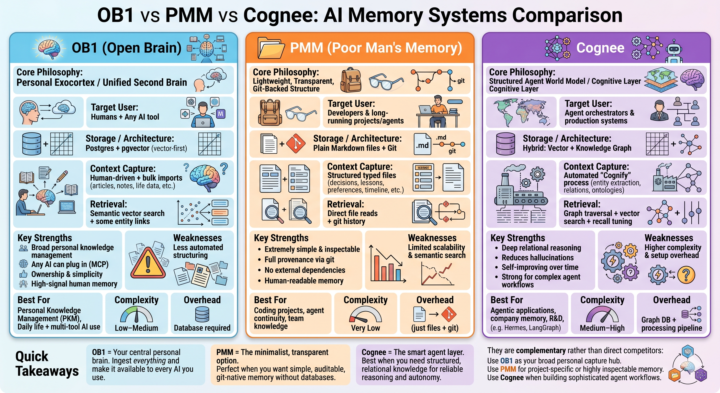
Memory management is the next frontier!
Most people are still treating LLMs like goldfish with infinite context windows. But the real power comes when you give your AI systems persistent, structured, and reliable memory. I’ve been diving deep into three distinct approaches: - Open Brain (OB1) — the personal exocortex - Poor Man’s Memory (PMM) — the ultra-lightweight, git-native path @Millenial Cat - Cognee — the structured graph + vector layer for serious agents Each represents a completely different philosophy for how we should capture, store, and retrieve context. Full breakdown dropping soon: architecture comparisons, strengths & tradeoffs, how they actually fit together in a real stack, and when I’d choose one over the others. If you’re building any kind of long-term AI workflow, personal knowledge system, or agent setup — this one’s for you.What’s your current memory strategy? Drop it below
2 likes • 21h
This is super relevant for me at the moment! As context grows in size and complexity, the durability of the underlying structure can help to increase the fidelity and minimize cost of tokens. Doubtful it’s a best practice but I have an approach that I use for claude code side projects that i’d be happy to share when get back to my desk.
1 like • 18h
Awesome post! The memory system I've been using is somewhere between PMM and OB1. It's a file system with sqlite, no vector database. There's one addition where I'm attempting to solve for the compaction issue by injecting the most recent 30 messages as an attempt to solve/mitigate context decay over multiple sessions.
👑
⭐
1d •
Shoutout to Aaron and Messages
@Aaron Quiroz been crushing it as our Community Triage Lead. Inbound across Instagram, Skool, and Discord has gotten genuinely out of hand, and Aaron stepped in and built real order out of the chaos. He's fast, he's thoughtful, and he actually reads what you send before responding. That matters Going forward, if you're trying to reach me about work, partnerships, projects, or anything that needs a real conversation, please send it to Aaron first. He has visibility into my calendar and priorities, and he'll get things routed correctly. If it needs me, I'll be there. If someone else on the team can handle it faster, even better. I'm still around and still reading. This just makes sure your message actually gets seen and answered instead of buried under hundreds of others. Thanks for rolling with the change. And seriously, thank you Aaron.
2 likes • 21h
Thanks Aaron!

Mar 15 •
Welcome to Clief Notes. Here's where to start.
1. Watch the intro video and introduce yourself in the intro post here 2. Start with The Foundation (free course). Concepts, folder architecture, prompting framework. Everything else builds on this. 3. Check in at the bottom of each lesson. Polls, discussion posts, other members working through the same stuff. Use them. 4. When you're ready to build real things, move to Implementation Playbooks (Level 2). When you're ready to build your own tools, Building Your Stack (Level 3). 5. Post your work. Ask questions. Help others when you can. What are you here to build?
Poll
4923 members have voted
2 likes • 2d
Hey All! Looking forward to learning together.
0 likes • 21h
@Amber Nova Hi Amber! I’m doing great! Thanks for asking. I’ve tinkered around a bit on my own but just getting started with some more structured communities and courses like this one. My immediate interest is in use cases for business ops like gtm or rev ops as an operator and aspiring consultant/fractional practitioner. Lately I’ve been thinking about file structures and workflows for my Claude Code workspaces when I stumbled on Clief Notes. It seems very relevant for where I’m at and excited to dig in. How are you liking the community? Has it been helpful on your journey?
26d •
12 Weeks. Real Projects. $250K in Prizes. Let's Talk.
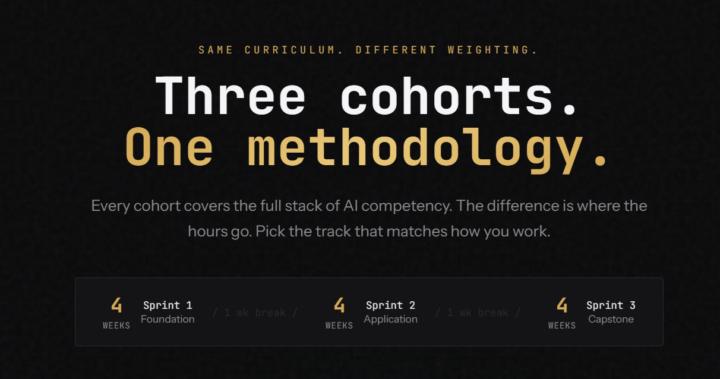
For those who missed the first post or just joined: The Lyceum is a 12-week program we're building. Live instruction from Jake and the Eduba team. Small cohorts. Real projects. You build something from week one, not watch tutorials. At the end, a competition with real prizes. Eduba's first certification, backed by the same methodology we've used to train Fortune 500 teams. Now here's what we've locked in since then. The Structure Three 4-week sprints with a 1-week break between each. Not 12 straight weeks of grind. You build, you breathe, you come back sharper. - Sprint 1: Foundation — Core methodology. Everyone starts here. - Sprint 2: Application — You're building. Real project, real progress. - Sprint 3: Capstone — Finish what you started. Demo day prep. The breaks aren't fluff. They're built in so you can catch up, refine, or just live your life without falling behind. The Cohorts Same curriculum across all three. The difference is where your hours go. Technical — Developers, engineers, technical founders. You're building a tool or production system. 30% of your time goes to Claude Code and integrations. Another 30% to production systems and capstone. This is the builder track. Business — Ops, managers, founders, consultants. You're automating a process or designing a system spec. Heavy emphasis on workflow design (30%) and decision frameworks (25%). You direct the work without writing the code. Creator — Marketers, educators, solo operators. You're building a content production system. One person replaces the team. 25% on content pipelines, 20% on workflow design. This is how you scale yourself. Pick the track that matches how you work. The methodology transfers no matter which one you choose. A 4th Cohort? We're considering adding a team cohort if there's enough interest. This would be for companies that want to enroll multiple employees, or for people in the community who want to form their own team and build together. If that sounds like you, let us know in the comments.
Poll
490 members have voted
0 likes • 2d
Sounds great! Let's gooo!!
1-5 of 5