Activity
Mon
Wed
Fri
Sun
Sep
Oct
Nov
Dec
Jan
Feb
Mar
Apr
May
Jun
Jul
What is this?
Less
More
Memberships
BUILT DIFFERENT™
637 members • Free
33 contributions to BUILT DIFFERENT™
14d •
What does cardio actually look like in your routine right now?
Let me ask you guys something directly. What does cardio actually look like in your routine right now? I get this question constantly and my honest answer is, it depends entirely on where you are and what you're trying to do. For me personally, I don't do a lot of traditional cardio. The way I train, shorter rest periods, higher reps, moving through the session with intention, my heart rate stays elevated through the whole workout. That's my cardio. It works for me. But I'm not you. If you're carrying extra weight, cardio has a role, but not mindless flat treadmill walking. You need incline. You need a real protocol paired with your diet. Walking on a flat belt for 20 minutes isn't moving the needle. If heart health is your concern, that's a different conversation entirely. Cardiovascular conditioning for longevity looks different from cardio for fat loss. Both matter. Neither is optional. And if you're trying to build muscle and you're a hard gainer, be careful. Too much cardio eats into recovery and you'll wonder why the gains aren't coming. There's no cookie cutter answer here. That's the whole point. You are built different from the next guy. What works for one man may work against another. What does cardio look like in your routine right now, and do you feel like it's actually serving your goals or just something you feel like you're supposed to do? Drop it below. 👇

0 likes • 12d
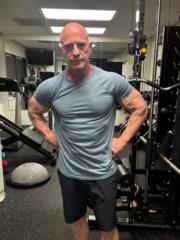
@Edward Wagner Looking great!
2 likes • 12d
At the end of some workouts (usually amounts to 3 times a week), I'll get on the treadmill for a very brisk walk, on the edge of jogging. At times, I do jog, mixing it with that brisk walk. Walk about 3-5 minutes, jog about 3-5 minutes for as long as I feel like. Usually about 20 minutes total.
20d •
I want to hear from you directly.
Not about your program. Not about your numbers. About the moment things started to shift. There's always a moment. The morning you looked in the mirror and made a decision. The session where something clicked. The week you realised you were actually consistent for the first time in years. That moment is worth sharing, because somewhere in this community right now there's a man who hasn't had his yet. And reading yours might be the thing that gets him there. This brotherhood grows when we're honest with each other. The wins, the setbacks, the turning points. What was the moment things started to change for you, and what did it feel like when you knew you were back? Drop it below. 👇
3 likes • 18d
I have these moments where something clicks, and it's always when I've gotten a little heavier than I want to be. It's always diet related because I do not miss my workouts. Something happens, it clicks, that I have to get myself on-track with my diet. You can't force this to happen, something just takes over in your head and you just go for it, and the weight drops off. I know what to do--it's happened often over the years. My last "click" moment was just about 3 months ago. Jeans tighter, smoother looking, just generally uncomfortable. I made my adjustments and dropped about 10 pounds. Huge difference. I stray, realize it, and make the necessary changes to see what I want to see iin the mirror, and feel the way I want to feel.
2 likes • 12d
@Rick Love Love this--I find that when you start seeing results, it really gets you even more motivated.
24d •
They're chasing what they used to be
Most men over 40 are training with the wrong goal in mind. They're chasing what they used to be. The weight they used to lift. The physique they had at 30. And they're burning themselves out trying to get back there instead of building toward something better. Here's what I know after 45 years. The men who make the best progress at this stage aren't looking backwards. They've redefined what winning looks like. Stronger than last month. Moving better than last year. Building a body that works at 60, 70, and beyond, not just one that looked good in their 30s. That's not lowering the standard. That's raising it. What does winning look like for YOU at this stage of life, not compared to who you were, but who you're becoming? Drop it below. 👇
5 likes • 22d
I have to admit, that I do look back at photos of myself when I competed and recall those days with a smile. I'm glad I competed--not many of us do. As I train now, lighter, I'm really not that far off from those photos for my age. I'll be 75 in September and am happy to maintain what I have, and adjust my diet to look cut and hard. My doctor tells me at every checkup, "keep doing what ever you're doing." I'll keep training so I can continue to do most everything as I am now--travel and many hobbies. It's Sunday morning at 6:20, and the gym opens at 7. Gotta go!
1 like • 20d
@Bill Quistorf Thanks, Bill. But even with those years and experiences, I still question so much of this--Am I training too much? Am I not training enough? There are so many different ideas and opinions, I still get confused and doubt that I'm dong the right thing. At this point, I just try to get a good pump and put in honest work, and a safe diet. I don't think I will ever have all the answers.
26d •
Legs.
I want to talk about something most men in this community skip. Legs. And I get it. You can't see your legs in the mirror the same way you see your chest or your arms. Nobody's impressed by your squat at 50 the way they were at 25. And if you've got bad knees or a history of lower back issues, the idea of leg day can feel more like punishment than training. But here's what I've learned, the men who neglect legs are leaving serious results on the table. Not just in how they look. In how they function. How they move. How they feel at 60, 70, and beyond. Your legs are the foundation of everything. Longevity, stability, energy, metabolism, it all connects back to having strong legs that work properly. A man who can't carry himself well as he gets older loses independence before he loses anything else. Now I'm not talking about loading up a barbell and squatting heavy until your knees give out. That's not what this community is about. I'm talking about controlled, intentional leg training that builds real functional strength without destroying your joints. Bulgarian split squats. Leg press with a full range of motion and controlled tempo. Romanian deadlifts at a weight you can actually feel. High reps, full control, no ego. Your legs deserve the same discipline you bring to every other session. What does your leg training look like right now, and is it something you prioritise or something you find yourself skipping? Drop it below. 👇
4 likes • 25d
Leg presses on the "sled", leg extensions, leg curls and calf work. This is in my regular rotation which covers my whole body. "Leg day" is about 34-38 sets overall on 4 days rest. You HAVE to do legs!
28d •
Heavy as possible
Let me talk to you guys about something I call walking the rack. Most men in the gym have one setting, heavy as possible. They walk up to the dumbbells, grab the biggest pair they think they can handle, and fight their way through it. Grinding. Squirming. Using everything but the muscle they're actually supposed to be training. That's not progressive overload. That's ego. Walking the rack is different. You start lighter than you think you need to. You get the blood flowing, you get the mind-muscle connection firing, you get locked in. Then, and only if you can still hit 12 to 16 clean reps with full control, you move up. You're not chasing a number. You're chasing the feeling. The pump. The connection. That zone where your brain and the muscle you're training are completely dialled in to each other. Some days I stay light the whole session because that's what my body needs. Other days I walk up the rack and find a weight that really challenges me within that rep range. Both are right. What's never right is grabbing a weight so heavy you can't feel the muscle working. I could do 50s or 60s on a shoulder press. I choose not to. Not because I can't, because it doesn't serve what I'm actually trying to build. That's the difference between training with ego and training with intelligence. Do you walk the rack, or do you go straight to the heaviest weight you can handle? Drop it below. 👇
2 likes • 26d
I've always walked the rack. If I get the 12-14 reps, I move up just a bit and see if I can get the 14 reps again. We used to say "We're getting stronger 2.5 pounds at a time." When I get to failure in a 12 rep set, that's my heaviest set. I usually do 6 sets for an exercise, first set is a warm up, then good 4 working sets, then the last set is a just a bit lighter than my heaviest weight to get the 14 reps again. A problem in my gym is that they do not have the half number range of dumbbells (22.5, 27.5, 32.5 etc.), so doing a smaller muscle like biceps or delts, it sometimes not feasible to increase a full 5 lbs. I requested these dumbbells, but they have not appeared yet. I find this to be very limiting, and almost worth changing gyms. In this case, I sometimes move to the cables where I can hang a 2.5 pound plate on the pin to get the weight I need. You do what you have to, improvise at times, to make gains.
1-10 of 33
@john-cianti-3765
Retired professional, lifting all-natural, always for over 47 years. Competed all-natural for 9 of those years.
Active 2d ago
Joined Jan 12, 2026
Long Island, NY
Powered by