Activity
Mon
Wed
Fri
Sun
Jul
Aug
Sep
Oct
Nov
Dec
Jan
Feb
Mar
Apr
May
What is this?
Less
More
Memberships
College Soccer Recruiting Hub
85 members • $39/month
Steve Coxon Soccer Network
322 members • Free
35 contributions to Steve Coxon Soccer Network

Feb 10 •
Tuesday Q&A: Fire Away, We’re Here to Help!
Got questions? Post them here, and Steve or one of our team members who’ve been through the process will get you a straight answer. Remember, there are no dumb questions on this complicated journey—so don’t hesitate, fire away!

0 likes • Feb 10
We've gone to an ID camp, and while I think we showed well it's a slow burn on the relationship development. New camps (same school) are now being posted for the spring and summer, but I don't want to waste time or money going if we have no chance. What is the best way to ask a coach if you are on their radar and what chance you have at remaining spots? (I'm not so bold as to ask if we are being recruited, but knowing if there is still an opportunity to make an impact would be nice)
Feb 9 •
“Monday Morning Video Review”
Folks, It's that time of week again. Every Monday, I’ll be reviewing your most recent highlight videos! This is a valuable opportunity to ensure all your hard work translates into a polished, high-quality video that stands out. Here’s why these reviews are so important: 1. Understand what coaches are looking for: I’ll break down exactly what catches their attention and what makes a video effective. 2. Learn and grow: Both parents and players can follow along to gain insights and improve their approach. 3. Make a strong first impression: Your video is often the first thing a coach sees—let’s make sure it leaves a lasting impact. What to do next: - Post your video link - I’ll review each submission and provide quick, actionable feedback to help you improve! 💪⚽ Just an FYI I'm still in Orlando so the reviews might spill into Tuesday. Thanks for being patient! Steve

0 likes • Feb 9
@Stephen Coxon How do you feel about "every touch" and full length game videos ? Specifically as a tool to bridge the gap for coaches that wouldn't otherwise come to see your athlete? (I know it's not Question Tuesday, but this more aligns with the Monday theme :) )
Feb 4 •
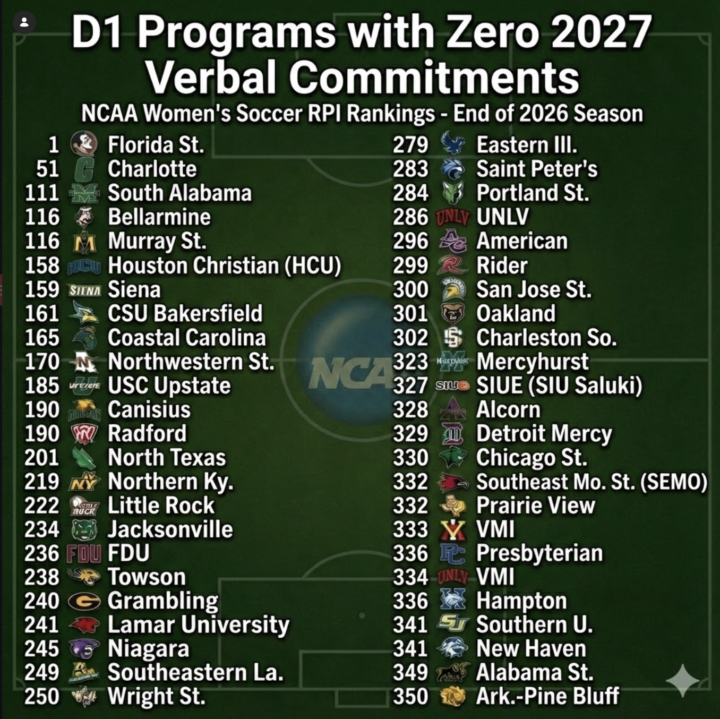
Northeast schools still with ZERO public verbal commitments for 2027!
Plenty of Northeast schools still with ZERO public verbal commitments for 2027: Siena Canisius St. Peter's Rider Merrimack FDU Niagara St. Bonaventure Mercyhurst #CollegeSoccer #ClassOf2027 It’s important to take a closer look at these schools and ask yourself some critical questions before making any decisions: - Why don’t they have commitments yet? - Could their lower rankings reflect challenges in recruiting? - Do they have a unique recruiting style, like Siena and FDU, who take a slower approach? - Are they navigating changes, such as a new coach, like St. Bonaventure? Don’t blindly sign up for ID clinics or rush into commitments just because a school catches your interest. Take the time to research, ask the right questions, and ensure the program aligns with your goals—both on and off the field. Thoughts? What questions do you ask before considering a program?
1 like • Feb 5
@Diego M Lopez Good questions. My (extremely) personal experience, Binghamton and Stony Brook filled their 2027 roster within about a month of the June open. Admittedly there is one spot left for each team, but I was under the impression those were being held for transfer portal evaluations. Now the question is, are those colleges "mid-major". I have no experience with previous years, but if I was to believe the twitter feeds, this class is filling up faster than previous years. There might be some outliers, this list, but most are still filling up quickly. I'd be curious to see how that number of schools compares to last years at this time. Similarly, if there is a trend specific to these schools or if this year is different.
Feb 4 •
Missed Tuesday Question
It seems I'm a day late on all the things this week, but here goes anyways. Regarding emails to coaches. I'd like to say we all know that emails should be coming from the athlete, and that parent intervention is a red flag, but how does AI play into the mix ? Just this morning I was typing an email (gmail), and there was a button at the bottom that was offering to re-write it for me. Is the smart athlete using AI, or is it just as bad as having a parent ghost write? Or a different way to ask it, if an athlete continues to be authentic, are they going to be at a disadvantage because they aren't using AI to groom/author/edit?
Feb 3 •
Tuesday Q&A: Fire Away, We’re Here to Help!
Got questions? Post them here, and Steve or one of our team members who’ve been through the process will get you a straight answer. Remember, there are no dumb questions on this complicated journey—so don’t hesitate, fire away!
0 likes • Feb 3
@Stephen Coxon I think we are getting some semi-personnal progress with those same schools, just wondering if it's worth the effort for the two-day commuter camps considering how competitive they are.
0 likes • Feb 3
Other than the biggest ECNL/RL/GA tournaments, are there key recruiting showcases that teams should be aiming for ?
1-10 of 35
@jason-wheaton-5070
Just another soccer dad trying to do the best for their kid.
Online now
Joined Oct 16, 2025