Activity
Mon
Wed
Fri
Sun
Oct
Nov
Dec
Jan
Feb
Mar
Apr
May
Jun
Jul
Aug
Sep
What is this?
Less
More
Owned by Jason
Everyone is an athlete, though the “sports” may look different. Training the body so you’re ready for LIFE is key to staying in the game!
Total Goalkeeping
7.9k members • Free
Sports Brand Builders
112 members • Free
AI Accelerator
20.2k members • Free
SW Automation
8.9k members • Free
Chase AI Community
77.9k members • Free
Skoolers
159.8k members • Free
24 contributions to Total Goalkeeping

May 22 •
Heartbroken
So this week at school, my 10 year old son Elliot was just minding his own business doing keepy uppys when another boy in the playground decided to slide tackled him, the outcome of that tackle a double fracture which requires surgery, and plates / screws fitting to help him heal right I am absolutely heartbroken for him as football is his life, he loves being a goalkeeper and playing football Im going to assume a long road to recovery for him due to the severity of the break I want to try and cheer him up a bit as he is very scared nervous, but I dont know hows the best way to approach it Thanks Jamie

12 likes • May 22
Oh that is most unfortunate, and I’m sorry he must experience this. As for the surgery and talk of plates and screws it’s really not as scary as it sounds. Think of the hardware as an “inside cast” that’s necessary to hold the bones where they need to be so they can heal in the best position which will allow him to get back to soccer. The recovery process is slowed mainly because the bones simply need time to heal and become structurally sound enough to handle the loads needed to work on getting back to normal. Unforseens are possible of course, but perhaps the most important ingredient is believing his body is strong and resilient, and that it is entirely possible to return to normal. There will be PLENTY he can do to work the rest of the body and the mind during the recovery process while he’s working to bring the affected area back to speed. Best of luck, and don’t hesitate to ask questions and reach out!💪
11 likes • May 22
@Jamie Bryan he’s got this!
May 17 •
Advice needed
What do you do when you talk or call for the ball but your defense doesn't listen? Even when setting up a wall the field players struggle to listen to him telling them to move. He is doing well communicating and even the parents say the team doesn't listen and they need too. They have been playing together for about 4 month.
7 likes • May 20
One question I have is what age/grade level are we discussing? In any case my best guess is not that the other players are simply ignoring your keeper, but rather that their attention is inextricably locked elsewhere and prevents them from receiving the information. The technical term for the phenomenon is called Inattentional Blindness, and you see it all the time in matches - particularly at the younger ages. The "obvious" pass or shot that isn't made, the "easy" tap in which gets muffed or even ignored completely. In the house it's probably most obvious when you're trying to get the attention of your kid who is engrossed in their video game (or perhaps a book) and the entire place could be burning down or being robbed yet the little bugger wouldn't budge at all despite their name being screamed! LOL Many players have a difficult time simply moving their bodies in space due to deficiencies in strength, coordination, or both...and there isn't even a ball or soccer skill involved. Now factor in shouting from the sidelines (both positive and negative), opponents on the field, perhaps some worry about making a mistake, and don't forget the ball! The pleas of the keeper, who is usually behind all this action looking at the backs of their teammates, adds even MORE to the mix. With all this information flying about those same pleas are easily be overrun by the more "pressing" demands on attention. The solution is to make everyone involved aware of these demands, the chaos it causes with mental processing, and the need to actually slow down a bit. Here is a video which provides a bit of a glimpse into the phenomenon! https://youtu.be/vJG698U2Mvo?si=7PFbjg29RcGBHc8Q
May 16 •
When has an exercise served its purpose?
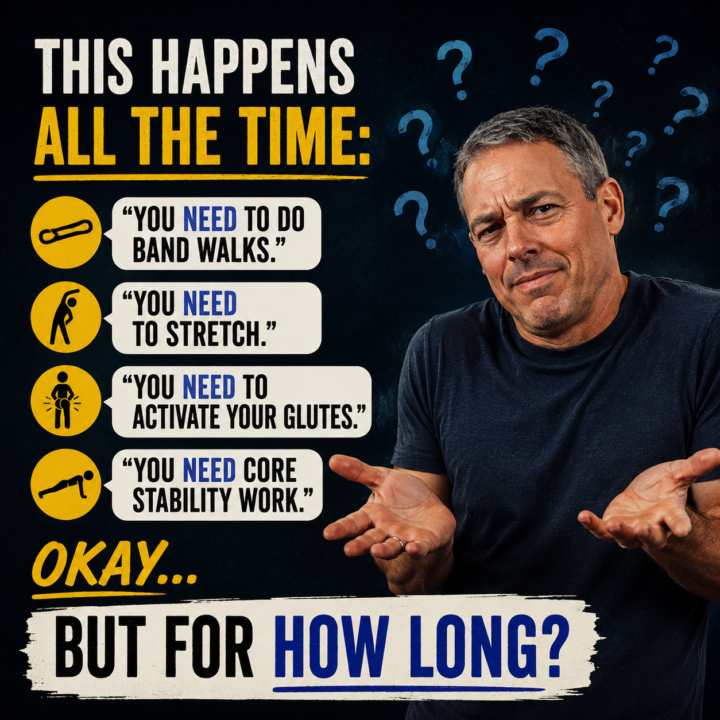
Some food for thought this weekend: OK. So you were having an issue… You did some mobility work. You strengthened a few things. The issue improved. Now what? Do you NEED to keep doing all those exercises forever? That’s a question most people never ask. Even more importantly: WHY are you doing the exercise in the first place? Take something like the Dead Bug exercise. Is the goal to endlessly perform 3 sets of 10 forever? Or is the goal to develop a specific ability: ✔ Coordination ✔ Trunk control ✔ Position awareness ✔ The ability to move effectively without unnecessary compensation Because those are VERY different things. The truth is: There are exercises that are useful for addressing specific limitations, deficits, or challenges… …and then there are fundamental MOVEMENTS that should be practiced regularly because they’re part of everyday life. Knowing the difference changes everything. Otherwise people end up with a giant laundry list of exercises they’ve been told they “need” to do forever: Band walks. Clamshells. Stretching routines. Activation drills. Correctives. At some point you have to ask: “Is this still serving a purpose?” Think about it like math class. Once you master: 2 + 2 = 4 …you don’t spend the rest of your life repeating that same equation hundreds of times every day. You move on to more complex and meaningful applications of the concept. Movement works much the same way. There are exercises you should be ABLE to do competently. But once the ability is there? Doing MORE of the exact same thing often produces very little additional benefit. The goal shouldn’t be to collect more exercises. The goal should be: ✔ Build capability ✔ Improve movement options ✔ Develop confidence ✔ Maintain essential movement patterns ✔ Spend LESS time needing “corrective” work Personally? There are PLENTY of things I’d rather be doing than spending unnecessary hours in a gym or my basement doing endless exercise lists. Master the essentials. Train what actually matters.
4 likes • May 16
@Xavier Stark indeed, though the question becomes are you getting simply better at the exercise itself OR is the progression of the exercise helping you get better at the sport or activity you are wanting to improve at? I believe this makes a good subject for another post!
Apr 28 •
Key Goalkeeper Movements to Boost Performance
Here is a video I made showing two movements/exercises that need to be ON POINT for goalkeepers to be effective in the position, and they are the hinge and the plank (which would also include the push up). Many athletes I work with have significant difficulty with what I refer to as "foundational movement patterns" and this contributes to restrictions in their overall performance as well as the development of pain conditions/injury. The solution is typically quite simple once you uncover the key factors causing the movement restrictions. Have a look and let me know what you think in the comments including ideas for future videos to help. If there's enough interest I can look at putting together an online class to teach some basic workout progressions folks can put to use! Just let me know! https://youtu.be/Wp9joi0kLnw
5 likes • Apr 28
@Xavier Stark the key is to focus on how the movements and positions FEEL rather than chasing times and numbers if that makes sense.
4 likes • Apr 28
@Xavier Stark awesome. Let me know how it goes!

Apr 17 •
Scaphoid Fracture Recovery
Hey guys, unfortunately I fractured my scaphoid bone and I’m scheduled for surgery where they’ll take a small piece of bone from my elbow to help fix my wrist. Honestly, I’m mainly wondering how long recovery usually takes and when it’s realistically possible to get back in goal. If anyone has been through something similar, I’d really appreciate any advice or experience. Thanks.
5 likes • Apr 17
I wouldn’t plan on any significant keeper training involving that wrist for a good 8-10 weeks post op. To get back to “normal”…perhaps closer to 16. Your surgeon (and your body) will have more information as recovery progresses. Best of luck.
1-10 of 24

@jason-goumas-3925
Physical therapist and strength/conditioning professional dedicated to helping people unlock their physical and mental potential!
Active 9h ago
Joined Feb 25, 2026
New London, NH
Powered by