Activity
Mon
Wed
Fri
Sun
Nov
Dec
Jan
Feb
Mar
Apr
May
Jun
Jul
Aug
Sep
What is this?
Less
More
77 contributions to 3X Freedom

Oct '25 •
This Framework Turns Your To-Do List Into a Strategic Plan
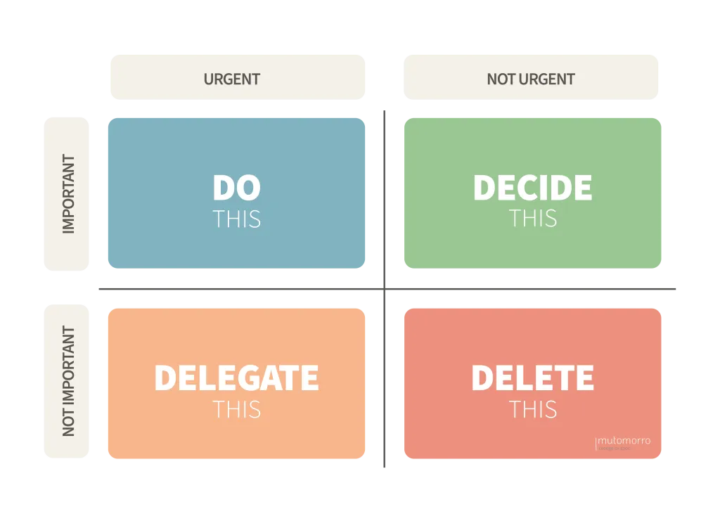
Feeling overwhelmed by a never-ending task list? Meet the Eisenhower Matrix aka the method that separates the noise from what actually moves the needle. When you’re managing client work, testing new tools, and trying to grow your business, it’s easy to feel like everything needs your attention at once. But the truth is, not everything matters equally. This approach helps you sort through the chaos whether you’re a solo freelancer or running a lean team so you know exactly where your time should go. What is the Eisenhower Matrix? It’s a simple tool that helps you sort tasks based on two things: urgency and importance. That way, you’re not just reacting, you’re making space for what actually matters. The matrix has 4 quadrants: Quadrant 1: Urgent + Important (DO) These are fires that can’t be ignored. Examples: A campaign deadline today, broken client system, payment issues holding up a project. Action: Handle it now. Quadrant 2: Not Urgent + Important (PLAN) This is where the real growth happens. It doesn’t feel urgent, but it’s what sets your business up for the long haul. Examples: Updating onboarding workflows, improving delivery systems, building that long-overdue client dashboard. Action: Block time for it and commit. Quadrant 3: Urgent + Not Important (DELEGATE) Looks urgent. Isn’t valuable. Someone else can handle it. Examples: Meeting requests that don’t require you, tool setup that someone else can handle, quick questions better answered by a bot. Action: Assign it, automate it, or create a system around it. Quadrant 4: Not Urgent + Not Important (DELETE) These are the little distractions that eat up hours. Examples: Refreshing analytics five times a day, endlessly tweaking branding, aimlessly clicking through tools for “research.” Action: Let it go. Seriously. Want to use this in ClickUp? Here’s a fast setup that keeps you focused: 1. Create a List for your weekly priorities (call it something like “Weekly Focus” or “Task Triage”). 2. Add a custom dropdown field with four options: Do First, Schedule, Delegate, Eliminate. 3. As you add tasks, assign the right category. 4. Create views filtered by each label so you can jump into the right mindset fast. 5. Bonus: Set a weekly reminder to review and reassign every Friday.
1 like • Nov '25
@Ali Raza It definitely works well, and is simple. It just depends on if you can adapt this framework to how you actually think and work.
0 likes • Jan 9
@Kasim Aslam 🙏
Dec '25 •
The Real Reason Your KPIs Never Improve
Metrics do not move because you track them. They move because someone owns them. Entrepreneurs and agencies grow faster when every key number belongs to one person with clear authority. Tracking alone gives you charts, not progress. Many teams review dashboards each week, yet the numbers stay flat. The problem is simple. When everyone watches a metric, no one drives it. You see this in daily operations. Lead flow drops, but no one commits to fixing the gap. Conversion rates stall, but no one directs experiments. Delivery slows, but no one controls the steps that create delays. Reports keep coming, outcomes do not. Ownership changes this. One person accepts responsibility for the metric and takes direct action. They define the target. They decide the steps. They remove blockers fast. They work across sales, delivery, or marketing to keep momentum. They report progress in simple, clear updates. Strong owners do not wait for meetings. They adjust outreach, refine offers, tune follow-up speed, or tighten delivery processes. Each action links to the metric they protect. You get shorter cycles and clearer decisions because one person drives the number forward. When every key metric has an owner, your business gains speed. You see: • Higher revenue because someone owns lead quality and follow-up. • Better margins because someone owns delivery steps. • Stronger retention because someone owns client success. • Faster operations because someone owns process flow. The structure is simple to set up. List your highest impact metrics. Assign one owner to each number. Give them control over the actions tied to that metric. Set targets with clear deadlines. Review progress on a steady rhythm. A quick test exposes the gaps. Pick a metric and ask who owns it. If answers differ, the metric has no owner and progress will slow. Assign one person and give them authority to act. Your numbers rise when someone defends them each day.

0 likes • Dec '25
@Ramin Tajallipour 🙏
0 likes • Jan 9
@Grant Charge Thanks man!
Sep '25 •
Why I Pay People to Do Things I Could Do Myself (And Why You Should Too)
I've built multiple 7-figure businesses over the years, but one of my most valuable skills isn't what you might expect. It's not marketing genius, tech savvy, or even industry expertise. It's knowing when NOT to do something myself. Throughout my 30-year entrepreneurial journey, I've hired hundreds of people—from high-level professionals to personal chefs, housekeepers, and landscapers. My rule? I outsource without hesitation if their rate is lower than my "effective hourly rate" (EHR). Let me put this in perspective: If you're earning $75/hour and debating whether to spend $45 on someone taking care of your landscaping (a 2-hour task), you're essentially choosing between: A) Doing it yourself = Costing $150 of your productive time B) Outsourcing = Spending $45 That's a $105 LOSS when you choose to do it yourself. And yet, I watch smart, successful people make this mistake constantly. Why? Three possibilities: 1. You're greedy (sorry, but it's true) 2. You're overly frugal to the point of self-sabotage 3. You fundamentally misunderstand leverage This isn't just about lawn care. This principle applies to EVERYTHING in your business. That social media content you're creating? Those customer service emails you're answering? The website updates you're tinkering with? Calculate your EHR. Be honest. Then ruthlessly eliminate everything from your schedule that falls below that threshold. As James Schramko brilliantly explains in "Work Less, Make More," understanding your EHR is the cornerstone of working smarter. (If you haven't read it, stop what you're doing and order it now.) Another game-changer is "Who Not How" by Benjamin Hardy. The premise is simple but profound: When you have a goal, don't ask "how do I accomplish this?" Instead ask, "WHO can help me accomplish this?" Most entrepreneurs know HOW to do many things. That's not the problem. The problem is thinking we SHOULD do them. Every time you perform a task someone else could do for less than your EHR, you're choosing to make less money. You're actively deciding to be less successful.

1 like • Sep '25
@Axl Gonzalez You're welcome. Now, what are you going to outsource or delegate?
1 like • Jan 9
@Elizabeth DeMoulin You're welcome! It's definitely a mindset shift, but you can do it!
Nov '25 •
If Your Revenue Feels Random, This Is Why
Most entrepreneurs don’t stall because their talent runs out. They stall because their blind spots take the wheel. And blind spots don’t disappear when you hustle harder. They don’t vanish with new tools, better funnels, or a cleaner productivity stack. They only dissolve when you change the way you think. Across this entire landscape, the patterns are identical. Bootstrapped or funded, B2B or DTC, digital or brick-and-mortar. The symptoms differ, but the underlying constraint is almost always the same. Revenue spikes, then drops, and you can’t tie it to anything meaningful. Your offer feels airtight internally but meets resistance in the market. Your workload becomes reactive instead of predictable. Most founders interpret these as execution failures. They assume they need more tactics, more skill, more efficiency. But the real constraint sits upstream. It lives in the decisions that rarely get interrogated. Skill solves tasks. Strategy solves plateaus. One pattern shows up more consistently than anything else: pricing without a strategic anchor. Entrepreneurs default to what feels safe. They price from emotion instead of value. That single blind spot pulls them into low-margin clients, cash flow volatility, and engagements that cost more energy than they return. Another pattern: optimizing the wrong variable. Entrepreneurs keep adding tools, learning new platforms, or experimenting with more offers. Novelty feels like progress. But novelty does not create momentum. Leverage does. The most expensive pattern of all: vague offers. When your offer is unclear, you rebuild scope, pricing, and delivery every time you land a customer. Nothing compounds. Every sale becomes a custom project. Custom guarantees inconsistency. These are not skill gaps. They are thinking gaps. Momentum comes from identifying the structural constraint, not trying harder inside the constraint. But most entrepreneurs never shift out of that mindset. They double down on effort because effort feels familiar.

1 like • Dec '25
@Donna Dhoostelaere Wow, I'm flattered! Keep on rocking!
0 likes • Dec '25
@Darcy Umpierrez You'll need to engage in the community before you can gain access to most of the frameworks. Once you do gain access, the frameworks are pretty detailed.
Nov '25 •
The Smartest Partnership Strategy You’re Probably Overlooking
Most coaches and consultants spend too much time trying to find new clients. The smarter move is to partner with people who already have them. Here’s how it works. You reach out to another service provider who serves your same audience — a marketer, accountant, systems expert, or agency owner. Then you say: “I’ll give you one of my ready-to-go frameworks, templates, or systems for free — something that saves you time or adds value to your own business. You can also gift that same framework to one of your clients as a bonus from you. If they want to go deeper, you’ll earn 20% of whatever work comes from it.” You’re not doing custom work. You’re giving away something you’ve already built, a productized system, workshop, or process that takes minutes to deliver but feels valuable. The beauty of it: - Your partner looks like a hero to their client. - Their client gets value without risk. - You get warm introductions built on trust, not cold pitches. No ads. No funnels. No awkward discovery calls. Just genuine collaboration that grows your business quietly in the background. If you offered one of your frameworks or systems this way, who would you start with?

1 like • Nov '25
@Jason Szakel Wow, what a compliment! Thank you for reading and sharing your thoughts. You're welcome!
1 like • Nov '25
@Ali Raza My pleasure
1-10 of 77

@jamie-miralles-4794
Helping Solopreneurs & Agencies Build Durable, Self-Scaling & Profitable Businesses | 28+ Years of E-Commerce Experience | Click on Website Link Below
Active 7d ago
Joined Sep 10, 2025
INTJ
Scottsdale, Arizona
Powered by