Activity
Mon
Wed
Fri
Sun
Jul
Aug
Sep
Oct
Nov
Dec
Jan
Feb
Mar
Apr
May
What is this?
Less
More
Memberships
The Subconscious Estate ™️
27 members • $188/m
⚜️The Financial Way ⚜️
53 members • $88/m
Power of Equity & Discharging
304 members • Free
39 contributions to The Subconscious Estate ™️

Apr 3 •
📢 Reclaim Your Estate Banquet/Reunion – Travel Poll & Headcount
We need to secure accommodations and need an accurate headcount for the trip. 🗳️ Step 1: Vote in the Poll Below ➡️ Which dates will your party be traveling? * September 10–13 * September 11–13 📝 Step 2: Comment Your Headcount After voting, please comment with: ➡️ The total number of people traveling in your party ⚠️ Guidelines (Please Read Carefully): * Only those attending should respond * One response per household/group * If multiple families are in this chat, select one spokesperson * Keep comments clear and minimal (no extra messages, can't wait, or side conversations) * The above will helps us keep the thread clean and easy to track ⏰ Deadline: Please submit your vote + comment before class on Thursday, April 9, 2026 so we can review totals and secure the Airbnb.... plus work to implement a payment schedule. Thank you for your cooperation!
Poll
20 members have voted

8 likes • Apr 3
+1. Jenn and I.
3 likes • Apr 3
At hotel

Dec '25 •
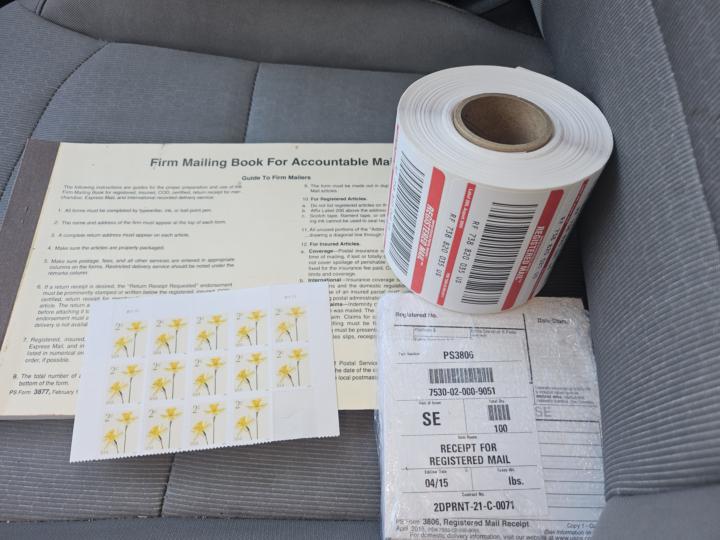
Pulled teeth for the firm book and registered mail stickers 🤓
Had some fun at the post office yesterday! Apparently the final mail boss lives there and wanted to fight me about all my requests.. lol In my podunk Oklahoma town closest to the house (interestingly called Noble 👁), I was able to acquire the firm book, registered mail stickers, and some 2 cent stamps. When I requested first item (firm book), a little old lady heard me and ran upfront from the back...🏃🏻♀️ She told me that they were obsolete, antiquated, and nothing I needed to bother with. She told me I was just fine printing out the 3877 sheets off the website. I told her I was tired of printing them from online (I never have.. lol).. that the firm book is still discussed on the website and "antiquated" was fine as I have an old-fashioned, picky client who insists on it. 😆 I could hear her going back and forth with a man in the back knocking things over. He came out with a confused frown hugging the firm book (this man is who I call the "final boss" he came out super pumped up and a bit aggressive 😆). He asked me "aren't you a bit young to know about these? I haven't had a request for one in decades. You'd be happier printing the sheets".. I told him the 1964 Civil Rights Act protects from age discrimination and I'd just like the book. He reluctantly handed it to me finally, and apologized it was the 1994 version. 🤣 I then asked him for a roll of the red registered mail stickers and he immediately told me order it online. I informed him they did not have the ones with the bar codes online and asked if he had it in-house or could he order it for me. His forehead was sweaty and he got close to the counter and whispered that I didn't need those since they were only routinely for items at least $10k in value. I whispered back that wasn't true but good thing that six-figure values and up were very normal for my client, and I was most interested in the chain of custody function. He rushed off to the back grumbling to himself and seemed to argue with the little old lady again behind the cubicle wall.. lol
2 likes • Dec '25
Haha this the best story I’ve read in a while. Thank you for the entertainment Angel!!! “Sweaty Forehead”

Dec '25 •
No Hiccups...
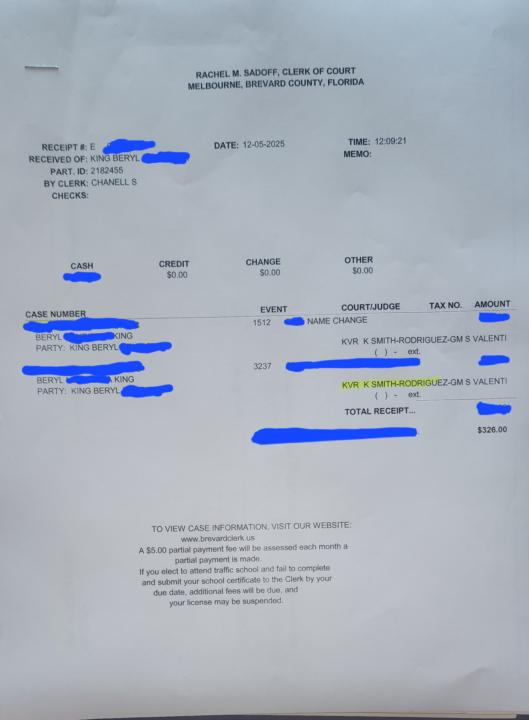
All my life, anytime things don't go as planned, it's a block to me. It's frustrating, irrtitating and discouraging and it brings me to a full on stop a needed one but I don't give up I put my focus, somewhere else for a bit, then revisit. It took for Minister Melshonda Buchanon to call me that put me on track truth be told she was asking for help and ended up helping me. Real community action here! I was supposed to make it to the courthouse yesterday but ended getting off later than expected and did not want to deal with the traffic or get a ticket for speeding so since I knew I was off today I planned to go this morning. The call last night had me rechecking my paperwork and, revealed a, couple of errors I was able to correct. (There is always a reason) To me things need to fall like domino's so first Montriniki Williams reached out, Minister Melshonda Buchanon and this, Morning Kween Ryisha Bullock all encouraging and prayerful! This again is real community... I love you ladies! 💜💜💜 Today, I walked in the courthouse with FULL CONFIDENCE, I had no defenses, no vangard energy. I had made it a point that everytime I went into the courthouse to talk to this one particular lady... and guess what? She was the one who waited on me in fact when she saw me she called me up and told me to sit right across from her (I had a number but she had me cut the line) I'm not going to lie, this felt good almost like a celebrity... I think I almost was starting to do a Nikki B move but I held back. lol. The lady took ALL my paperwork: Petition for Name Change, Name Petition, and Deed Poll, she filed every bit of it, she also told me it was not a requirement to put it in the paper. (I will anyway) I was in and out so fast and as soon as I got outside yes, I bust the Nikki B move! 😁 Sorry about all the redacting I have to protect my information. I 💜 it when the stacked domino's fall in line. #Finally
3 likes • Dec '25
Ms. King!!! Yea yaaaaa!

Dec '25 •
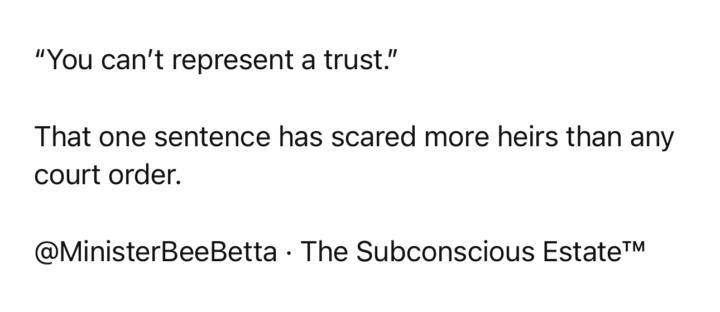
🔥🔥🔥Why would someone say this , Cause you can't represent a trust...
1. In court, you can only represent yourself pro se In the U.S., the general rule is: - A natural person can speak for themselves in court (pro se). - Separate legal entities (corporations, LLCs, and often trusts) must be represented by a licensed attorney in most courts. A trust is treated as a separate “person”/entity for procedure. So: - You (Norwood) can represent Norwood. - But you, as a non-lawyer, usually cannot show up in court and “represent” The XYZ Trust as if you’re its lawyer. If you try to file pleadings, argue motions, or appear in court on behalf of the trust, many judges will say you’re engaging in unauthorized practice of law. That’s the core behind: “You can’t represent a trust.” They’re talking about courtroom/legal representation, not everyday administration. 2. Trustee vs. attorney: different hats Even if you’re the trustee, that doesn’t automatically give you the right to be the trust’s lawyer. - Trustee = manages the trust, signs contracts, opens bank accounts, executes documents. - Lawyer = licensed to practice law, draft pleadings, represent entities in court. Most jurisdictions treat a trustee who goes into court “for the trust” as representing the interests of others (beneficiaries). That’s legal representation, which requires a law license. So a clerk, judge, or opposing attorney might say: - “You can’t represent a trust, you’re not an attorney.” - Translation: You, as a non-lawyer, cannot appear in this court as counsel for that entity. 3. You can still act for the trust outside of court Don’t confuse “represent in court” with “act on behalf of the trust” in life. You can, if properly appointed: - Sign contracts as “Trustee of [Trust Name]”. - Open bank/brokerage accounts. - Execute deeds, notes, bills of exchange, etc. - Send letters, notices, affidavits in your fiduciary capacity. - Administer assets and make decisions under the trust instrument. That’s not “practicing law” — that’s performing your fiduciary duties.
3 likes • Dec '25
Positions, thank you for this alignment.

Dec '25 •
It My Birthday Today!
This birthday, I’m investing in purpose. If you’d like to support my fashion, NFT, and AR business Nu.illum, as I travel to showcase at Miami Art Basel, your gift makes a real impact. https://nuillum.com/
1 like • Dec '25
Happy Grand Soul Day Brotha !
1-10 of 39

@jacob-shoemaker-6959
Action bridges the gap between knowledge and our timeline of choice. Action, love, and logic. Adonai!
Active 56d ago
Joined Nov 10, 2025
Powered by