Activity
Mon
Wed
Fri
Sun
Dec
Jan
Feb
Mar
Apr
May
Jun
Jul
Aug
Sep
Oct
Nov
What is this?
Less
More
Owned by Jackie
Christ-in-Kundalini combines ancient yogic wisdom and the teachings of Jesus into a unique embodied writing and storytelling experience.
Skooligans
631
Free
The Kalana Yoga Skool
54
$5/m
Empowered AI Collective™
3.6k
Free
Roots of Love Collective
54
Free
The MAGDALENE Network
859
5.0
Free
High Vibe Tribe
83.2k
Free
Tantra Nectar
29.6k
Free
Digital Life Decluttered
104
Free
AI Growth Club
290
5.0
Free
72 contributions to Christ-in-Kundalini
Aug 1 •
Ekphrastic Writing: Holy Whole
A note before we begin: today’s artwork depicts the severed head of John the Baptist, whose beheading is the focus of today’s Scripture reading (Matthew 14:1–12). Today we’re trying something new in Christ-in-Kundalini: ekphrastic writing, or writing in conversation with a work of art. Begin by looking at Aelbert Bouts’s "Head of Saint John the Baptist on a Charger." Painted around 1500, the round panel resembles the platter on which John’s head was carried. The rest of the story has disappeared—the prison, the banquet, the executioner, the disciples who came for his body. We’re left with the part of John his killers demanded. But beheading isn’t relegated to ancient times. We metaphorically behead people today, striking at the source of identity. We can say we are not our heads, we are not our bodies, we are not the roles we play—we are bodies of light and love. And yet, we are not. Not when we strike out of revenge, bitterness, or fear. Not when we steal away someone’s joy out of jealousy or our own suffering, striking at their sense of wholeness in an attempt to ease something within ourselves. Yoga Sutra II.30 places "ahiṃsā," non-harming, beside "satya," truthfulness. John’s body is divided, but the truth he spoke survives the attempt to silence him. His voice remains. And those esponsible for his death may remain physically intact, but are really are divided from love. What do you think? WRITE: Spend a few minutes looking at the painting before you begin. Describe the shape, color, light, texture, and expression without explaining what they mean. Allow yourself to write from stream of consciousness. Not judging what you write or the process. What has this frame cut away from the story? What has this frame cut away from the whole of you? Where are you being asked to restore wholeness—to yourself or to someone you’ve reduced to a single story? Let me know how you did with this one. Love, Jackie Here's a link to more information on the painting: https://www.metmuseum.org/art/collection/search/435759

0 likes • Sep 15
Kiana, this is beautiful. I love "...bringing every piece before God, and remembering that what the world tried to cut away can still be reclaimed, healed, and made holy." So many people in my life right now are feeling that "cut," that partitioning. Thank you for this inspiration. "Bring every piece before God" will be part of my prayers this morning. Thank you! I needed this! 💖
Jul 22 •
"Seek and You Will Rise"
Today is Day 36 of my 40-day Sadhana with Sat Krya (you can read about it in my early post: “Get on your knees, Jackie!”). After the krya and after prayer and contemplative meditation, sometimes I’ll sit for a few more moments in silence or with music. This morning, these lyrics from my playlist stayed with me: "Root down deep Spread your wings out wide Trust in life Seek and you will rise" In Scripture, we read, “Seek and you will find.” When the disciples ask Jesus why he speaks in parables, he tells them about the mysteries held within the teachings. A parable doesn’t explain itself. It doesn’t just pass down wisdom. The listener/seeker has to investigate it from exactly where they are—and exactly where you are changes every time you look. I like the “rise.” Not as a replacement for “find,” but as a direct sensation. I don’t have to explain what I have found. I can give my mind a rest, and hear the wisdom of my heart. Sometimes we don’t want to seek because we’re afraid of what we may find. We may even be afraid that we won’t be able to handle the wisdom God gives us. But when wisdom arises from active seeking—from an honest exploration of the little self and the Self united with God—it moves us. We rise and become joyfully free. “Seek and you will rise.” And so, I let the song become a practice. Here it is: - Come to the ground in Easy Pose. Sit on a pillow if needed to lift your hips and lengthen your spine. Feel yourself rooting into the earth. - Spread your arms wide in the shape of a cross, palms facing up. Stay here for as long as you can. - When you can’t hold your arms out any longer, cross them over your heart and bring your hands to your shoulders, with the thumb and index finger touching in Gyan Mudra. There’s a bridge about midway through the song. That’s where I crossed my arms and let the lyrics move in and around me. Toward the end, the song moves into the yogic prayer: Lokah Samastah Sukhino Bhavantu “May all beings everywhere be happy and free.”

0 likes • Jul 28
@James Williams Thank you!!
Jan 28 •
Welcome. I’m glad you’re here.
Christ-in-Kundalini is a space for exploring spiritual life as something lived and felt. I hold the path of spiritual growth as deeply personal, and this work is designed to meet you where you are—whether you are new to yoga or Christianity, returning after time away, or long practiced. The work unfolds throughout the year, loosely following the Christian calendar. The intention is not to move toward a single belief, but to stay present with what is forming through embodied practice, reflection, and creative attention. You’ll see the words Shape, Symbol, and Symbiosis here: Shape speaks to the body and the stories we live. Symbol points to the language that helps us touch what is deeper than words. Symbiosis names the space where sensing and knowing meet. This is an interspiritual space that honors many paths. I'd love to hear yours. xxjackie
1 like • Jul 20
@James Williams Thank you James. For some reason I'm reminded of an exhibit displayed on the front lawn of a local museum. There were signs planted everywhere--hundreds of them. The prompt was, "Walls are..." or "Walls are not..." and people wrote their responses on the signs and stuck them in the grass. There were all sorts of responses. I texted my granddaughter, maybe she was 12 at the time, and asked her what she thought mine would be. Right away she texted back: "bridges." I was so touched by that. I'm sure you touched the lives of those kids and helped them with their own bridging. I really believe our daily devotional practice, and this seeking that we do, does this even when we're not watching!
0 likes • Jul 25
@James Williams Absolutely!
Jul 14 •
What do I believe?
First, welcome new members! I’m glad you’re here. I thought the question above would be a good starting point, since I too am asked the question. And everyday, I ask it of myself: "Is this belief really true? And is it meaningful to me?" In many traditions we have affirmations that shout out what we believe. In Catholicism, for instance, there is the Apostles' Creed ("I believe in one God, the Father..."), in the U.S., we have The Declaration of Independence--an affirmation of the natural rights of humanity and purpose of government. But for those of us who were not the authors of these affirmations or declarations, do we ever stop and ask, "What do these words really mean?" And, “what do they mean to me?” And, when we ask these questions, do we know where the answers come from? From the head? The heart? The gut? From Family? Or Culture? Religious institutions? Or Books? What do we know as true and what do we repeat because this is what has always been required of us? To know Christ/Christ Consciousness, as many of you seekers want to explore, we must first begin with our relationship to the word "belief." And so I ask you: What happens in your body when you say, "I believe" ? Examine just those two words, not what is or can be attached to them. Sit with this. Come to a supportive position, on the floor or a chair. Place your hands on your thighs, palms down. Breathe long and deeply, inviting the breath into the belly and the back body. Breathe into the chest, the shoulders, the back of the neck, the face. The top of the head. Gently release. On your next round of breathing, mentally say: “I believe.” Don’t add an ending. Just work with these two words: I. Believe. I - BE-LIEVE. BE-LIEVE. Visualize the syllables floating through the body. Where do they land? How do they land? What frequencies or sensations do you notice? Notice any emotions, colors, or images. But try not to get caught up in any story line. Keep the attention on the body, on the words. Let’s continue:

0 likes • Jul 22
@Beáta Šváb Beáta, thank you for your beautiful share. I'd like to ask you-- when you close your eyes, where is trust in your body? You don't have to answer. Part of the work here is to discover the felt sense of the body, and a big part of that felt sense is our sense of God--in my belief, anyway. So, when you sit down to prayer or meditation, breathe in the word "trust." What is its source? Maybe even write: Trust appears in my body as.......; Trust appears in my thoughts as..... Trust appears in my relationship with God as....
0 likes • Jul 22
@Gulraiz Christian Gulraiz, I like what you have to say about work. I think it’s also how we express our faith: right action, compassionate kindness, honesty, and love. Christianity places service at the heart of faith—not only in what we believe, but in how we care for one another and use the work we’ve been given. The Yoga Sutras offer a similar understanding through the yamas, especially ahimsa, the practice of non-harming, and satya, the practice of truthfulness. Our spiritual practice takes form in how we act, how we speak, and how we live in relationship with others. There is nothing passive about it.
Jun 24 •
"Get on your knees"
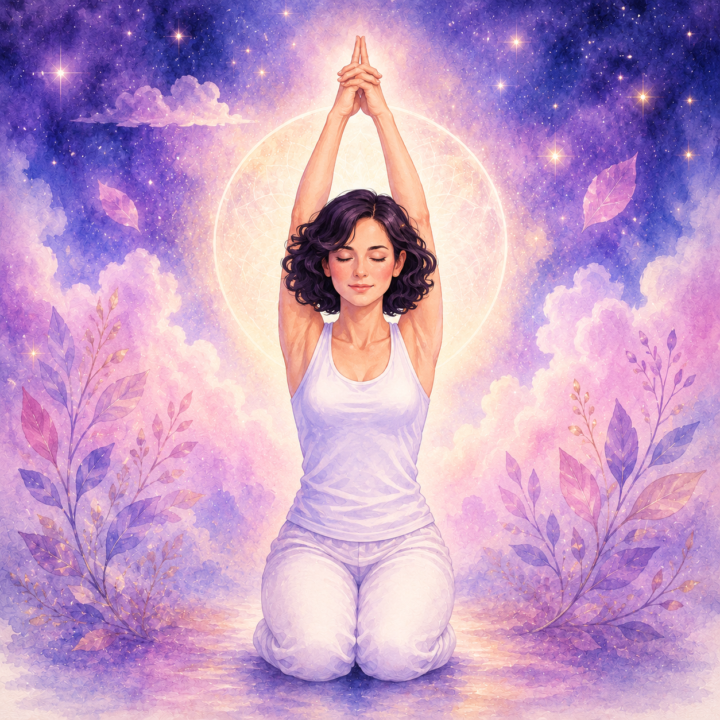
About five days ago, I was in bed struggling with some anxiety. It was still dark and I was torn: do I get up? Do I stay in bed with all my looping thoughts? And then there was this voice, strong but not commanding: “Get on your knees, Jackie.” And so I did. In Sat Kriya. Seven years ago, I used Sat Kriya to calm my nervous system after a debilitating bout with Guillain-Barré Syndrome, an illness that affects your peripheral nervous system. I couldn’t walk for weeks. After I was “stabilized,’ I had a cancerous tumor removed from my kidney that was discovered during diagnosis. I was healing, but not quite. Getting on my knees was the only thing I could do. And everyday for 40 days, I did. Then it was 60, Then it was 90. And then I was off the Gabapentin and into another stage of my life. It was after that I joined a Kundalini 200 hour cohort, got my certification with Brett Larkin & Guru Singh, so amazed I was but the effectiveness of Kundalini—in a three-body way. Not partitioned. Whole. Now seven years later I’m about to finish a 300-hour certification with Guru Singh. And I’m back on my knees. This time the experience is different. Every day of Sat is different. You wouldn’t think so. You would think every day of that 40 is the same. But what I’ve found is that in each day there is something new to discover. My body speaks to me. It expresses itself through posture, breath, mantra, drishti, mudra, movement. Each morning before I rise, I listen to scripture. I’m a practicing Catholic, and I say practicing because that’s what Christianity is for me. A practice. Sat Kriya, for me, is an expression of that scripture. Not only of prayer, though it is or can be that, but of story. For instance, yesterday, my body was the “narrow gate.” “Enter through the narrow gate…” —Matthew 7:13 After listening to the reading on my Hallow app, I thought my practice that day would be about drishti. About where and how I placed my gaze. But then I discovered I wasn’t moving through the gate.
0 likes • Jul 15
@James Williams I find that correlation has deepened both practices. In academia, they talk about heuristics, looking at a text through another lens. Here I'm looking at the "text of the body" through Catholicism; and then my Catholicism through yoga and the body. I wonder, what philosophers are you drawn to? Perhaps, you can incorporate yoga poses that use a lot of repetition and correlating shapes to help frame your logic study. That's what I love about Kundalini: the repetition of breath, sound, poses. That repetition creates a current that influences the alignment you mentioned. It helps clear our vision, in all aspects of the word. Thank you for responding! I appreciate your input!
1 like • Jul 18
@James Williams Yogic and Logic, yes! William Carey, I've heard of him but haven't read him. I found it in the internet archive: https://archive.org/details/godmanwordmadefl00carerich I'm going to put a running list of books and articles together, so keep them coming! Thank you, James!
1-10 of 72
@jackie-moloney-4931
writer, poet, editor. Reiki Master. Kundalini Yoga Instructor. Embodied Writing & Life Coach.
Active 25d ago
Joined Jan 25, 2026