Activity
Mon
Wed
Fri
Sun
Apr
May
Jun
Jul
Aug
Sep
Oct
Nov
Dec
Jan
Feb
Mar
What is this?
Less
More
Owned by Hector
Use AI and automation to create print-on-demand products and start making money online with a real side hustle.
Memberships
Clief Notes
6.6k members • Free
AI for Non-Techies
485 members • $47/month
Skoolers
190k members • Free
Chase AI+
722 members • $97/month
AI Mate Plus
141 members • $97/month
AI Profit Boardroom
2.6k members • $59/m
AndyNoCode Premium
179 members • $59/month
The Ai Agency Mentorship
64 members • $97/m
EricTech
104 members • $10/month
18 contributions to AI Automation Society

19d •
The perfect prompt does not exist.
It’s a mythical and magical creature everyone talks about—but no one has truly seen. A unicorn. A pegasus. Even Nessie, the Loch Ness Monster. Yet everywhere you look, there are so-called gurus promising to sell you the ultimate master prompt. The one prompt that will magically build your app, create your business, generate your videos, automate your life, and turn your ideas into reality. They sell you the spell. But they never teach you how to write the book of magic. Because the truth is simple: The power was never in the prompt. The power is in the thinking that happens before the prompt. The Paper Is More Powerful Than the Prompt Before ChatGPT. Before Claude. Before Perplexity. Before AI. There was paper. Ancient. Analog. Silent. Honest paper. Notion is fast. Google Docs is convenient. But paper forces clarity. Paper forces intention. Paper forces you to think. When you sit down with a blank sheet, something changes. You are no longer reacting. You are designing. So start there. Not in Claude. Not in ChatGPT. Not in your IDE. Start on paper. Write: What you want to create What it should do How it should behave What it should look like What it should sound like How it should evolve Write everything. Messy. Incomplete. Imperfect. Because this is not the prompt. This is the blueprint. Design It Like an Architect An architect does not walk into a construction site and say: “Build me a building.” They bring plans. Dimensions. Materials. Systems. Naming conventions. You must do the same. If you want graphics: Write that. Describe them. Name them. Example: ###### Graphic Name: hero_image_v1 Description: Minimal futuristic illustration of AI agent assisting a business owner. Orbix titanium and glass aesthetic. Dark gradient background. Professional. Clean. Graphic Name: dashboard_preview Description: Screenshot-style graphic showing automation workflows connected visually. ###### If you want video: Write that too. If you want automation:

Jan 27 •
install clawdbot for free
i was going to create a small video on how to install clawdbot on the ffee tier of aws, but , i found that Matt has already done it so i will link his video here . https://www.youtube.com/watch?v=GLwTSlRn6-k
0 likes • Feb 3
It’s strangely weird having something do so many things for you. I’m used to n8n automations where I built everything myself. I decided what happens and how it works. This feels different. Now I just say “do this,” and it actually does it. It even helps optimize my web pages, create new pages for my brands, and a bunch of other things. I guess I should add one more item to the list: researching underground bunkers, like the one Colin Furze has under his house.
Jan 23 •
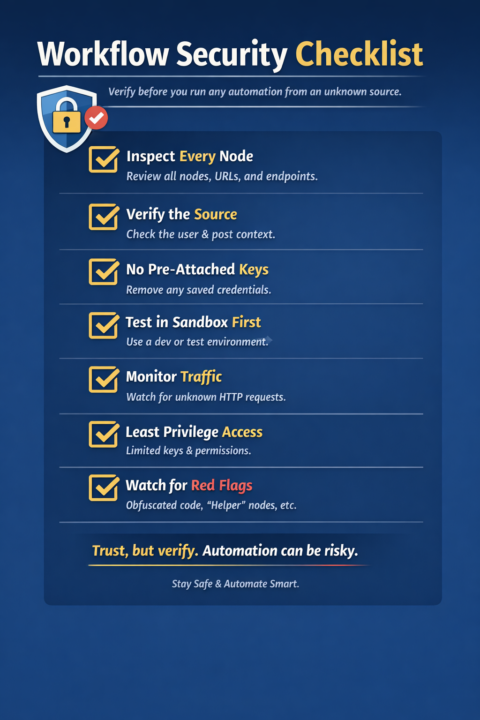
🚨 A quick security reminder about automation workflows
Don’t run workflows from strangers without inspecting every single node first. Whether it’s an n8n workflow, Make scenario, Zap export, or a random JSON someone drops in a Discord or Skool post — blindly importing and running automations is risky. There are bad actors out there. Some are obvious. Some are very good at hiding what they’re doing. I’m sharing workflows to help people learn and move faster — but you should still verify everything before you run anything. Why this matters Automation tools usually have deep access to: - APIs - Databases - Credentials - File systems - Webhooks - Internal business data A single hidden node can: - Exfiltrate credentials - Send your data to a third-party server - Create hidden webhooks - Write or delete database records - Trigger actions on a schedule you never notice And the scariest part? ⚠️ It can look completely harmless at first glance. Good security practices (please don’t skip these) 1️⃣ Inspect every node — no exceptions - Open each node - Check URLs, endpoints, headers, payloads - Look for unfamiliar domains or IPs - Be suspicious of “utility” or “helper” nodes 2️⃣ Verify the source - Who posted it? - Do they explain what it does and why? - Does the workflow come with context or documentation? - Anonymous drops = 🚩 3️⃣ Never import with credentials pre-attached - Remove all credentials before testing - Re-add your own manually - Never trust “ready-to-run” workflows with keys baked in 4️⃣ Test in a sandbox first - Use a dev instance - Use test APIs / fake data - Never run unknown workflows in production first 5️⃣ Watch for outbound traffic - HTTP Request nodes - Webhooks - “Logging” endpoints - Anything sending data “for analytics” If you don’t recognize the destination — investigate. 6️⃣ Least-privilege access - Use limited API keys - Separate prod vs dev credentials - Rotate keys regularly 7️⃣ Assume automation = code No-code does not mean low-risk.
1 like • Jan 28
For anyone curious about how to check workflows, here are a few tips. I use a simple Raspberry Pi with nothing else on it—just a plain n8n setup with FFmpeg and Python. Whenever I find a free template, I open and test it there. If you can’t install n8n on a separate device, another option is to create a VM. Inside the VM, install a lightweight Linux system and run n8n there, either with Docker or directly on the machine—it doesn’t really matter. You can then verify the workflow safely in that environment. This setup also makes it easy to test n8n updates and confirm they don’t break anything in your workflows.

Jan 20 •
Need help getting an automation up and running
Hi everyone. Please, I'd like some help understanding something. I'm a beginner in automation, and my first challenge is to create an AI agent for WhatsApp. I created an application on developer.facebook.com and connected it to the n8n WhatsApp Business "on message" node. When I click on "execute a test event" and send a message, the node doesn't trigger. I put the application live and publish the workflow, and I run more tests, but still nothing. Please help me understand the underlying issue so I can fix it. I installed my n8n on EC2 (I got help from Chat GPT to complete the installation). Do you think the problem might be related to that? Thank you.
1 like • Jan 21
@Issa Boro Je recommanderais Hostinger. C’est abordable et ils proposent une option spécialement conçue pour n8n. Si vous décidez d’utiliser Hostinger, je peux vous fournir un fichier YAML pour installer n8n.
0 likes • Jan 27
@Issa Boro its the configuration file used to create the n8n container. it cintains all the configuration parameters to get tarted.
Jan 26 •
We Do Magic — What Automation Really Is — and What We Actually Do
When most people hear the word automation, they think of something simple: a repetitive task that gets done automatically so they can save time. And honestly? That part is true. At its most basic level, an automation is a system that takes Task A, applies a defined set of rules, and reliably delivers Result B — every time, without human intervention. No breaks. No forgetting. No inconsistency. That alone already has value. But that definition barely scratches the surface of what automation really means in a business context. Automation Is Not the Tool — It’s the Outcome A common mistake businesses make is focusing on the tool instead of the outcome. Automation is not: - n8n - Zapier - Make - AI agents - APIs - Scripts Those are just instruments. Automation is the intentional design of a process that removes friction, reduces waste, and produces consistent results aligned with business goals. The real question is never: “Can this be automated?” The real question is: “What business result do we want to achieve, and how do we design a system that gets us there reliably?” What Actually Happens Behind the Scenes This is where we come in. We are not “button clickers” or “workflow builders.” We are architects of business flow. Our job is to take something that exists in your business — an idea, a task, a process, a bottleneck, or even pure chaos — and design a structured path from Point A to Point B, based on your desired outcome. That “thing” can be: - A lead coming in - An email being received - A form submission - A customer action - A manual internal process - A recurring operational chore - A creative workflow - A reporting requirement Once the goal is defined, we design the logic, rules, validations, fallbacks, and integrations that make the system work reliably in the real world, not just in theory. The “Magic” Is Just Well-Designed Systems From the outside, automation often looks like magic. An email triggers a workflow. A lead gets scored automatically. A report is generated and sent. A video is created, branded, and posted across multiple platforms. A customer receives the right message at the right time.

1 like • Jan 26
And remember, you can always set up an auto-fixing workflow, or at least one that notifies you immediately if there’s an error or a failed outcome.
1 like • Jan 26
From experience, I can tell you this. I was having lunch with a friend, and another friend of his happened to join us. During the conversation, he mentioned he was planning to shut his business down. There were too many things he knew how to do, but they were taking up all his time, and other parts of the business were falling apart because of it. Even with employees, nothing was really improving. I explained what I could do to help him stay afloat and even increase his profits. When we talked about cost, he told me he was struggling and could barely pay his employees. I knew I wasn’t going to work for free or wait to get paid later, so I changed the approach. The automation system he needed was worth about $15,000 — a near-complete setup with web automation, voice agents, and clones. Instead of charging $1,500 a month, I raised the fee. I told him, “Let’s do $2,500 a month, and you’ll see improvement almost immediately.” He agreed. Now I receive $2,500 a month, and he’s making more than three times what he was earning before. And the best part was that many of the things he needed were already built for other clients. So it was mostly a matter of adapting and reusing what was already there — not exactly a simple copy and paste, but close enough to move fast and get results.
1-10 of 18

@hector-diaz-9181
Orbix Automation Solutions. AI automation agency helping businesses and individuals replace manual work with smart AI systems and automated workflows.
Active 26m ago
Joined Dec 4, 2025
Powered by