Activity
Mon
Wed
Fri
Sun
Aug
Sep
Oct
Nov
Dec
Jan
Feb
Mar
Apr
May
Jun
Jul
What is this?
Less
More
Owned by Gwenael
Stop forcing yourself into broken systems. Turn your Neurodivergent brain into a freelance weapon. This is where you finally win. unmask yourself.
Memberships
Daily Art Skool
18 members • $7/month
Content Engine +
7 members • $970/year
Creative Hearts
119 members • Free
Live Light Hearted
56 members • Free
The Human Practice
320 members • Free
Spanish For Professionals
393 members • Free
HAPPY Hangout
96 members • Free
The Skoolers Library
101 members • Free
Content Engine
222 members • Free
81 contributions to Creative Hearts

Apr 9 •
Let’s share your photos of your pets.
Trying out a fun app- yes this is a ai generated video of my pup Archie


0 likes • Apr 9
Ugo, Valais black nose, unfortunately not with us anymore 👼
1 like • Apr 10
@Leeanne Hurren yes a real pet
Apr 8 •
Always evolving...
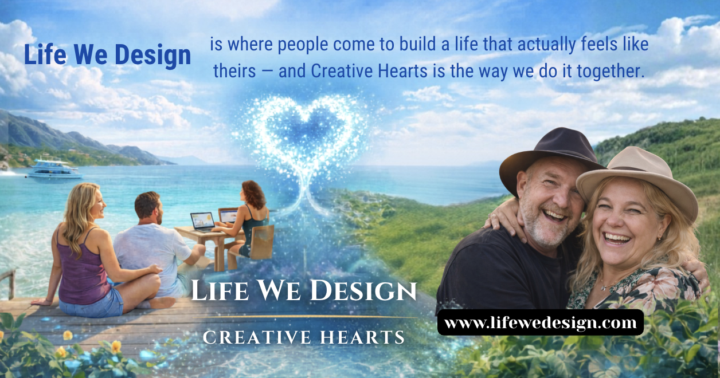
You’ll feel at home here if you’re a Heart Creative — someone who gives deeply, cares deeply, and has spent years showing up for others… while quietly putting your own dreams to one side. Creative Hearts is a space to come back to yourself. For parents, carers, and grandparents who know there’s more to who they are — and more to how they want to live — but haven’t yet had the space or direction to explore it. This isn’t therapy and I am not personally a therapist. There’s no pressure to have it all figured out. It’s a space for conversation, reflection, and connection — where you can begin thinking differently about what’s possible. Through Life We Design, A complete business package (www.lifewedesign.com), you’ll be connected to an entire business community that share skills and tools, Business development, training, and a mentor and coaches that provide onging support — including topics such as self-development, Human Design, and building something of your own with your templates for your own website. Some come to reconnect. Some to explore and develop lifelong friends and connections. Some to build. All of that belongs here. You are most welcome here.
1 like • Apr 9
1% better everyday
Mar 13 •
When you're a full-time carer… it’s easy to forget that you matter too.
I am back in Sydney now, going through all of the content that I captured whilst I was away. I am feeling so happy to have been able to experience the excitement of connecting with people as we discovered the beauties of Fiji.

1 like • Mar 15
That's what I do now: focus on myself for a time. And GOD, I feel way better
Feb 25 •
There is no "i" in team
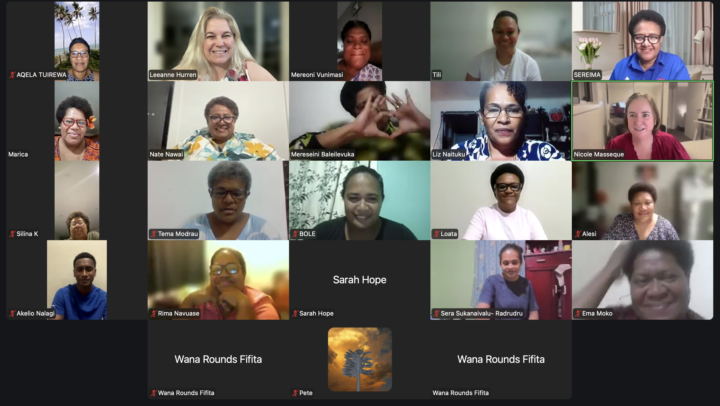
There was a time 7 years ago, when I thought that I could not possibly be an "influencer" and lead a group of people in running a business. Who am I? Could I really do? Have you ever said that to yourself. However there are some things that I have learned, especially more so, in the past 3 years of overseeing and leading events where business owners travel from around the world to gather together in person to learn marketing skills and business skills in person - shoulder to shoulder. There is no "i" in team. Our events were successful because every person, every volunteer, played a very important role in the success of the experience of the event. Where I lacked in foresight, or in my availability of time because of my role as a foster mum of a child with high needs, there were "angels in my team" walking along side me that met the "space" that I created and it helped that person to step up, to shine in their role. I now enjoy creating space for others to grow because of my experience with this business. I now know the benefits of creating space for people to step forward and use their talents to benefit the group, the team. Seeing the self- confidence and pride on a mentee's face as they achieve is simply the best experience! I can't wait to meet these incredible business owners in Fiji next week. I am buzzing. What experience have you had where you realised that it is better to find connection with others then to try to do it on your own?
2 likes • Feb 25
If we want a team that lasts, we need a vision that goes beyond deadlines and deliverables. A “high and infinite” team is not built on constant output. It is built on sustainable humans. Taking care of yourself is not a personal luxury. It is a professional responsibility. Because the quality of your thinking, your decisions, your patience, your creativity, your leadership, your reliability, all of it is produced by a nervous system. And nervous systems have limits. Rest is not the opposite of performance. It is the condition for performance. In a real team, people don’t just share tasks. They share reality. They understand that you are not a replaceable part, you are a person. So when someone needs time to reset, to breathe, to protect their health, to recover from overload, that is not “less commitment.” That is maturity. That is strategy. That is how you protect the long game. A team that cannot understand why someone needs time for themselves is not functioning as a team. It is functioning like a production line. A chain of individuals expected to behave like a machine: always available, always efficient, always “fine.” That is not collaboration. That is control. And machines don’t innovate, don’t care, don’t grow, and eventually they break. An infinite team thinks differently. It measures success not only by what gets shipped this week, but by whether the people doing the work can still think clearly next month, still trust each other next quarter, still feel proud of what they’re building next year. It creates a culture where taking time for yourself is normal, respected, and even encouraged, because the team understands a simple truth: Healthy people build healthy outcomes. So the vision is this: we choose sustainability over heroics. We choose clarity over burnout. We choose humans over machinery. And we build a team that can go far, not just fast.
2 likes • Feb 25
@Leeanne Hurren yes, I was totally off during some time
Feb 13 •
Share something that inspires you
https://www.facebook.com/share/r/1D8oCQ26oP/?mibextid=wwXIfr I cant wait to see what you share- extra value tip- share why it inspires you.
1 like • Feb 13
@Leeanne Hurren what are you waiting for?
1 like • Feb 13
@Leeanne Hurren that's true. You told me about your foster daughter. At least you will see the Fiji. Have fun!
1-10 of 81
@gwenael-mouthuy-3051
Entrepreneur & Agile Coach. Building power through habits, knowledge & action.
Growing with fellow Grims. Be honourable.
Active 55d ago
Joined Oct 23, 2025
INTP
Chiang Mai, Thailand