Activity
Mon
Wed
Fri
Sun
Jan
Feb
Mar
Apr
May
Jun
Jul
Aug
Sep
Oct
Nov
Dec
What is this?
Less
More
Memberships
Learn Microsoft Fabric
14.4k members • Free
2 contributions to Learn Microsoft Fabric

Sep '24 •
Azure Bill on a Fabric Capacity
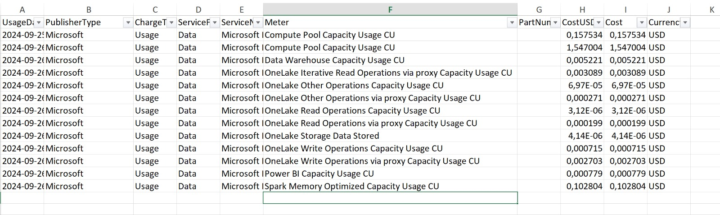
Hi everyone! I’m starting to delve into this new world of Fabric, understanding the architecture, pricing model, etc. I have an initial question about Azure pricing in Fabric that I don’t fully understand. If I have my capacity deployed as "Pay-as-you-go," will Azure charge me hourly for all the "CUs" (capacity units) in my SKU as long as my capacity is "on," regardless of whether I'm using the CUs or not? Or does Azure only charge me based on the actual consumption and utilization of the available "CUs" in my SKU? Another question I have about Azure's pricing model in Fabric concerns the use of Spark. Reading through the documentation, it’s not entirely clear to me whether the use of Spark incurs an additional cost beyond the reserved CU consumption for my capacity. If Spark consumes and utilizes the CUs, which have vCores and memory allocated for their use, why would it generate an additional charge when CUs in the capacity are already being charged? Yesterday, I ran a test by creating an F2 to start interacting and see Azure bill when using Spark and interacting with OneLake and a Lakehouse. Looking at the costs, besides the CU compute consumption, I also see a specific consumption item called "Spark Memory Optimized Capacity Usage CU." So now I’m wondering, in the first two lines, what does "Compute Pool Capacity Usage CU" refer to? Is it a fixed cost for having the capacity turned on? Thanks for reading.

Sep '24 •
Medallion Architecture and Environment separation
Hi folks, I'm in Fabric, so I need some help in order to design the best medallion architecture based in the requirement that I need dev, qa and prod items. Based on Will's lectures, I made this diagram, but I require your opinion. Thanks in advance.

0 likes • Sep '24
@Dean Hall Hi Dean! I'm in a similar situation with Fabric when it comes to creating a Fabric ecosystem. Looking at your diagram and noticing the separation you make between 'Data Engineers / Citizen Developers' and 'Report Builders / Analysts,' I have the same doubt mentioned in the post: whether those two separations should indeed be represented literally as Fabric domains, or if it's not a best practice to create domains unless they're used to separate business departments within a company, for example. So, when you separate these two groups of 'Data Engineers / Citizen Developers' and 'Report Builders / Analysts,' are you using them as separate Fabric domains? Or do the six workspaces you use actually live in the same capacity without real domains?
1-2 of 2

@gonzalo-rodriguez-7223
Hi! I'm a Big Data Engineer since 2021, always looking to improve my skills and professional career!
Active 235d ago
Joined Sep 23, 2024
Argentina, Buenos Aires.
Powered by