Activity
Mon
Wed
Fri
Sun
Nov
Dec
Jan
Feb
Mar
Apr
May
Jun
Jul
Aug
Sep
Oct
What is this?
Less
More
KRISTINA’S PEPTIDE JUNKIES 24
1.5k
Free
Project Biohacked - Peptides
15.1k
5.0
Free
FINE LAB
206
Free
PEPTIDE PORTAL
503
Free
OfficialShelbyPepTalk
2.3k
Free
Core Peptides
194
Free
Camacho's Peptide Lab
941
Free
Cale's Peptide Guide
3.5k
Free
Powerhouse Fitness for Women
29k
5.0
Free
11 contributions to KRISTINA’S PEPTIDE JUNKIES 24

Sep 11 •
Switching peptides
If I want to switch to Tris from Reta how would I do that? I take 60ml of Reta. And if I want to take Tris and take a little Reta how do I do that?

0 likes • Sep 22
I would start at 2mg of tirz and work my way up because the appetite suppression is stronger on tirz and you want to be mindful of the digestive side effects 🙂🙂

Jul 12 •
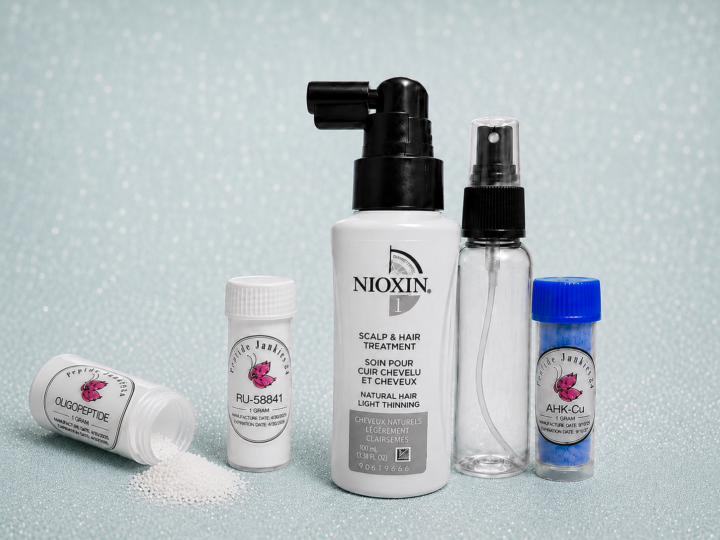
💥‼️WOLVERINE HAIR REGROWTH STACK NOW AVAILABLE AND 40%OFF‼️💥
Now available on my Peptide Junkies 24 online store: Wolverine Hair Regrowth Stack Nioxin RU-58841 AHK-Cu Oligopeptide-54 FREE 4oz spray bottle Purchase bundle for $80-$32= $48 with Discount code: SKOOL40 https://peptidejunkies24.shop ‼️Skool group members now receive 40% off with code: SKOOL40‼️ 💥💥For a complete Wolverine Stack, add TB-500 from the vetted vendor of your choice💥💥
1 like • Jul 27
Oh this is interesting! Will definitely look into it 🙌
1 like • Sep 2
@Kristina Marie thank you!
Aug 21 •
SS-31
Hey everyone! For those of you who have already researched SS-31, what’s your take on the best protocol? Dosing and duration? And what about stacking it with MOTS-C vs. doing one before the other? Thanks!
0
0
Aug 18 •
CAN YOU DRAW MULTIPLE PEPTIDES INTO THE SAME SYRINGE? 🤔
This question comes up constantly, so let's clarify exactly what we're talking about. I'm NOT talking about mixing two peptides together in one vial and storing them that way. I'm talking about this: You have two or more peptides already reconstituted in their own separate vials. You draw peptide #1 into the syringe, then draw peptide #2 into that SAME syringe, and inject them immediately. Can you do that? Sometimes combinations are used this way in practice, but there is a big difference between “people commonly do it” and “we have actual compatibility data proving every formulation can be mixed in the same syringe.” ****************************************************************************************************** WHY IMMEDIATE USE IS DIFFERENT FROM STORAGE: If two peptides are drawn together and injected immediately, they aren't sitting together for hours or days. That matters because chemical degradation, aggregation and other stability problems can be time-dependent. But immediate administration doesn't magically eliminate compatibility concerns. The moment those two solutions meet, you've potentially changed: - pH - concentration - ionic strength - buffer composition - preservative concentration - solubility conditions - So my answer is never simply: “They're peptides, so sure — mix them.” ***************************************************************************************************** COMBINATIONS YOU'LL COMMONLY HEAR ABOUT: CJC-1295 + Ipamorelin This is probably the classic example. These two are commonly paired and are even commercially compounded together by some pharmacies. If someone has two separately reconstituted vials, you'll frequently hear about both being drawn into the same syringe for immediate administration. Does that mean every independently sourced CJC and ipamorelin formulation has documented syringe-compatibility data? No. So I would describe this one as: COMMONLY COMBINED — but formulation-specific compatibility still matters.
0 likes • Aug 18
@Kristina Marie I’ve been wanting to get those! I feel it would save a lot of time and make things easier 🙌🏼
1 like • Aug 18
@Kristina Marie oh nice! That is something to look forward to, definitely 🙏🏼
Aug 18 •
BPC157 and TB500
Good morning all! I have a question, if I have BPC and TB in separate vials to control dosing, can I still inject them in the same syringe?
0 likes • Aug 18
@Kristina Marie thank you! It makes sense since it also comes as a blend but just wanted to make sure ☺️
1-10 of 11
