Activity
Mon
Wed
Fri
Sun
Oct
Nov
Dec
Jan
Feb
Mar
Apr
May
Jun
Jul
Aug
Sep
What is this?
Less
More
Oasis Builders
159 members • Free
Inner Healer School
275 members • Free
Embrace Your Inner Weirdo
118 members • Free
Second Act Wealth Society™
190 members • Free
Scale Without Noise
69 members • Free
LDL: Plant-Based Edition
51 members • Free
AI Story Crafters
283 members • Free
Midlife Revival:for Women 50+
54 members • Free
Ai Storytellers-Nick Nebelsky
570 members • Free
22 contributions to Has2BGreen

25d •
When the Ponds Disappear
I went looking for a pond. Instead, I found cracked earth. The bullrushes were browning, the mud was hard and dry, and as I crouched beside one of the deep cracks, a solitary dragonfly appeared. That encounter led me to a question I hadn't really considered before: When we talk about water shortages, whose water are we talking about? We think about water for our homes. Water for farming. Water for businesses and industry. But what about water for nature? Article 3 of my Water Stress series explores what happens when ponds disappear — and I discovered that the answer is much more complicated than simply filling them back up. Some ponds are supposed to dry out. Some wildlife depends upon that cycle. But Britain has also lost around half of its ponds during the last century. That means when one dries, wildlife may have far fewer alternative places to go. So perhaps resilience means rebuilding a landscape containing lots of different kinds of water: 💧 Permanent ponds 💧 Seasonal ponds 💧 Deep and shallow areas 💧 Wetlands 💧 Garden ponds 💧 Restored farm ponds And perhaps we need to start thinking about ponds as part of our climate-adaptation infrastructure — places that help us move winter water through time, not for ourselves, but for entire ecosystems. The article also asks some harder questions. Should we ever top up a wildlife pond during drought? Should new ponds include deeper refuge areas? Could we restore some of the thousands of ponds we've lost? And how do we create more open water while managing the very real risk of drowning? 👀 Notice. Find the ponds near you. 📣 Speak up. Find out who looks after them. 💡 Suggest ideas. Could lost ponds be restored or new ones created? 🌍 Share stories. How are communities elsewhere helping nature survive drought? Article 3: When the Ponds Disappear is now available in Has2BGreen. I'd particularly love to hear what is happening to ponds and wildlife where you live — and any solutions you've encountered elsewhere.


0 likes • 19h
Oh, so sad....😢
7d •
🔥 Are We Ready for Wildfires?
Article 6 of our Water Stress series is now up. This one started with a simple question about Britain's increasing wildfires. We know that when a major fire overwhelms a local fire service, neighbouring services can send crews and equipment to help. But prolonged heat and drought don't stop at county boundaries. The same conditions that create a wildfire in Hampshire can exist simultaneously in Surrey, Berkshire and Sussex. So what happens when everybody needs help at once? That led me to investigate how prepared we actually are. 🚒 Can fire engines reach remote heathland and woodland? 💧 Where does the water come from when streams and ponds are already depleted by drought? 🚁 Does Britain have aircraft capable of water-bombing wildfires? 🔥 What happens when several major fires occur simultaneously? 🌍 And what can we learn from countries such as Spain, Portugal, Greece, Australia, Canada and the United States that have been dealing with this problem for much longer? One idea particularly struck me. Throughout this series we've been talking about moving water through time — capturing some of our abundant winter rainfall so it is available during increasingly dry summers. We've already found reasons to store water for people, farming and wildlife. Perhaps we need to add another: Water for emergencies. The latest article is: 🔥 When the Countryside Catches Fire Have a read, then come back and tell us what you think. And particularly, if you live somewhere where wildfire is already part of life, I'd love to hear what your community does that we could learn from. Notice. Speak Up. Suggest Ideas. Share Solutions.

1 like • 6d
Oh, the implications and facts of the article, coupled with the image of the cigarette...brought a memory to mind. California is known for its wildfires and droughts over the years (I am a native Californian). I remember living in South Lake Tahoe and on my way to work at the casino...when an undeniable cloud of smoke was coming from our 100-year-old pine forest. A tourist spotted flicking his cigarette butt out his car window and into the forest of pine needles. 7,500 acres of trees burned to the ground. I sat in my car and cried...🌲🌲🐦🔥😭😭
1 like • 6d
@Richard Knight Oh, I know the poor 'tree-people' 🌲🌲🌲😭😭 (as my Navajo friends refer to them.) Between climate change and careless humans...they🌲🌲 can't fight back. 😭😭 I still remember this commercial from 1970's when I was a kid...it impacted me...we need another one...
10d •
Two new members!!
Please welcome @Sophia Garcia and @Kendra Cigdem Hi to both of you and welcome to this strange group. The aim of the group is to provide background data on the Climate Crisis so that you can speak with an informed voice on the subject. The next step is to look at how the crisis is affecting each of us in our different parts of the world. Since I am in the UK I am doing a lot of work to identify how the climate crisis is affectring us in the 6th wealthiest country and, for me in Hampshire, how it affects us in one of the wealthiest counties. I am finding that the effects are all around us. And after five heatwaves over the summer we are seeing changes to our countryside, to our local farmers and to our local wildlife. Changes that are, in some cases, irreversable. As a result of this work I am now contacting local action groups to see how we can identify actions that are impactful. I have two in my sights. The first is that we are running out of water during our summer months. Not only for household use but also for the trees in our towns. The idea of needing to "water" our trees is alein to us. But without doing this, we will lose our Silver Birches, our Beach trees and maybe even our Oak trees. My suggestion is that we build new reservoirs to capture the increased winter rainfall and store it until we need it during our long dry spells in the summer. We don't have the money, reservoirs are not on the local council's radar (especially for trees!) and we do not have the land. If we do not do this we will lose the trees that provide cooling in the summer, the benefits of their air purification and carbon sequestration services. We are planting new trees, beacuse we have been told this is a good idea, but we are not doing enough to protect them during the early years and many are dying. So I have put forward the idea of Eco-Guardians, allocating groups of trees to nearby residents. As water supplies dwindle, the cost of water is increasing. Do we supply these guardians with payments to cover their costs?

1 like • 10d
Whoohooo!!! Welcome @Sophia Garcia and @Kendra Cigdem !! 🤩🤩 I have truly enjoyed learning so much in this community and all the resources @Richard Knight created and members' conversations! 🤩 Looking forward to sharing with you! Yippies!!💫💝
1 like • 9d
@Richard Knight I appreciate all you do to inform members! Truly, a work of love for the earth! 🌍🌍💚💚
22d •
We Don't Just Drink Water. We Eat It.
Article 5 of our Water Stress series is now up — and this time we're heading into the fields. I've been following stories from farmers dealing with this year's prolonged dry weather. 🌾 Wheat fields that look normal from the road — but are producing far less grain. 🥔 Potato plants producing much smaller crops beneath the ground. 🌱 Sugar beet that survived the drought, only for the rain to arrive too late to recover the lost yield. 🌾 Hay and silage harvests falling just when livestock farmers need to build their winter feed reserves. That last one particularly struck me. When grass stops growing, farmers don't just lose today's grazing. Some have to start feeding the hay and silage they stored for winter. Summer drought starts eating winter's food supply. And eventually that can leave farmers facing a horrible calculation: do they have enough feed to keep all their animals through the winter? But this isn't just a UK story. Farmers across Europe, the US, Australia, Africa, India and elsewhere are confronting different versions of the same problem. Which also means there are people around the world already experimenting with solutions. Better water storage. Healthier soils. Different crops. Agroforestry. Drought-resistant varieties. Different grazing systems. More targeted irrigation. So Article 5 asks two questions: What happens to our food when water becomes less reliable? And: What can we learn from farmers who are already adapting? 👀 Notice what is happening in the fields around you. 📣 Speak up about food and water security locally. 💡 Suggest ideas that could help farmers become more resilient. 🌍 Share stories from where you live — wherever in the world that happens to be. Because a shortage of water in a field eventually becomes a shortage of something else. Less wheat. Smaller potatoes. Less hay. More expensive feed. Fewer animals. Potentially higher food prices. Water stress doesn't stop at the farm gate. Eventually, it reaches our kitchens. Read Article 5 — When Water Stops Growing Food in Has2BGreen.

2 likes • 22d
We are in monsoon season here in Korea, and there are floods everywhere... Japan as well...if only we could evaporate that water and send it to the dry areas!! In my dreams.... I can imagine the impossible! 🤩
2 likes • 21d
@Richard Knight Yes...water storage and conservation!! 💦💦
Dec '25 •
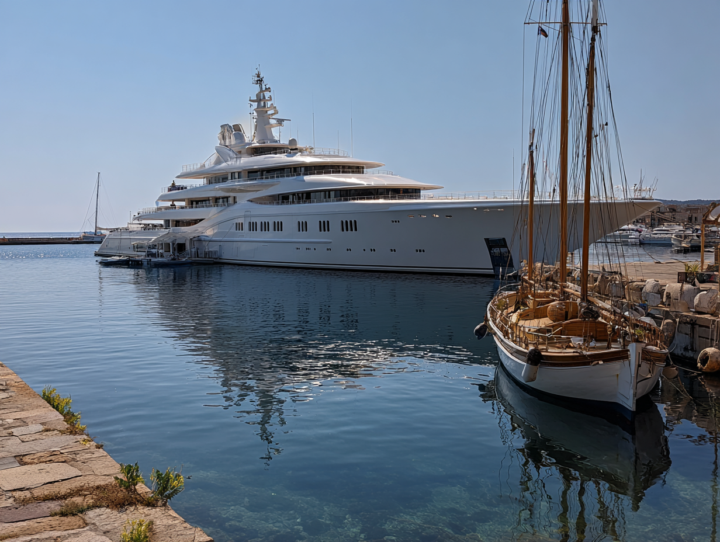
📢 Bonus Lesson: Is Ethical Billionaire Wealth Possible?
Today we’re releasing a special bonus lesson in the billionaire - climate series: Is Ethical Billionaire Wealth Possible? — separating personal virtue from systemic design. This lesson tackles the question that almost everyone asks at some point in the series:“ But what about the good ones?” “What about the generous billionaires?” “Can’t someone be rich and ethical?” This lesson gives a clear and grounded answer — and it reframes the entire conversation. 👉 Start the lesson here: 🔥 What you’ll learn today In this lesson, we explore the difference between personal ethics and system requirements. You’ll learn why billionaire status requires: - global scale - very low marginal costs - labour arbitrage or automation - externalised environmental costs - tax-minimising structures - financial engineering - favourable political conditions …and how each requirement functions like a filter, removing ethical pathways and rewarding extractive ones. The key insight: A person can be ethical. A billionaire cannot be created ethically inside the current system. The system is the issue — not the individual. We also explore what this means for climate justice, democracy, and the future of wealth. 💬 Your Activity for Today Question: Do you think billionaire wealth could ever be ethical — or does the structure of the system make that impossible? Why? You might reflect on: - the role of lobbying - global labour inequality - environmental costs - tax rules - shareholder pressure - monopolies - subsidies and public money - the difference between giving money away and how it was made - Even a short reflection can open up a powerful discussion.
1 like • 22d
I feel that money is an energy and 'flow' is important. A person who (Elon Musk) has amassed wealth can be swayed and caught up in the 3rd dimension programming. (Materialistic things bring happiness...we know it doesn't.) If the individual has a solid ethical and moral foundation, they can and will still be conducting their lives the same as they did before amassing wealth. However, those who are born with a 'silver spoon' and generational wealth...may be programmed or conditioned as entitled person.... So, those are my basic initial thoughts...now I will go to the lesson module and add a post on how/if my perspectives have changed! Whooohooo...🤩
1-10 of 22

@elizabeth-ocarroll-8652
Elizabeth, M.Ed., MRC, M.Msc. World traveler, counselor, author & educator inspired by life & beautiful souls.
Active 19h ago
Joined Jul 7, 2026
South Korea