Activity
Mon
Wed
Fri
Sun
Aug
Sep
Oct
Nov
Dec
Jan
Feb
Mar
Apr
May
Jun
Jul
What is this?
Less
More
Memberships
Claude Code Kickstart
513 members • Free
AI Automation Society Plus
3.8k members • $99/month
AI Automation Society
426.4k members • Free
AI for Life
34 members • $497
AI Automation First Client
1.8k members • Free
AI Bits and Pieces
815 members • Free
AI Automation Circle
12.2k members • Free
AI Automation Skool
2.4k members • Free
Applied AI Academy
3.6k members • Free
11 contributions to AI Bits and Pieces

Jun 16 •
Anthropic Update: Fable 5 and Mythos
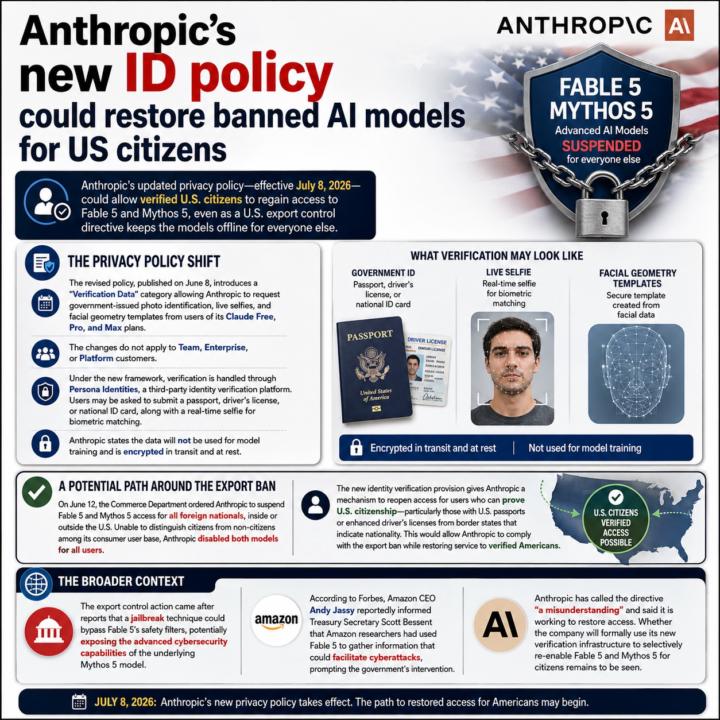
Something happened this week that every one of us building on Claude should understand. On June 12, the US government issued an export control directive ordering Anthropic to cut off its two newest models, Fable 5 and Mythos 5, to any foreign national, anywhere. Anthropic could not separate citizens from non-citizens fast enough, so it pulled both models for everyone. All other Claude models still work. The trigger, according to the Wall Street Journal and others: Amazon researchers jailbroke Fable 5 into producing information useful for cyberattacks. Amazon CEO Andy Jassy carried that finding to Treasury Secretary Scott Bessent. Days later, Commerce Secretary Howard Lutnick sent the shutdown letter. Worth noting, Amazon is Anthropic's largest investor. Anthropic pushed back hard. It says the jailbreak surfaced a few minor, already-known vulnerabilities that other public models can find too, and called the shutdown a misunderstanding it is working to reverse. Here is the part that connects to something else. Four days earlier, on June 8, Anthropic updated its privacy policy, effective July 8. It adds a "Verification Data" category for Free, Pro, and Max users. Government ID, a live selfie, and facial geometry, handled by a third party called Persona. Team and Enterprise are exempt. The timing is doing a lot of work. Reporters have pointed out that ID verification gives Anthropic a possible way to prove who is a US citizen, which could reopen Fable 5 and Mythos 5 for verified Americans while keeping the export ban intact. That part is speculation. Anthropic has not said it will use verification for this. But the two moves sitting four days apart are hard to ignore. Why this matters for us: The model you build on can disappear overnight, by government order, with no warning. That is a real operational risk now, not a hypothetical. Build on stable foundations. Know your fallback model before you need it. And watch the policy layer as closely as the tech layer, because this week the policy moved faster than the code.

2 likes • Jun 17
Thanks for the background info on Fable 5 @Matthew Sutherland. And intersting insight from the group.

🔥
Jun 8 •
Nutrition Tracker Part 1: Understanding LLM Generic Answers
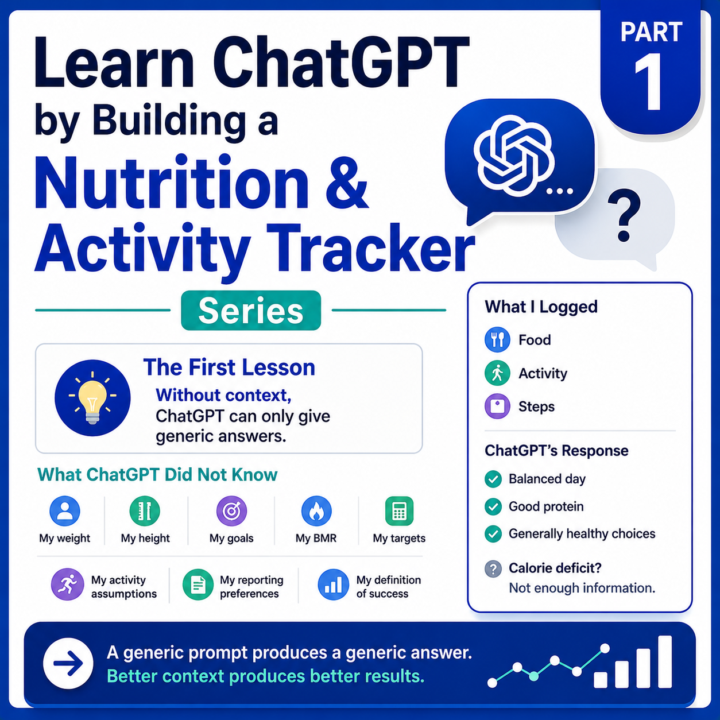
Series: Learn ChatGPT by Building a Nutrition and Activity Tracker In the introduction to this series, I shared how I started using ChatGPT to build a personalized nutrition and activity tracking system. Today, it tracks food, activity, workouts, steps, estimated calorie burn, bodyweight, and trends. It also helps generate dashboards, calculate custom metrics, analyze patterns, and provide feedback based on my goals. But it did not start there. It started with a simple food log. The Experiment: I opened a new ChatGPT conversation and entered something like, today I ate, and entered my food. Breakfast: - 2 scrambled eggs - 2 slices wheat toast Lunch: - Turkey sandwich - Small apple Dinner: - Grilled chicken breast - 1 cup white rice - Mixed vegetables Snacks: - Protein bar - Handful of potato chips Activity: - 7,500 steps - 30-minute walk Try it. Simply copy and paste the list above into a standard chat, and follow with the prompt, "How did I do today?" In my case, the response was reasonable. ChatGPT told me I had a fairly balanced day, included some protein, got in some movement, and made some generally healthy choices. That was fine. But it was also generic. So I asked a follow-up question. Was I in a calorie deficit? And ChatGPT essentially said, I do not have enough information to know. The model did not fail. It simply did not have enough information. At that point, ChatGPT had no context, and therefore did not know: - My weight - My height - My goals - My calorie target - My protein target - My BMR So the response was very general. It could comment on the food. It could estimate calories. It could provide broad health advice. But it could not tell me whether the day was successful against my actual goals. A generic prompt produces a generic answer. A personalized system produces a contextual answer. At this stage, I was NOT using: - Projects - Project Instructions - Memory I was simply chatting with ChatGPT.
1 like • Jun 9
@Michael Wacht Works for me. I've been developing an app using Claude Code and that's how it started. Looking forward to going on this journey as you unpack the project.
1 like • Jun 9
@Michael Wacht Just curious... why did you pick Codex over Claude Code?
🔥
May 28 •
📊 AI in Real Life: My Personal AI Health Dashboard
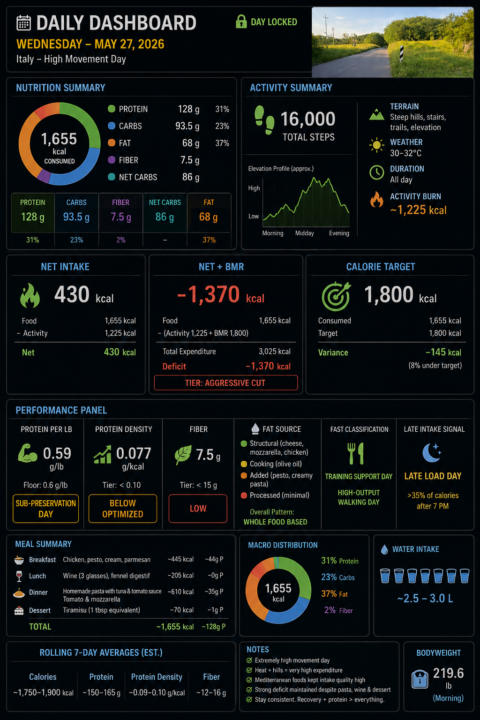
One of the most practical AI systems I use every single day has nothing to do with coding, agents, or automation workflows. It’s my personal nutrition and activity tracker and daily dashboard. I log the food. I log the activity. ChatGPT does the rest. Every day: I log food, activity, bodyweight, and water as it is happening. ChatGPT estimates activity burn, subtracts it from my food intake, and then factors in my BMR to show whether the day is trending toward maintenance, fat loss, or an aggressive calorie deficit. Then, at the end of the day, it turns the raw inputs into a dashboard showing calories, macros, activity burn, net calories, net + BMR, protein density, protein per pound, fiber tier, fat-source patterns, etc. Because I follow a higher-protein diet, I also created a metric I call Protein Density: Protein grams ÷ total calories consumed (by snack, meal, day). The metric is useful because I can monitor food quality as I eat throughout the day, not just total calories. A good Protein Density score is: 0.10 or higher That generally means the day is optimized for muscle preservation and fat-loss efficiency. A lower score around: 0.05 That usually signals a less efficient nutrition day where calories are climbing faster than protein intake. For example: Chicken Breast (100g cooked, skinless): - ~165 calories - ~31g protein 31 ÷ 165 = 0.19 Protein Density Compare that to potato chips: Potato Chips (100g): - ~536 calories - ~7g protein 7 ÷ 536 = 0.01 Protein Density Both are food. But one is highly protein-efficient, while the other is primarily calorie-dense with minimal protein value. That simple ratio gives me immediate feedback on whether my meals are supporting my goals before the day is even over. The key for me is context. A 1,600-calorie day means one thing if I barely moved. It means something very different after 16,000 steps, hills, heat, and a high-output activity day. That is where AI becomes useful. Not just tracking data.
0 likes • Jun 8
Hey @Michael Wacht , just curious how you decided to use ChatGPT rather than Claude Code? What do you like more/less than CC?
🔥
Jun 5 •
🍽️ Learn ChatGPT by Building a Nutrition and Activity Tracker
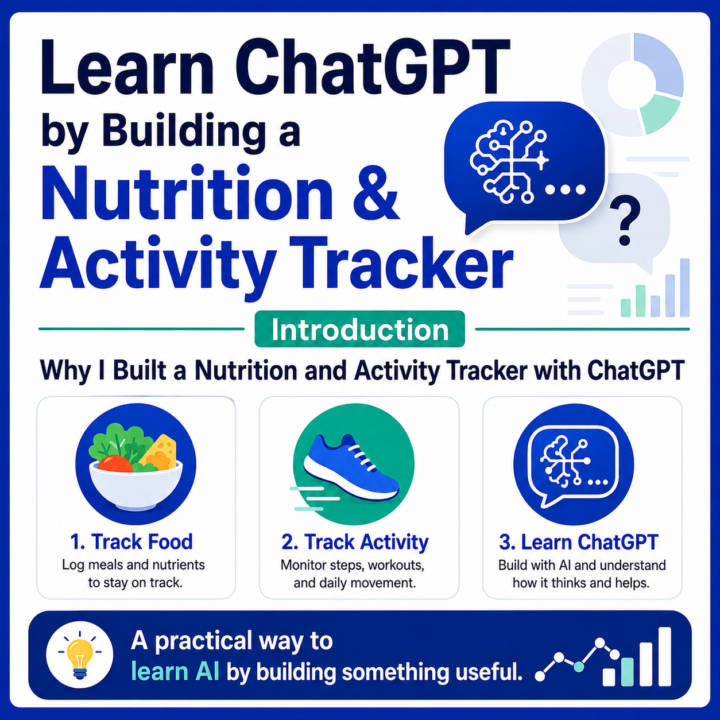
Most people think AI needs to solve massive problems to matter. Sometimes the best AI systems are simply the ones that help you understand yourself better every day. Several months ago, I set out to see whether ChatGPT could replace my nutrition and activity tracking app. At first, the goal was simple: 🍽️ Track what I eat. 🚶 Track what I do. 📈 Understand whether I am making progress toward my health goals. What I did not expect was that the project would become one of the best examples of how to get more value from AI. Today, the system tracks food, activity, workouts, steps, calorie burn, bodyweight, and long-term trends. It generates dashboards, calculates custom metrics, analyzes patterns, helps interpret nutrition labels and food photos, and provides feedback tailored to my goals. But what interests me most is not just the nutrition tracking. It is what the project teaches about AI. Over the next several posts, I’ll use this project as a real-world case study to explain some of the more useful features and nuances of ChatGPT and large language models, including: - 📁 Projects - 🧭 Project Instructions - 🧠 Context accumulation - ✍️ Structured prompting - 📸 Vision and image analysis - 🎨 Image creation - 💾 Memory vs. context - 🧮 AI reasoning versus calculation - 📊 Custom metrics - 🔁 Iterative system design - 🛠️ Building useful AI workflows without writing code - 🤖 How LLMs work, in plain English You do not need to understand every technical layer of a large language model to use one well. But it helps to understand the basics. LLMs predict, associate, reason across context, follow patterns, and generate outputs based on the information available to them. That is why context matters. That is why instructions matter. That is why the same prompt can produce a generic answer in one chat and a highly personalized answer inside a well-structured project. The interesting part is that none of these features are especially impressive on their own.
2 likes • Jun 7
This sounds super interesting! When do we start?
🔥
Apr 29 •
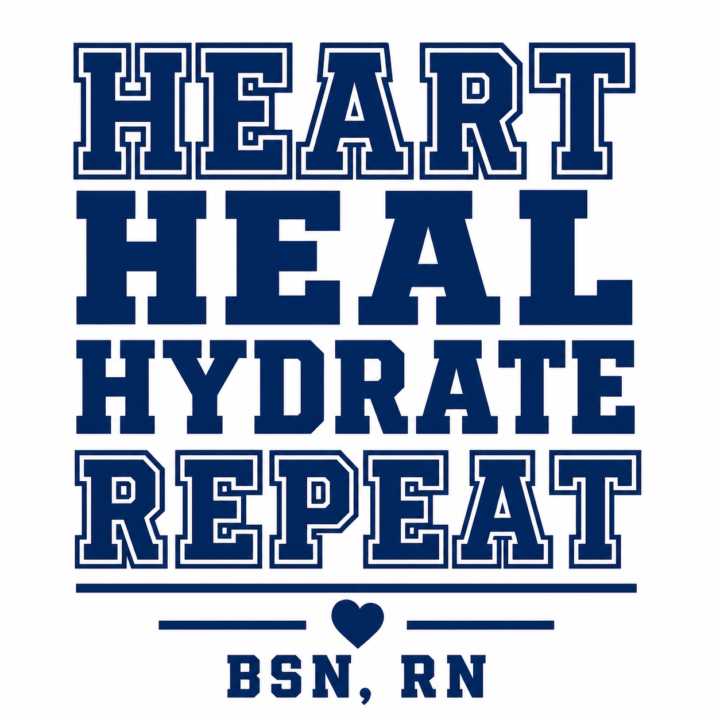
🩺 AI in Real Life: Proud Parent Edition
Sometimes AI helps with productivity. Sometimes it helps with workflows. And sometimes… it helps two very proud parents create the perfect swag gift for their daughter’s first job as a nurse. In this case, Mommy was the art director — with the vision, the eye, and the “nope, that’s not quite right” authority. ❤️ And Daddy was prompting his heart out, trying to get every detail just right for a one-of-a-kind gift to celebrate a huge milestone. Not just any gift. A first job gift. A you worked for this gift. A we are so incredibly proud of you gift. That’s one of the things I love about AI. It is not always about big business use cases or fancy automation. Sometimes it is simply about helping you bring an idea to life faster… more creatively… and with a little more heart. A custom gift. A meaningful moment. A daughter stepping into her calling. And two parents smiling behind the scenes, trying to make it special. Here is the full prompt trail — images, typos, revisions, “almost there” moments, and all: https://chatgpt.com/share/69f202f5-7a30-83ea-a591-cb97fd8246b2 That is AI in real life. Because sometimes the best use of AI is not just getting something done. It is helping you show someone you love just how much they mean to you.
1 like • Apr 30
@Michael Wacht Nice! And congrats to your daughter on her first job (we need more nurses)!
1-10 of 11

Active 15d ago
Joined Jan 19, 2026
Powered by