Activity
Mon
Wed
Fri
Sun
Jun
Jul
Aug
Sep
Oct
Nov
Dec
Jan
Feb
Mar
Apr
What is this?
Less
More
Owned by Edwin
Join us Build a Skool in Real Life. Bomani Farms is an actual real ecosystem farm. A live build with you all taking part 🌴Lets grow together 🌱
Memberships
AI Launchpad for Creators
536 members • Free
CLUES
236 members • Free
Animated Story Academy
137 members • Free
the skool CLASSIFIEDS
1.7k members • Free
Unk Editz
89 members • Free
Good For You Producers
46 members • Free
The Credit Hub
860 members • Free
Business Builders Club
7.9k members • Free
Fix Your Funk
304 members • Free
2 contributions to Syntropic Sunlands w/ Milan

Jan 22 •
Interview with Scott Hall
Hey y'all. I am stoked today to share this interview I conducted with Scott Hall. He's been one of my mentors for 3 years now, and to give him credit he's the first one who introduced me to the approach practically speaking, after I watched the Youtube documentary "Life in Syntropy". And, still to this day, I have not found anyone in the syntropic space that can explain syntropic ag the way he does, that's because he's simplistic, practical and grounded rather than going down the rabbit hole of nerding out on the content - which happens a lot in this space. I'll leave you to enjoy this interview ! the next guest I've got in the pipeline is Klaus Lotz from Permadynamics - he's actually a member of this platform. I'm actually gonna put the link to Scott's platform called "The pathway to regeneration" on Mighty Networks where he shares foundations and principles of syntropic ag as well as progress on his farm and it's a great online community of a few hundred people, some of them really know their stuff and there's loads to learn from beginner level to intermediate to advanced level. https://the-pathway-to-regeneration.mn.co/share/UGipdeUOczQbL98y?utm_source=manual

0 likes • Jan 22
@Rohan Sommers thanks
1 like • Jan 23
@Milan Marquis thanking you
Jan 21 •
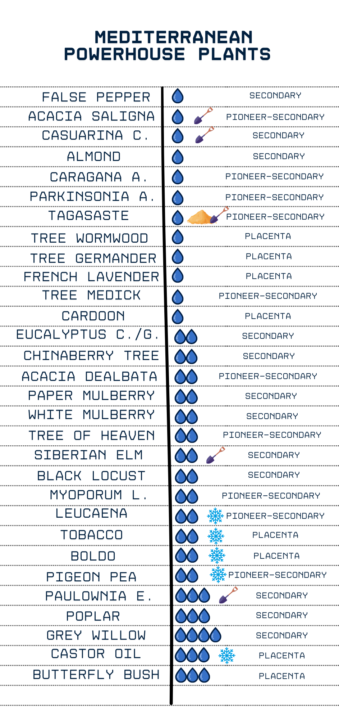
Powerhouse Plants for the Mediterranean Climate
Electing your plant species for your syntropic system is a very difficult process for many. It's this typical overwhelming process where you don't know which plants to choose, that's why I aimed at making it much easier for you; condensing it down to 30 plants that grow very fast. Bear with me, it doesn't include later succession species, but don't worry, it's much more important to elect the right species entering into the secondary phase of a forest rather than thinking too much about which species will come later, as you can plant these later anyway. Most important advice here, don't overthink it, use whatever species grows fastest in your context to establish your system ASAP. I've separated the low water needs plants from the moderate water needs from the high water needs plants - symbolized by the water droplets. To be clear this is about water requirements at establishment, many plants in the moderate water needs will become tough as nails over time but if not watered enough at establishment, they will die. As well, the pile of sand (only tagasaste) symbolizes the need of the plant to be in loose or sandy soil. The shovel means these plants require good decompaction to get a good headstart - meaning breaking down the hardpan in a clay compacted soil - ex: using a subsoiler. Also, the snowflake means that these plants are frost sensitive, typically when temperatures go lower than 2 degrees they can exhibit damage. these plants are truly meant for a mild Mediterranean climate - especially mild winters. Lastly, the successional role of these plants is added at the end : - Placenta : Short-lived - Usually about 5 years maximum within a Mediterranean syntropic system. They can reach maturity within 6 months to a year and provide the fastest growth at establishment of your system. - Pioneer - Secondary : Plants that consolidate the transition from scrubland to forest. They are fast-growing too - but not as much as the placenta plants, usually reaching maturity around year 2 or 3. They create these conditions for the secondary forest to take place by providing high amounts of biomass and shade for the secondary seedlings below.
0 likes • Jan 21
I had no idea of any of this when I started out. Successions, beneficials etc 😂🤣🤣. I just started planting fruit trees I liked and kept going. The more I planted, the more I became curious really. Finding Skool has been literally the breakthrough I absolutely needed for sure. Having spaces like yours is definitely crystallising how I need to be more intentional in what works. Keenly following. Loving it👌
1-2 of 2

@edwin-bomani-5372
Road to retirement. Creating resilient systems in wellness and wholesome living. Natural building methods , permaculture, aquaponics, biogas and more
Active 4h ago
Joined Jan 14, 2026