Activity
Mon
Wed
Fri
Sun
Aug
Sep
Oct
Nov
Dec
Jan
Feb
Mar
Apr
May
Jun
What is this?
Less
More
Memberships
Wholesale Vacant Land
18.3k members • Free
Contemporary Art
78 members • Free
Fluency University
1.6k members • Free
4 contributions to Contemporary Art
Feb '25 •
Personal Emergency & Life Events Pushing Back Class Scheduling
I hope you're all doing well. I want to take a moment to apologize for the rescheduling of our classes last week and this week. Classes on our syllabus will pick back up next week or early March. This course means a lot to me, and I want to show up fully present and prepared to engage in the way that you all deserve. I’ll send an update soon but new dates are on the calendar. In the meantime, I encourage you to continue reflecting on past discussions, engaging with the materials, and sharing thoughts in the community space. I truly appreciate your patience

0 likes • Feb '25
Hope all is well, look forward to your return!
Feb '25 •
Halftime show w/ what we’ve been learning.
I’m uncertain if I’m permitted to do this, but can we analyze Kendrick’s performance? I believe what we’ve been learning was illustrated throughout his performance.
Feb '25 •
⏰ Class 2 Now Posted! (Write Discussion Notes Below)
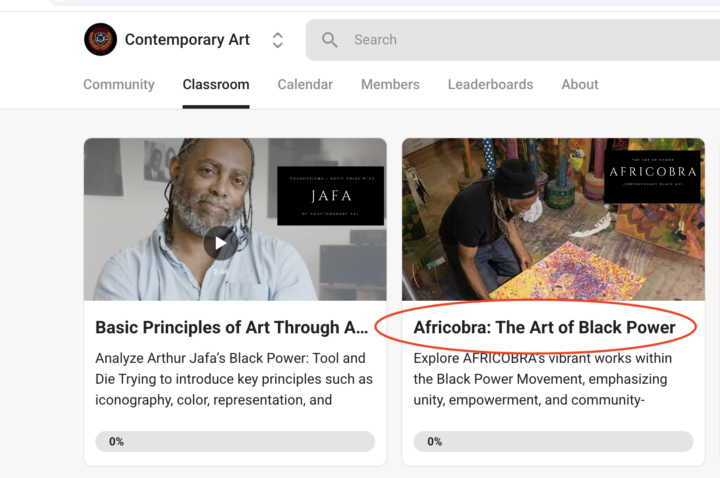
Write your discussion notes below from "AFRICOBRA – The Art of Black Power and Cultural Revolution ." If you are having trouble opening it, view the screenshot below with instructions. QUESTIONS: In 1967, Jeff Donaldson, a pivotal figure in the Black Arts Movement and co-founder of AFRICOBRA, posed a series of thought-provoking questions to fellow artists. These questions were designed to challenge and inspire artists to reflect on their roles and the impact of their work within the Black community. 1. The Role of the Artist in Society: What responsibilities do Black artists have in representing and uplifting their communities? 2. Defining a Black Aesthetic: How can artists develop a distinct aesthetic that authentically reflects Black culture and experiences? 3. Art as a Tool for Social Change: In what ways can art be utilized to address and combat social injustices faced by the Black community? 4. Community Engagement: How can artists actively involve and engage the Black community in the creation and appreciation of art? 5. Cultural Preservation: What role does art play in preserving and celebrating African heritage and traditions within the diaspora? 6. Economic Empowerment: How can Black artists create sustainable economic opportunities for themselves and their communities through their work? 7. Collaborative Efforts: In what ways can artists collaborate to strengthen the collective impact of Black art movements? 8. Challenging Stereotypes: How can art be used to dismantle harmful stereotypes and reshape the narrative surrounding Black identities?
0 likes • Feb '25
1. The Role of the Artist in Society: What responsibilities do Black artists have in representing and uplifting their communities? A: Our responsibility is to identify and amplify the voices of the heard and unspoken past, present, and future. As Black artists, we possess the unique ability to draw inspiration from the challenges we have faced throughout history, expressing this through various forms of art in its rawest form. I firmly believe that our strength as storytellers, revolutionaries, and agents of change in the arts stems from our awareness of the obstacles from our past and current reality. Instead of allowing society to use these challenges as weapons against us, we can harness them as tools for calling others to action. Howard Mallory, a member of AfriCOBRA, stated in an interview, “Our self-worth is not defined by the power to be.” To uplift our communities as Black artists, we must remind our community that we have the power to become; we don’t have to accept the reality of merely “surviving in America.” As mentioned in the video, in order to build a nation, we must work together. While working alone may allow us to move quickly, working together helps us go far. 2. Defining Black Aesthetic: How can artists develop a distinct aesthetic that authentically reflects Black culture and experiences? A: Through community and classes such as this, this platform does not only educate us about the many Black artists and their voices, past and present, but it's also building a foundation by reflecting on Black culture and experiences. This empowers us with the tools to design solutions in today’s world. Authenticity emerges from a foundation paved before us, rooted in the Black Arts Movement. As a dancer, I learned early on how past movements influenced today’s genres and subgenres of different styles of dance. My mentor would say, “Don’t ignore the gap; instead, build the bridge.” This is how we cultivate a distinct aesthetic—by connecting the past with the present, honoring our history while innovating for the future, just as those before us did. The aesthetic exists within our lifestyle and experiences just as it did in the past. Now, we must consider how we can contribute to it.
Jan '25 •
⏰ Class 1 Now Posted! (Write Discussion Notes Below)
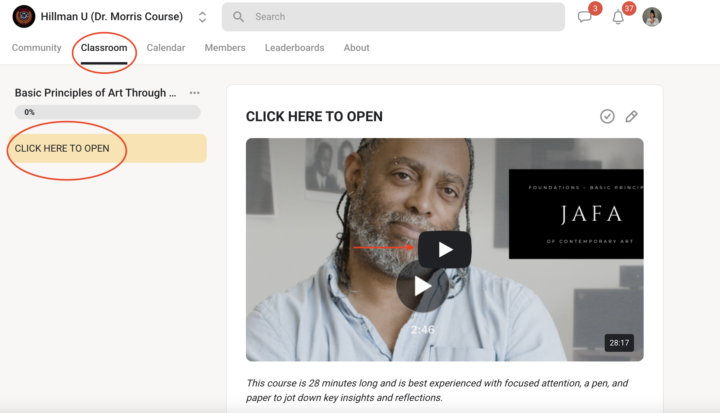
Write your discussion notes below from "Foundations – Basic Principles of Art Through Arthur Jafa." If you are having trouble opening it, view the screenshot below with instructions. SUPPLEMENTAL QUESTIONS: 1. How does rhythm appear in both the tool installation and photo arrangements? 2. Where do you see the strongest contrasts in the exhibition? 3. How does Jafa use proportion to create emphasis? 4. What movements guide viewers through the space? 5. How do recurring symbols create visual connections? 6. Where do you see hierarchy in the exhibition layout? This approach makes contemporary art principles more accessible while using Jafa's work as a concrete example of their application.
4 likes • Jan '25
I am excited to delve deeper into this class. Thank you for creating a safe space to educate and guide our growth in understanding our voices as Black artists. When analyzing Arthur Jafa’s work, I had to take a step back and view it in its entirety. Jafa mentioned in his interview that he’s not trying to convey a single message but instead aims to DO multiple things through his work, which creates a lens of simplicity through complexity because we can take in so much a once or break it down little by little. In his work, he shows the duality of events occurring at the same time designing it in a way that demands your focus and fixes your focus all at once, creating a rhythm of that throughout the installment— what are we choosing to acknowledge? Which side of history are we fixated on? What caught my attention, if you look at the hallway adjacent to the pipes on the wall, it illustrates the principle of proportion, which could highlight the limitations then of being black in America and the foundation that was laid to get us where we are today. I also couldn’t help but notice the reflection of the pipes. I believe it represents our past and the blood that was shed to build the body of black existence. Entering the installation gives us an introspective conversation as we see which history we’re fixated on. As you discussed iconography as a symbolic cultural representation created by the artist, I couldn’t help but see his work as one cohesive art piece rather than a collection of different works. We are witnessing the complexities of the term "Black" and its various implications, as the post suggests, when viewing the installation as a whole. I think Jafa is attempting to build tension. In today’s society, people often struggle to hold tension because it makes them uncomfortable, which is a feeling evoked by Jafa’s work. I don’t believe he intends to make a statement by simply stating something; rather, he wants us, as viewers, to engage deeply and process everything at once. His hope seems to be to provoke the tension that his work may uncomfortably bring while encouraging curiosity and introspection.
1-4 of 4
@dennis-stagg-3937
Hello! My name is Dennis and I’m looking forward to being apart of this class.
Active 26d ago
Joined Jan 28, 2025