Activity
Mon
Wed
Fri
Sun
Mar
Apr
May
Jun
Jul
Aug
Sep
Oct
Nov
Dec
Jan
Feb
What is this?
Less
More
Memberships
Peptides4Power
1.3k members • Free
Exploring Peptides Community
10.8k members • Free
Peptide Price
9.2k members • Free
Peptides & Pump Knowledge Base
744 members • Free
212 contributions to Peptide Price

🔥
21h •
💘 Two More Valentine's Day Deals Just Dropped Modern + Omegamino
Two more sales just popped up and I wanted to make sure you guys know about them before they're gone — both are TODAY ONLY. 🔬 Omega Amino — 30% Off (Stackable) Omega Amino is running 20% off site-wide and my code DEREK stacks on top for an additional 10% off. 🔗 https://omegamino.net/?ref=Derek 🔑 Code: DEREK (extra 10% off, stackable) 📅 February 14th only 🧬 Modern Aminos — Code DEREK Boosted to 15% Modern Aminos just bumped my code from 10% → 15% off. If you've been eyeing any of their amino blends or unique formulations, this is the widest variety of products in the space and the code works sitewide. 🔗 https://modernaminos.com/?ref=derek 🔑 Code: DEREK (15% off) 📅 February 14th only Compare Here: peptideprice.store Both deals are gone after today. Don't sleep on these. Happy Valentine's Day ❤️ PS. I'm sorry about all the sales announcements. It's just a crazy time right now for research sales. We will get back to a lot more educational content after these sales wrap up. Research Use Only — Derek


🔥
6 likes • 21h
For the love of money, STOP! 🤪😂😂
🔥
1 like • 21h
@Nancy Lopez Olivera All right! Properly endorsed! 🤪👍😂😂😂
🔥
22h •
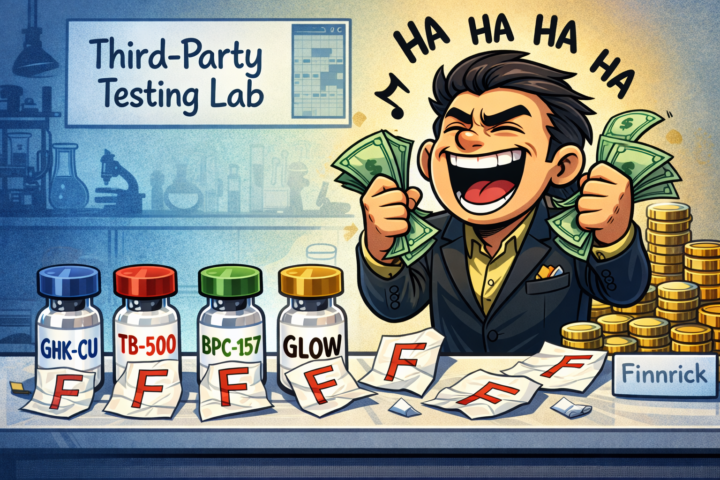
🔬 The Truth About Finnrick & "Independent" Peptide Testing Websites
Let's talk about something that keeps coming up — these third-party testing websites that position themselves as the ultimate source of truth for peptide purity across every vendor in the space. The concept sounds great on paper. An independent party comes in, collects samples, sends them to a lab, publishes the results, and gives researchers a one-stop shop for purity verification. In theory? Fantastic. In practice? I have some serious concerns. How They Work These sites collect samples from individual researchers, send them off to third-party testing labs, accumulate the data, and publish their findings. Sounds noble, right? Here's where it falls apart for me: nothing is truly free. Lab testing is expensive. Running a platform is expensive. Collecting and processing samples at scale is expensive. So when a website is testing hundreds of samples across dozens of vendors and not charging researchers a dime — you have to ask: where is the money coming from? Follow the Money A lot of these sites are backed by corporate interests. That alone should make you pause. When there's a financial incentive behind "independent" results, the independence becomes questionable. I've seen some very interesting interviews — specifically from Finnrick — where the people behind these platforms couldn't clearly articulate a real business model. No transparent revenue stream. No clear explanation of how they sustain operations. That's a red flag. My honest take? I believe sites like these are incentivized to surface bad purity results for established vendors. Think about it — if a major company sees poor results published about their products, what's the natural next step? They go directly to that testing platform to "verify" or get "certified." And now that testing company has a paying customer. Rinse and repeat. That's how you go from bleeding money to printing it. Why I Don't Personally Trust It The peptide space already operates in a gray area when it comes to regulation and oversight. Adding another layer of unverified "authority" doesn't solve the problem — it can actually make it worse if the data is being influenced by financial motives.
🔥
1 like • 21h
I depend on you as the "regulatory body". I hope that's OK.
🔥
0 likes • 21h
@Derek Pruski Definitely!
🔥
22h •
Peptide Blends vs. Individual Peptides — Which Route Should You Go?
This question keeps coming up, so let's break it down once and for all. First, let's kill a myth: Peptide blends do NOT degrade each other over time. We've seen plenty of degradation studies on popular blends like Glow, KLOW, and the Wolverine Stack — they hold up just fine together. So that's not a reason to avoid them. So why do people choose blends? Two reasons: convenience and cost. And those are both completely valid. But here's where it gets tricky. I always steer people toward individual peptides if there's any chance they'll need to modulate or titrate their research amounts up or down based on biofeedback. Take GLOW for example — that's 50 mg GHK-Cu, 10 mg BPC-157, and 10 mg TB-500 in one vial. Sounds great on paper. But what happens when your research calls for more BPC and TB-500? Now your GHK-Cu amount is climbing right along with it — and you might not want or need that much GHK. The reality is, a lot of the time you don't know ahead of time whether you're going to need to adjust. And that's exactly the problem. When everything is locked into one ratio, you lose the ability to fine-tune. When DO blends make sense? If you already know your amounts are going to stay constant. Something like a GHK-Cu + KPV blend where you're holding both steady — that's a perfectly reasonable use case. No need to overcomplicate it. The bottom line: Are blends bad? Absolutely not. But combining too many things into one vial can leave you guessing — guessing what's causing a side effect, guessing what you need more or less of. Individual peptides give you full control. Convenience is great. Control is better. If you can go the individual route, that's what I recommend. If you know your protocol is dialed in and nothing's changing, a blend can save you time and money. Just know the trade-off going in. Drop any questions below 👇

🔥
1 like • 22h
I prefer individual peptides, myself. Sometimes I lower or raise the dose of something, and you can't do that with a blend.
🔥
2d •
🧬 What Bioregulators Do YOU Want to See From Vendors?
Which bioregulators would you most like to see available? Drop your votes below and comment if there's one I missed. If possible, drop your top three. This will help a lot, thank you in advance.
Poll
133 members have voted
🔥
0 likes • 2d
My top 3 Cartalax Bronchogen Retinalamin
🔥
2d •
🔥 February 13th — THREE Brand New Sales Just Dropped 🔥
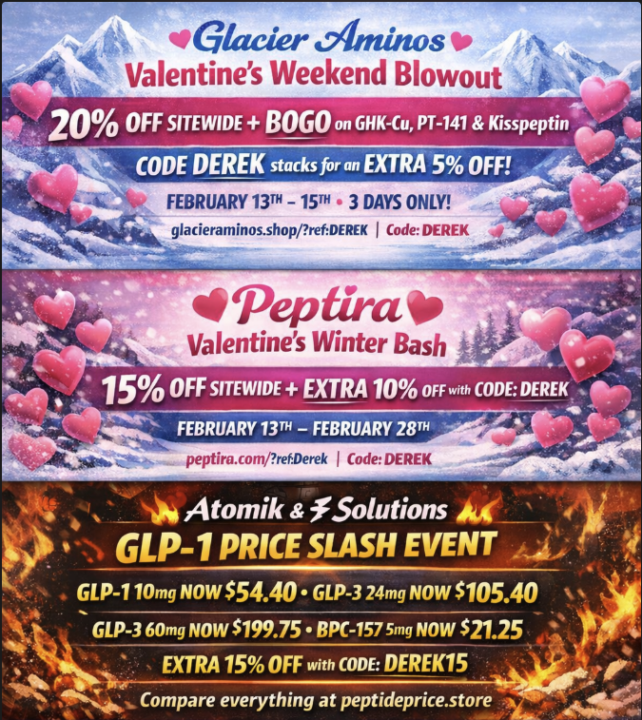
Happy Valentine's week, researchers! We've got three fresh sales hitting all at once. Let's get into it. 🥶 Glacier Aminos — Valentine's Weekend Blowout 20% OFF SITEWIDE + BOGO on GHK-Cu, PT-141 & Kisspeptin Code DEREK stacks on top for an additional 5% off — that's 25% off everything plus buy-one-get-one on three popular compounds. February 13th – February 15th at midnight MST — only 3 days! https://glacieraminos.shop/?ref=DEREK | Code: DEREK 💘 Peptira — Valentine's Winter Bash 15% off site-wide PLUS an extra 10% off with code DEREK — up to 25% off some of the highest-quality research peptides on the market. February 13th – February 28th https://peptira.com/?ref=Derek | Code: DEREK 🔥 Atomik & Solutions — GLP-1 Price Slash Event Slashed pricing PLUS an extra 15% off on top with code DEREK15: GLP-1 10mg — $99 → Slashed to $64 → $54.40 after code GLP-3 24mg — $199 → Slashed to $124 → $105.40 after code GLP-3 60mg — $544 → Slashed to $235 → $199.75 after code Stack even more: $5 off with ACH | 3% off with Bitcoin Live now — February 13th. No announced end date. https://atomiklabz.com/aff/51/ https://solutionpeptides.net/aff/51/ Code: DEREK15 As always, you can compare pricing across all vendors at https://peptideprice.store. All products are for research use only and not for human consumption. Don't sleep on these — especially Glacier, which ends in just 3 days.
🔥
0 likes • 2d
I can't find COA for GHK-CU on Glacier. @Richard K I'm sorry, I deleted my comment which deleted everything. How did you find the COA?
🔥
1 like • 2d
@Richard K Thank you! I appreciate that!
1-10 of 212

🔥
@deborah-brown-5014
Got into peptides to lose weight and fell down the peptide hole! Born 1955
Online now
Joined Nov 4, 2025
Michigan