Activity
Mon
Wed
Fri
Sun
Jan
Feb
Mar
Apr
May
Jun
Jul
Aug
Sep
Oct
Nov
Dec
What is this?
Less
More
Memberships
Data Alchemy
38.1k members • Free
7 contributions to Data Alchemy

Jul '23 •
Welcome to Data Alchemy - Start Here
The goal of this group is to help you navigate the complex and rapidly evolving world of data science and artificial intelligence. This is your hub to stay up-to-date on the latest trends, learn specialized skills to turn raw data into valuable insights, connect with a community of like-minded individuals, and ultimately, become a Data Alchemist. Together, let's decode the language of data and shape a future where knowledge and community illuminate our way. Rules - Don't sell anything here or use Data Alchemy as any kind of funnel - We delete low effort community posts, and posts with poor English. Proofread your post first. - Help us make the posts high quality. If you see a low quality post, then click on the 3 dots on the post and "Report To Admins". Start by checking out these links - Classroom - Introduction - Roadmap - Contribution Be Aware of Scammers - Please be aware that this is a public group. Unfortunately, some people abuse the Skool platform to send DMs or post comments to trick people. This is the internet, so always do your own due diligence. Never automatically trust someone here on the Skool platform other than @Dave Ebbelaar's official account. To kick things off, please comment below, introducing yourself. Let us know: 1. Your name and where you're from 2. What project(s) you're currently focused on See you in the comments!


6 likes • Mar '24
Welcome! Sounds like you’ve got a solid background. Thanks for joining.
6 likes • Mar '24
It sure is enlightening to see how many people in the world here are in the hunt for gold, so to speak, by massaging data to gain insights. It’s kinda inspiring. Thanks.

Mar '24 •
Frontend-Frameworks Python and Beyond - Discussion
Hi everyone, just want to quickly drop a question concerning the "overall landscape" of frontend-frameworks. Afaik, as Python Programmers we have the following options: - Templating Frameworks (Flask, Fast-API, Django): Uses Jinja, everything happens server-side, each small change forces a rerun and a refresh of the whole website, complex, slow - Streamlit / Dash / Gradio Frameworks: Varying degrees of speed/flexibility (rerun of the whole page or different components), uses ReactJS under the hood - HTMX: New framework which is like a templating framework but can be applied to single HTML elements, faster, more flexible - Full React/JS: Python is only used for the backend, the frontend is run by a JS-Framework, (maybe with GraphQL? - no idea what that does), professional, but steep learning curve - FastUI: No idea into which box to put th - Webassembly - no idea what that is either I have used Streamlit, but I have found it a bit lacking in speed and flexibility. HTMX is promising, a full backend/frontend split and using JS for the frontend is probably the most professional approach. What are your experiences, what is your opinion/preferences, do you agree with my assessment, or are there any factual mistakes?
3 likes • Mar '24
I second what’s been said above. Python is just not the best front end tool or framework. To confirm this, I once dissected the Python Foundation’s website. I figured if anyone was using Python for serious web development it would be them. Nothing special. It was good HTML. Solid JavaScript. :) Having said that, Jupyter documents are a front-end tool that deserve to be in every website dedicated to technical documentation. Love to hear if anyone has a different take. I don’t want to be missing out on something good
Mar '24 •
Data Science Applied to Wordle?
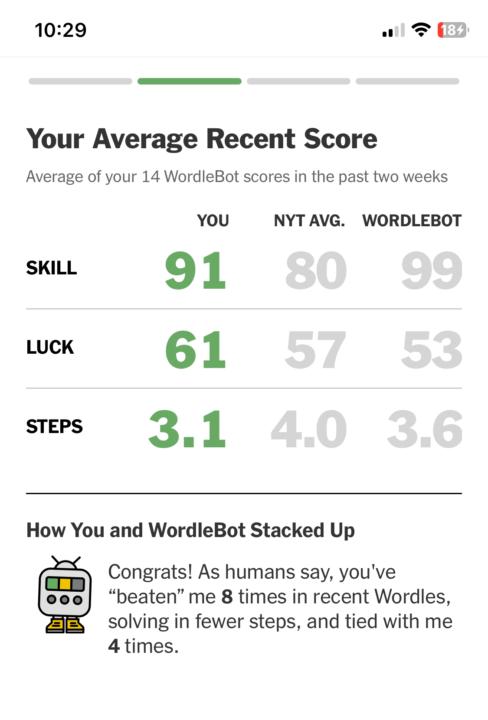
Hey, anyone playing Wordle (NYT puzzle) and applying data science to it? If so, I'd love to hear about your approach. (My current 25-day average is 3.04 and my 100-day average is 3.12.) Anyone better? For those interested... the puzzle comes with a bot (WordleBot) that shows the data science it uses to solve the puzzle. It scores better than the average human player and you can learn a lot from it, but it's not as clever as it could be. My bot routinely beats WordleBot. It uses all the knowledge and data science I have available (short of looking up the answers in advance on the web) but I don't know how to formally explain some of the insights it has uncovered. ("Clusters of probability?" Is there such a thing?) I'm wondering if there are experts on this forum with techniques better than mine that would be willing to share. Attached are my current and best 14-day average scores... Any puzzle-gamers out there?
2 likes • Mar '24
p.s. The WordleBot always rates my skill as lower and my luck as higher than its own because it doesn't understand how I get better scores than it does. :)

Mar '24 •
Hello World 👋
Hi everyone, I found the group on the recommendation of a friend and I'm very excited to see that the group is still active and has a community of members, from what I've seen so far, that is very receptive and engaged. I am a Ads manager, Data Analyst and new business enthusiast and I see A.I. as an unstoppable reality. My English isn't very good, so I hope I can handle it well. I hope to learn and contribute with you guys. 🥰
3 likes • Mar '24
@Renan Alves I'm working on writing firmware for microcontrollers that drive CNC milling machines to create smooth toolpaths. I'm using AI to discover analogies in scientific concepts. For example, I strongly suspect that there is an analogy between the transmission of information (Shannons) and the way light and electrons are transmitted from one atom to another. (In other words, when a photon travels from one place to another, I think this might actually be information that's traveling.) I think the shared properties of light and information - they both involve probabilities - might be "more than a metaphor."
3 likes • Mar '24
@Renan Alves p.s. I once worked for an advertising company, so I have some a tiny bit of knowledge of your field.
Mar '24 •
Money is Data
One of the things I like about this group is that it discusses how to make money as a data scientist, not only because money is necessary and/or liberating, but because money is part of the data stream. It's flow or lack of flow, it's accumulation or decline, tells us whether or not we're producing something of value... or communicating and actually transferring that value. Money is not the only data point, but it should not be ignored. It is data.
3 likes • Mar '24
Honestly, maybe the most important things is to follow your obsessions and also respond to what’s urgent. That’s just what I did. I owned a company (onsite computer repair) that needed better billing software but I couldn’t afford any of the commercially available programs at the time, so I responded to that urgency by writing my own billing program in Access which was free to me at the time. At the same time, I got the programming bug, I guess. I sat at the counter of a diner for hours with my laptop, just determined to write a simple tic-tac-toe program. I don’t know why I felt I had to do that. But it felt critical to learn. Soon after that a wealthy neighbor asked me if I would write a program that generated real estate closing documents. I jumped in and did it and that was the first time I got paid directly for programming. So I guess my only advice on connecting money to programming is follow the opportunities right in front of you, also follow threads of learning you feel compelled by some crazy instinct to follow, and people will see your capability and passion and pay you to solve their problems… which in turn leads to more learning and passion. If you were asking a different question than I answered, please let me know. I don’t know all the answers by far, but I’m still really interested in exploring how money flows where information, talent, and good judgment do. What’s the connection between good design and smooth economics? Are they branches of the same process — the search for Quality?
1-7 of 7

@david-long-5572
Wrote my first AI in 2001 and began applying it to improving the quality and beauty of hand- and machine-made products over the last 10-15 years.
Active 616d ago
Joined Jan 26, 2024
Powered by