Activity
Mon
Wed
Fri
Sun
Nov
Dec
Jan
Feb
Mar
Apr
May
Jun
Jul
Aug
Sep
What is this?
Less
More
5 contributions to What Do You Want? Library

Nov '25 •
Prompt for Founder’s Study Guide
Here is an example of a prompt I use to create detailed study guides for each episode. I have attached an example of the output. This is just to help start the conversation on the best way to study and learn from Founders Podcasts. The issue I have is, if I don’t have notebook in hand, I miss key actionable ideas. This helps me not forget the most important principles David is teaching u. CO-STAR Prompt: Founders Podcast — Study Guide Builder Context You will create an in-depth, structured study guide for a single episode of the Founders podcast. The audience is a Skool community of entrepreneurs and operators who listen to Founders to sharpen their edge. They want notes that help them think better, execute faster, and build stronger companies. Objective Turn the episode into a tool: a practical study guide that extracts the episode’s most useful insights, strategies, and patterns. This is not a summary. It’s a founder-to-founder field manual built from the stories, decisions, and scars inside the episode. Style Story-driven like Founders, but clean and structured so readers can skim or dig deep. Vivid examples, strong verbs, short sentences, no wasted words. Tone Intense. Sharp. No-fluff. Assume the reader cares about winning and hates filler. Audience Entrepreneurs at every level—first-time founders to seasoned operators. The writing must be clear enough for a beginner, but sharp enough a veteran learns something new. ✅ Response Structure (1–3 pages max) 1. TitleName of the episode or featured entrepreneur. 2. Big IdeaOne or two sentences that capture what matters most from this episode. 3. Core TakeawaysBold bullet points.Tactics, strategies, beliefs, and mental models that are usable. 4. Teachable PrinciplesBreak down the founder’s operating system.How they thought, made decisions, and competed. 5. Reflection QuestionsQuestions that force the reader to apply the ideas to their own business. 6. Noteworthy QuotesShort, powerful lines from the episode showing how the founder thinks. 7. Founder FlawsWhere they got punched in the mouth—mistakes, blind spots, overconfidence, missed markets. 8. Modern ApplicationHow a founder today can use these lessons in 2025:early-stage, growth-stage, or owner-operator. 9. If You Only Remember One Thing…One sentence. The essence.

1 like • Nov '25
That's a fantastic prompt output and a generous share @Kendall Doble. I also really appreciate how you didn't (or, at least it doesn't look like you did) outsource the most important part of it which is that list of 9 things in the response structure. Well done, and thank you!
Nov '25 •
Even fanatics need the reminder: Ask better questions before you start.
Here I was trying to build an AI automation to scrape every Founders transcript… Then I did a Google search. Turns out every episode is already organized in one place. Common sense: 1 Me: 0 Asking better questions beats knowing fancy answers. I had the knowledge, but skipped the obvious step. For the group: here’s the link with all 462 Founders transcripts in one spot: https://www.tapesearch.com/podcast/founders/1141877104 Reading transcripts doesn’t replace listening. It lets you study deeper, pull quotes, and create your own notes. Use both. I’ll post a CO-STAR prompt to turn any episode into a study guide you can save, review, or print. Have fun with it. Play with the tools. Build your own system. Even fanatics need the reminder: Ask better questions before you start.
0 likes • Nov '25
Hear hear - asking better questions (and then actually paying attention to the answers...) makes all the difference in the world doesn't it @Kendall Doble ! 😎

Nov '25 •
Just here to connect & make friends
Hey everyone, I’m Adli/AT from Singapore. I’m working on a My startup business and joined Skool to meet people who are into growth, entrepreneurship, helping others and just having real conversations. Not here to sell anything but just want to network, share ideas, and make new friends. If you’re chill and open-minded, let’s connect here or even chat on Discord / WhatsApp if we vibe on a deeper level. Really want to my friend with same minded people. Drop a 👊 or say hi below and I’ll follow you back!
1 like • Nov '25
Hey Adli! 👋

Nov '25 •
The seven most common characteristics of founders (and the one most are missing)
I posted this previously, but I think it got lost, and I would love y’all‘s feedback on this list. I’ve listened to over 250 founders podcast episodes, started from the beginning, and I’ve put together a list of the most common characteristics that I was seeing over and over again, as well as the one that I’ve only really seen in Ed Thorpe. Here’s the list: The 8 - 1. Relentless resourcefulness 2. Dogged work ethic - James Dyson, Ernest Shackleton 3. Watching and cutting costs - Henry Clay Frick, Rockefeller 4. Stupidly high self confidence - all of them 😂 5. Obsessed with control - 6. FOCUS. Intense, singular focus. 7. Time to ponder, aka unstructured thinking time, aka mentally-active-physical-laziness 8. (the one most are missing) Knowing when enough is enough - Ed Thorpe Am I missing any? Or do you disagree with any of these? Would love thoughts on this

2 likes • Nov '25
It's an interesting list @Max Baldauf. I often wonder about these kinds of things. How possible is it that we can will ourselves toward these behaviors that exemplified (very) idiosyncratic leaders enough that they'll work for us at the level they did for them. Perhaps it was in their wiring differently than it is in ours? In effect, just because I aspire to the work ethic if Shackleton doesn't necessarily mean I'm capable of achieving it at the level that makes possible the accomplishments he achieved. I'm *not* suggesting we shouldn't aspire to these things. It's more about whether or not we're setting ourselves up for entrepreneurial and leadership burnout conditions by driving ourselves toward somebody else's example in pursuit of the same result. Learning from others is fantastic (and worthy of our time), figuring out how it applies to our particular space and time is equally important since we are unlikely to be idiosyncratic in these ways (and, to @Kendall Doble 's point - would we listen if we were?)
1 like • Nov '25
There's a study from quite some time ago called "Touched by Fire" in which a group of clinical psychologists determined there's a statistically significant increase in the incidence of DSM classified disorders present in entrepreneurs @Max Baldauf. It's these conditions that are actually often credited with the entrepreneur's success. For example, if you consider that people with ASD (someone in my family has this) sometimes/often have difficulty with social cues, it wouldn't be surprising that they take actions which result in commercial success while destroying interpersonal relationships along the way. People see the success but they either 1) don't see or 2) diminish the impact of the trail of damage behind the scenes. Folks have discussed elements of this with Musk's apparent behaviors and success. Clinically diagnosed narcissism (vs. armchair opinions of highly self-focused behavior) follows a similar pattern. In these conditions, I would be inclined to agree with your "unreplicatable" assessment and it's what I meant about incredibly idiosyncratic success of many of these founders. There's a venn diagram of factors contributing to their success - one of which is related to their behavioral patterns driven by their DNA which, by definition, isn't something replicable.
Nov '25 •
Saw this and thought it was cool
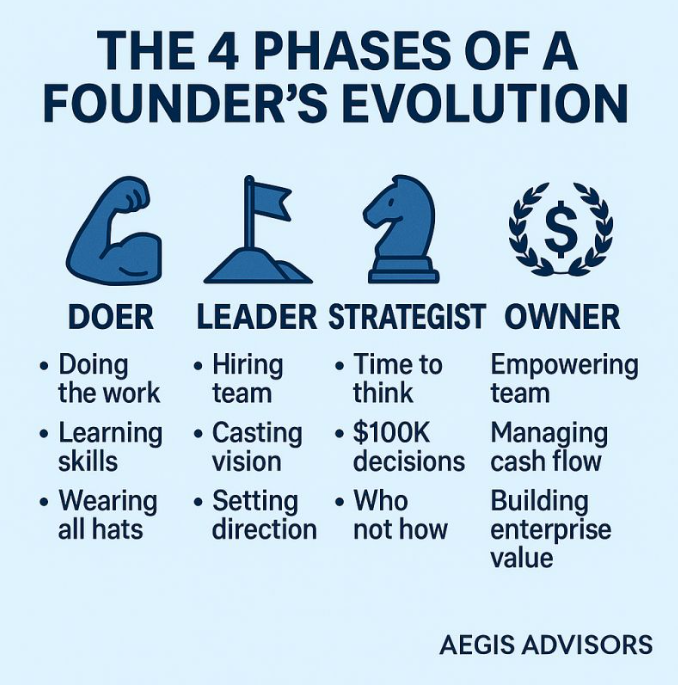
I should've announced this before, I'm sorry - Sundays are my day of rest, so I will not be active in the community those days. Eventually we'll grow this community where we'll have more than one admin to help solve problems or anything when we've got hundreds or thousands of people in here, but for now it's just me haha. I saw this this morning and thought it was a good visual aid! Let's make this week amazing!!
1 like • Nov '25
That's an interesting graphic @Max Baldauf. I have thoughts but they're not from a Founders episode and I feel like they might change in meaningful ways with a little more context.
1 like • Nov '25
I think it's a bit misleading @Max Baldauf because they're not actually discrete phases as implied. Most founders have to do all of these at some level all the time. For example, "doing the work" happens at all 4 of these stages - "what the work is" just looks different. It's a similar fallacy to the whole "maker vs. manager" mentality. Want a contract? Somebody's got to "make" that. It involves talking to other humans. Want some software? You've got to talk to other humans in addition to just coding. We love models and there's absolutely a place for them. We should also be ready to make every one of their words earn it's place on the page. I have been (on and off) working on a different model for the stages of a founder's journey. It has more to do with how the team works as we move from solo to leader of other humans. I haven't published it yet though so I'll leave you with a little tension. 😂
1-5 of 5

@dave-bates-9729
I'm an executive coach, consultant, author, and speaker with a focus on leadership and entrepreneurship.
Active 327d ago
Joined Nov 5, 2025
Raleigh, NC