Activity
Mon
Wed
Fri
Sun
Nov
Dec
Jan
Feb
Mar
Apr
May
Jun
Jul
Aug
Sep
What is this?
Less
More
The Empowerment Suite
407
5.0
Free
The Clarity Circle™
32.2k
Free
Holistic Health Academy
400
$7/m
Ultra Skool | Vagus Coaching
133
$9/m
Vagus School
1.1k
Free
17 contributions to Vagus School

Apr 15 •
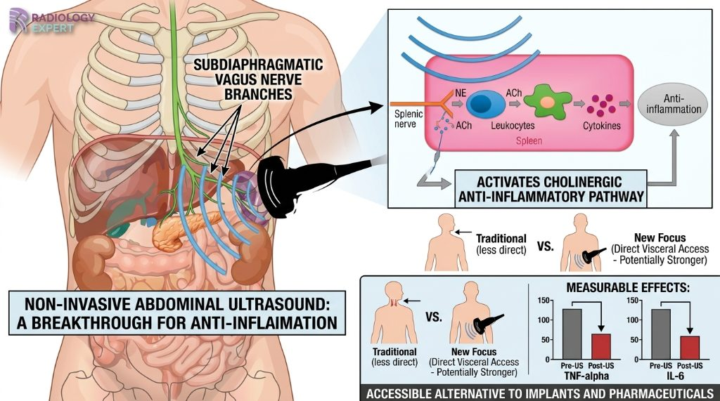
Revolutionary Splenic Abdominal Ultrasound Tech Targets Chronic Inflammation
Transcutaneous ultrasound applied to the abdomen is a precise method to modulate the cholinergic anti-inflammatory pathway. By targeting the subdiaphragmatic branches of the vagus nerve, this non-invasive approach directly inhibits pro-inflammatory cytokine production within the viscera. While traditional neuromodulation focuses on the cervical vagus nerve, abdominal stimulation provides direct access to the organs where systemic inflammation often originates. Recent clinical data demonstrate that focused ultrasound waves can significantly reduce circulating levels of inflammatory markers like TNF-alpha and IL-6. This technology offers a scalable, non-pharmacological alternative to invasive surgical implants or long-term immunosuppressant therapy. The clinical implications are profound for managing autoimmune conditions, Inflammatory Bowel Disease (IBD), and metabolic disorders driven by chronic inflammation. Precision bioelectronic medicine is shifting from internal hardware to targeted, external acoustic energy to restore systemic homeostasis. https://www.nature.com/articles/s41467-019-08750-9 https://www.ncbi.nlm.nih.gov/pmc/articles/PMC5859128/ https://www.skool.com/vagus/major-breakthrough-an-easier-way-to-target-inflammation-effectively-through-abdomen

0 likes • 25d
@Sterling Cooley is this the same protocol you refer to here? => https://x.com/sterlingcooley/status/2097746885322957013?s=46&t=P3rPPZAA5uBpVbdnhIDWFA
Sep 1 •
How A 10 Minute Sound Wave Can Shut Down Inflammation
10 minutes — that is all the time a gut ultrasound needs to signal your brain. This sound wave triggers a sensory pathway that can shut down inflammation. Mechanical sound pulses delivered to the abdomen stimulate sensory nerve endings nestled along the digestive tract. This local activation sends a surge of electrical signals up the vagus nerve toward the head. Those ascending impulses travel directly into the brainstem, arriving at a key processing hub called the nucleus tractus solitarius. That arrival triggers a distinct wave of cellular activity across the brainstem within ninety minutes. Once activated, this central hub relays instructions back down through autonomic pathways connecting to the spleen. These descending signals prompt splenic immune cells to release acetylcholine. That chemical messenger binds to specific receptors on nearby macrophages, the immune cells responsible for driving systemic swelling. This receptor contact reprograms the macrophages into a protective, anti-inflammatory state. As a result of this cellular shift, the release of inflammatory proteins like TNF-alpha drops sharply throughout the bloodstream. The entire biological circuit effectively converts a burst of targeted sound into measurable immune relief. Fine-tuning the exact sound frequency and depth for human tissue is the next step. https://www.pnas.org/doi/10.1073/pnas.2518969123

2 likes • Sep 3
Sounds https://youtu.be/hK6OgIEhtvc?is=5HlXUu9yvTysGMhv
Apr 2 •
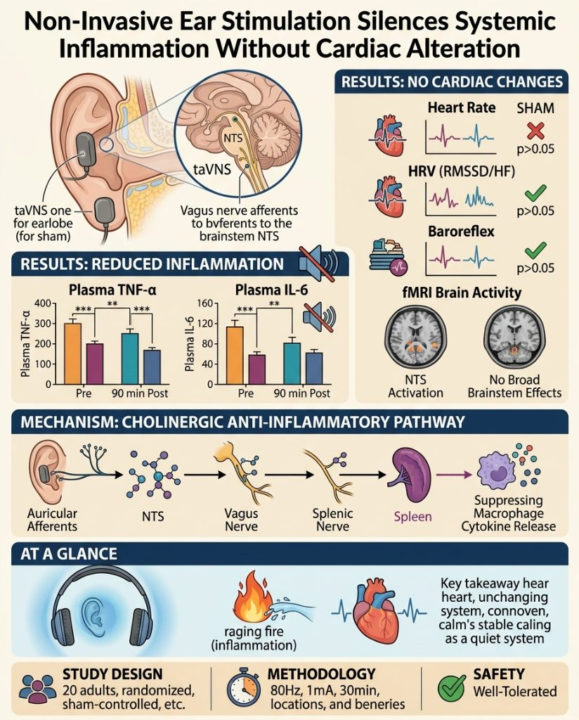
Vagus Nerve Stimulation (80hz) Suppresses Inflammation Without Drugs
Neuromodulation is advancing toward precision physiological control. A randomized, double-blind, sham-controlled trial has confirmed the efficacy of transcutaneous auricular vagus nerve stimulation (taVNS) in suppressing systemic inflammation. By applying 80 Hz pulses to the cymba concha for 30 minutes, researchers observed a 22% reduction in TNF-α and a 15% reduction in IL-6. These results were achieved without pharmaceutical intervention. The data reveals a critical distinction: taVNS modulates the immune system without impacting heart rate variability or baroreflex sensitivity. This indicates the stimulation bypasses cardiac vagal tone entirely. Functional MRI confirms the mechanism involves the nucleus tractus solitarius (NTS). This activates a splenic nerve cholinergic pathway that inhibits macrophage cytokine release at the source. This non-invasive approach provides a blueprint for treating chronic conditions like rheumatoid arthritis and IBD. It represents a paradigm shift toward targeted bioelectronic medicine - even possible further applications in preventing Alzheimer's from developing in the first place. Very big news ! https://pmc.ncbi.nlm.nih.gov/articles/PMC12960021
0 likes • Jul 13
Hi @Sterling Cooley 👋 qvestion - I found this post via your tweet. Is it possible to use the transducer on the ear for this? https://x.com/sterlingcooley/status/2076396241932730741?s=46&t=P3rPPZAA5uBpVbdnhIDWFA
Jul 5 •
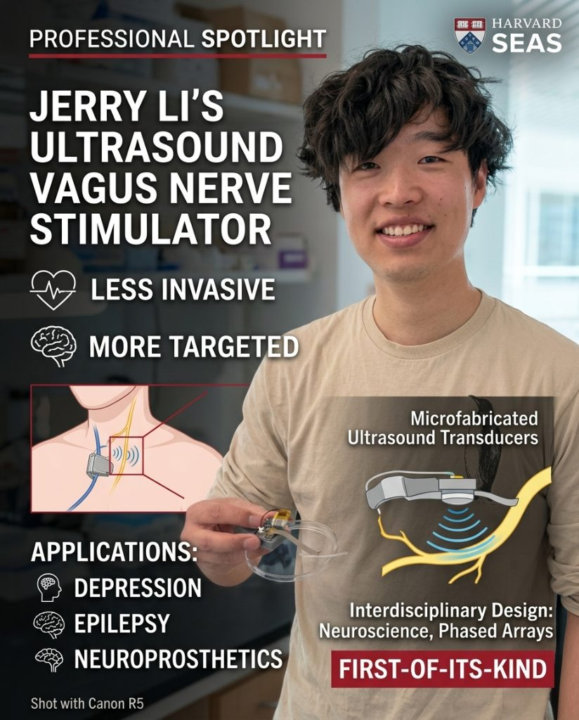
Revolutionizing Nerve Stimulation With The First Flexible Ultrasound Cuff
Jerry Li, an electrical engineering concentrator, developed a flexible cuff as his senior capstone project. The cuff uses ultrasound rather than electrical currents to stimulate the vagus nerve with precision. The approach is presented as having the potential to be less invasive and more targeted than prior methods. Applications noted include future treatment of depression, epilepsy, or support for neuroprosthetic control. Li stated that to his knowledge no one has used microfabricated ultrasound transducers for peripheral nerve stimulation before. Microfabrication work began in May 2025 and continued over the summer. Electronics design was the focus during the academic year. The microfabrication process itself was described as the most challenging element, characterized as a long and detailed procedure even with expert guidance. The project drew on multiple disciplines including neuroscience, phased array theory, wireless charging, and mechanical prototyping. Li noted that the interdisciplinary scope helped build his confidence as an engineer. The work was conducted under the Harvard John A. Paulson School of Engineering and Applied Sciences. https://www.facebook.com/hseas/posts/for-his-senior-capstone-project-electrical-engineering-concentrator-jerry-li-dev/1342732331285198/
1 like • Jul 10
@Sterling Cooley any word on when it will be available? 🤞
Jun 9 •
Master Your Vagus Nerve: A 7-Question Quiz And 5-Step Protocol
The article presents a 7-question self-assessment quiz covering sleep quality, stress recovery time, post-meal gut sensations, resting heart rate, breathing ease, voice and throat function, and social connectedness. Answers produce one of three profiles: resilient (low indication of vagal involvement), mild dysregulation (pattern commonly linked to the vagus nerve), or high-alert/low vagal tone (sympathetic overdrive cluster). The text states that certain responses, such as persistently elevated resting heart rate, ongoing air hunger, or changes in swallowing or voice, warrant medical evaluation before assuming vagal involvement. Two 30-second physical checks are described. The Hum Test involves placing fingers on the neck beside the windpipe while humming a low note to feel vibration along the laryngeal branch of the vagus nerve. The Exhale–Pulse Drop test requires timing a 4-second inhale followed by an 8-second exhale while monitoring pulse to observe slowing on the out-breath. A five-step protocol is outlined in sequential order. Step 1 is daily practice of nasal inhale for 4 seconds and exhale for 6–8 seconds, five minutes three times per day. Step 2 adds one minute of humming after meals, gargling while brushing teeth, and singing. Step 3 introduces cold water or pack on the face or neck for 15–30 seconds as a rescue technique. Step 4 incorporates morning sunlight, rhythmic movement, and consistent evening wind-down. Step 5 adds optional devices only after prior steps are habitual, listing sleep hypnosis audio, a breathwork pendant, and ultrasound stimulation. Symptoms are grouped into four clusters: gut (bloating, reflux, new intolerances), mood and brain (anxiety, brain fog, depersonalization), heart and autonomic (palpitations, low HRV, poor stress recovery), and voice/throat/breath (hoarseness, air hunger). The text notes that modern factors such as digital overload, processed food, and chronic low-grade stress are associated with lower vagal tone. Daily 1–10 self-ratings of sleep, energy, mood, and calm are recommended for tracking.

1 like • Jun 10
Whoa @Sterling Cooley this is amazing thank you and sharing 🖖🙌🎶
1 like • Jun 10
Whoa @Sterling Cooley this is amazing thank you and sharing 🖖🙌🎶
1-10 of 17

Active 23d ago
Joined Feb 15, 2025
Powered by