Activity
Mon
Wed
Fri
Sun
Nov
Dec
Jan
Feb
Mar
Apr
May
Jun
Jul
Aug
Sep
Oct
What is this?
Less
More
Confident Athlete Blueprint
155
Free
🏛️ Coaching Academy
5.3k
Free
The Relationship You Deserve
149
$97/m
Wealth OS - Coaches
1.1k
Free
Clients On Automation
70
5.0
$1,997/m
Expert Coach Certification
22.7k
5.0
Free
Iron Faith Wrestling Academy
8.7k
5.0
$49/m
278 contributions to Expert Coach Certification

Apr 4 •
Dear all,
Any one of you been working with the parents of high school students on building the trustworthy relationship with their teens? If yes, please share your experience. Thank you in advance for your time!

2 likes • Apr 5
@Ritu Raj @Ed JC Smith Generally, parents need to start with a mindset shift. According to Self Determination Theory, teens want three things: autonomy, competence, and relatedness. For parents, that means adopting a mindset and approach of an assistant manager or consultant. Author Michelle Ichard uses the anachronym BRIEF. It is similar to Ed's teachings and is easy to remember and explain to parents. B=begin with peace. If teens feel attacked they will immediately throw up defensive walls and the interaction will trend toward and argument or fight that only leaves the two parties feeling hurt and disconnected. Instead, start with questions like, "I noticed you were upset about your test score. Would you like to talk about it?" R=relate. This means acknowledging whatever the teen is feeling. Validate their emotions by showing you understand whatever is happening can be hard or frustrating. I=Interview. Ichard uses the term interrogate, which carries and adversarial connotation for me, so I change it to Interview. This is where parents ask questions like, "Tell me about it?" and "What else?" to collect information and let teens share all they can. E=Echo. Repeat back to teens what they say using the words they used. This helps them feel validated, heard, and understood. F=Feedback. Ask if they are interested in feedback. This is where parents can offer guidance. The emphasis here is that parents are a resource providing support. The teen still needs to be the doer and the one accountable for outcomes. If the teen is not receptive to feedback in that moment, respect the "no," and emphasize the open offer for when they are ready. The caveat, of course, is that parents can be more authoritative in moments of immediate safety.

Aug '25 •
Certification
I am super excited today: I have been finally certified as an Expert Coach 🙌 👏 🤗, I will be posting my Certificate soon on the community, big ups to Ed J C Smith and the team, guys you are doing an exceptional job on a global scale🙏.
2 likes • Aug '25
[attachment]

Aug '25 •
Story time
"The Way of the Turtle" Long ago, before the rivers carved the valleys and before the winds had names, the Great Spirit gave each being a path and a purpose. Some ran fast like the deer. Some flew high like the eagle. And some, like Turtle, moved slowly but surely, never hurrying, never stopping. This is the story of how Turtle taught the people a lesson they would carry for generations. In a time of hunger and drought, the Council of Elders gathered under the night sky. “We must find a new land,” the Chief said. “Our roots are drying, our wells are silent, and the animals have left. The Spirit has tested us, and we must begin again.” So, the tribe prepared for a long journey across high mountains, burning deserts, and deep forests. Among them was a young brave named Nokose, whose name meant "Bear Cub." Strong of limb but proud of heart, Nokose believed only the strongest would reach the new land. As the People began their trek, he scoffed at those who fell behind—especially old Turtle, who waddled along with a heavy shell and eyes full of patience. “Why even bring him?” Nokose sneered one morning. “By the time Turtle arrives, we will have built a village, raised the children, and grown gray with age.” The Elder Woman, who walked with a stick carved from lightning-struck oak, turned to Nokose and said, “Be careful, Bear Cub. The storm that starts loud may run dry, while a quiet river carves through mountains.” Nokose ignored her and ran ahead, chasing the horizon, leaving others behind. He crossed rivers in a single day, raced wind over cliffs, and beat his chest in pride. Days turned to weeks. The people endured many trials—some were bitten by snakes, others lost their footing on slippery rocks, and some gave up entirely. Turtle never stopped. He moved slowly. When others rested, he kept crawling. When storms came, he curled into his shell and waited, never fearing time or distance. At night, he listened to the Earth’s whispers. In the day, he followed the warmth of the sun.
1 like • Aug '25
This story has me thinking 🤔 thank you!
Aug '25 •
9 ways to build your inner strength
9 Powerful Ways to Build Your Inner Strength While there is plenty of information on how to become bigger, faster, and stronger, there is less available on how to increase one's inner strength. However, in today’s world, inner strength is far more important than physical strength. In our current culture, the ability to manage yourself is more relevant than the ability to lift 500 pounds over your head. The ability to persevere is more valuable than doing 1,000 push-ups. Life is easier to manage when your inner strength grows. Luckily, you can develop greater inner strength without spending a dime of your money or a minute of your time. Use these strategies to create greater inner strength and watch your obstacles fall: 1. Complain less. When you complain, it shows that you don’t believe you influence your life. It convinces some part of you that you’re weak. * If you can fix the situation, do so. If you can’t, deal with it. 2. Finish what you start. One “easy” way to build inner strength is to finish what you start. For example, if you signed up for 20 personal training sessions, finish them all. If you start organizing your office, complete the task. * We’re always starting tasks and then finding an excuse to finish them tomorrow. Finish them today, instead. 3. Fast for 24 hours. Physicians that run fasting clinics state that the average, healthy adult can go six weeks without food. There was a time in the past when many humans regularly didn’t have the luxury of eating each day, much less 3 meals a day, or a second breakfast. * Go 24 hours without consuming any calories. Nothing but water for a day. 4. Take a cold shower or bath. Hot showers and baths are a pleasure. Cold showers and baths aren’t that appealing. Teach yourself to be comfortable with physical discomfort. You’ll even save a little money by using less hot water! 5. Set a 30-day challenge and stick to it. Start with something easy and make it more challenging each day. * An easy challenge might be to go for a walk each day. A more difficult challenge might be to avoid all processed foods for 30-days, or to meditate for 60 minutes each day.
3 likes • Aug '25
Great insight!

Aug '25 •
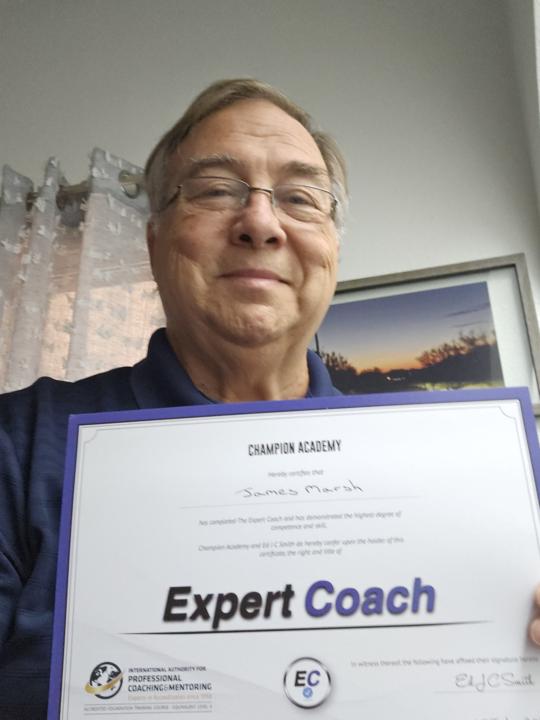
Received my Expert Coach Certificate
From across the pond, it made its way to Arizona. I happy to have achieved this certificate as the course work provides a strong foundation to build upon as I move forward as a coach. It'll provide proof to my clients that I am serious and have a toolset to use. I'm looking forward to be a successful coach, and continue my involvement in this community. Everyone here is supportive, open and non judgmental. Very appreciative of the support here.
6 likes • Aug '25
Congratulations 🎊
1-10 of 278

@daniel-wood-3981
I am a husband, father, and middle school science teacher and coach.
Active 8d ago
Joined Jan 25, 2025
Powered by