Activity
Mon
Wed
Fri
Sun
Aug
Sep
Oct
Nov
Dec
Jan
Feb
Mar
Apr
May
Jun
Jul
What is this?
Less
More
Memberships
AI Automation Agency Hub
328k members • Free
AI Automation Society
419.3k members • Free
61 contributions to AI Automation Society

May 28 •
Why communities like AIS matter
Hello to all. I have been part of this community for a while now and although sometimes (actually most of them) I felt overwhelmed with the amount of information being presented here every single day, I was able to focus on what was helpful for me, for the things I wanted to do. This community really matters. Besides the amazing (and overwhelming) content @Nate Herk shares, there are other folks that are mentors, or at least I adopted them as such, people like @sam-alder-7095 and @Chris Jadama. The reason I am writing about this is because I wanted to share a story of what I would consider a win, which is using the lessons I learn from Nate to add value for people with rare diseases. So here is the story, I hope it't not boring. It started with a tweet. Miriam, a patient with ultra-rare metastatic breast cancer, had accumulated nine years and almost 280 medical documents that nobody had ever seen together. Javi López, a developer, spent a week applying an adversarial AI methodology to her case and shared it openly. I read it and thought: this should exist as a tool. So I built MedSynth. Two AI models debating each other across eight rounds, analyzing a patient's full medical history and converging on structured findings. It worked. But someone with a regulatory background went through the code and showed me exactly where the risk lived. People in desperate situations were going to use this to make medical decisions. It was not ready for that. MedSynth is still paused. Meanwhile, Miriam told me what she actually needed: her 278 PDFs converted into clean, portable, verifiable data. Not a 1000-page PDF nobody can process. Her words: "my data curated so anyone with an LLM project can use them, and not one comma can change." That became the pipeline. Every PDF extracted, anonymized, structured, and verified before being committed to a private repo. Then a wiki layer: an LLM reading all 278 documents and compiling thematic pages covering her full timeline, treatments, lab trends, imaging, clinical trials. Every claim cites its source.
0 likes • May 28
@Nate Herk I guess that's the key Nate. You give us material. What we do with it is up to us. So I appreciate what you provide!
2 likes • May 28
@Chris Jadama Absolutely! There is no better way to learn than by doing. And honestly, I have learn so many things during this process, including docker deployment, 2FA, VPS and of course, a lot of medical terminology. But most importantly, I'm surrounded by geniuses on their fields like oncologist, experts in the medical industry. I am doing something that can be replicable to other patients and useful for their head practitioners. So yes, it's touching and incredible.

May 8 •
Being able to build is the baseline...
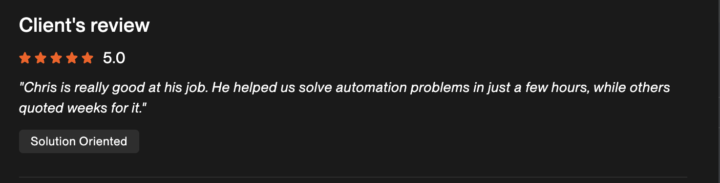
Being able to build is the baseline, and if I receive an offer on a partnership where the offer is "I can build". I'll be frank, there are so many people that can build, I'd wager that it's expected. So why am I bringing this up? Because the highest leverage skill is not building. It's getting clients, closing deals, and bringing in revenue. I could create a post right now and look to hire somebody, and I'd get at least 10 people wanting to work. So if that's the case that everybody can build, where is the leverage as a dev? Well, speed and reliability. Take this for example. I took over a project from a dev a few weeks back, and one look at what he built told me everything I needed to know. This would not scale or work at all, and that's why they hired me. To fix the entire system because it was not working. I rebuilt what needed to be rebuilt within a day. Used my experience to make sure that it does scale. And if they asked for extra things? I replied within an hour and fixed it. In fact, this client was so surprised by my speed and knowledge that they asked for more. Which is my goal with every single client, turn a one-off into at least 3 orders. But this is only possible if you're on top of your game. So instead of offering "I can build and you can bring leads," offer speed and reliability. Because at that point you're different, and of course the bigger portfolio you have, the better it is. And I don't mean show me the biggest, most complex thing ever made. I want to see how many different builds are under the person's belt and how they're built. Because with experience you'll realize that there is a right way to build things. And without that experience? We'll end up with a bad build that works in demo but not in the real world. And proof from the client as well :)
1 like • May 8
Great story Chris!
May 1 •
They are two worlds right now that don't mix.
One that needs the clicks and views to survive. And one that needs to solve problems to get paid. The difference? Well, if you want clicks, the easiest way is NEWS. News will always work. Which is why if you go to YouTube right now you'll see that we're getting flooded by Claude. Not only because it's new, but also because they're dropping new features every single day. So if you want clicks, create content about Claude Designer, or why not about the latest skill? That's the views game. And what about the other side of the coin? Solving problems and getting paid. Well, if you try to enter this space thinking that Claude will be the thing, you'll get punched in the face by life. Because it's not. The fact that businesses are still using Zapier today sounds crazy. I mean, when was the last time you even came across Zapier before I mentioned it? And this is what I mean: I get paid to solve business problems. I do not sell Claude Code solutions. If I were, I would need to set up a server and manage the code. Do I want to do that when there are easier ways to solve the problem? No. The only instance I'll set up a Claude Code solution is when I can't find an API that will work in my case. Besides that, I don't bother. What people will watch is quite different from what will make them money. It is what it is, but it's more fun to watch the latest Claude feature. Because watching the same video about how to do outreach gets boring fast. So you need new. But if you want to make money, old and boring is the safe path.
4 likes • May 1
Thanks for this post Chris and for bringing me down to earth when I start getting lost in the “shiny Claude Code new feature” space.
Apr 10 •
My first public repo - Why I built MedSynth
A few days ago I came across a tweet from a woman named Miriam. She’s 35, has rare metastatic breast cancer, less than 1% of cases, almost no documentation. She was asking the internet to help her find researchers who would take her case seriously. Javi López (@javilop in Twitter) is a developer and responded by spending a week applying AI to her complete medical history. He unified hundreds of documents, ran two frontier models independently, then had each challenge the other’s findings in rounds until both stopped finding new things. He shared the methodology openly so anyone could replicate it. I am finishing a master’s in AI and thinking about where to specialize. I replied to Miriam’s tweet and told her that her case was pushing me toward healthcare AI. I meant it. So I built MedSynth. The core problem: a patient with a rare condition accumulates years of documents that no single doctor ever sees together. Patterns go unnoticed. Contradictions stay buried. Standard AI tools retrieve fragments on demand but build nothing permanent. MedSynth builds a persistent structured wiki from a patient’s documents, then runs two frontier models against each other in an adversarial loop until they converge. The output is a structured clinical report: suggested tests, rare disease differentials, medication flags, clinical trial eligibility, and specific questions to bring to a doctor. The clinical reasoning protocols are Javi’s work, adapted from what he built for Miriam. The codebase is open source: github.com/daniszwarc/medsynth If you are interested in collaborating, I’d genuinely like to hear from you.
4 likes • Apr 10
@Chris Jadama thanks Chris! It means a lot man 🙏
1 like • Apr 10
@Sam Alder thanks Sam! And thanks Pep!

Mar 30 •
Most people fear Claude Mythos. I fear Meta
They just dropped TRIBE v2. A digital twin of your brain. I used to think AI risks were just about bad code. Rogue models. Misaligned chatbots. Then I read the Algonauts 2025 results. And my whole mental model of what "AI danger" actually means just broke. We worry about AI breaching our servers. The real danger is algorithms mapping our biology. Meta trained this thing on 1,000 hours of fMRI scans from 700 real people. It maps 70,000 brain regions. Blood flow. Oxygen levels. Neural activity. All to predict exactly how you will react to a video, a sound, a single word. It does not read your thoughts. It does something worse. It predicts your dopamine hits before you even feel them. Sit with that for a second. If an algorithm knows exactly what triggers you... what image, what word, what sound hits your reward system... it does not need to guess anymore. It rehearses on a copy of your brain first. Then it builds the perfect trap. And you never see it coming because the trap was designed around you specifically. Meta did not even keep this locked up. They open sourced the whole thing. Code, weights, everything. Handed it to the entire world. This is the same company that got caught making Instagram actively harm teenage girls. The same company whose own internal research showed their algorithm pushes rage because rage keeps you scrolling. That company now has a working map of how your brain responds to everything you see and hear. They do not have to guess what keeps you glued to the screen anymore. They already know. They rehearsed it on a copy of you before you ever saw it. The product was never the app. The product was always you. Save this. Come back to it later. Because by the time most people understand what just dropped, it will already be running inside every platform they use every day.
2 likes • Apr 8
If it was easy to manipulate us before this, I can’t imagine how easy it will be now.
1-10 of 61

Active 11d ago
Joined Jun 10, 2025
Montreal
Powered by