Activity
Mon
Wed
Fri
Sun
Sep
Oct
Nov
Dec
Jan
Feb
Mar
Apr
May
Jun
Jul
Aug
What is this?
Less
More
Owned by Curtis
Ship your SaaS to market fast, scaling, security, and UX built in. From an engineer who's spent 10 years engineering and securing classified systems.
AI Automation Society
439.1k members • Free
No-Code SaaS Founders (Free)
594 members • Free
Vibe Coding School
833 members • Free
AppMillers AI Builders
306 members • $9/month
Tech Snack | Vibe Coding & AI
19.7k members • Free
Clief Notes
45.2k members • Free
4 contributions to Clief Notes

Jun 15 •
I ported ICM to local models
ICM's premise is that structure replaces orchestration: folders and markdown carry each stage's context, and one agent reads the right files at the right moment. The paper assumes that agent is capable. I wanted to see if ICM holds when the agent is a small local model you run yourself. It does, by leaning on two things ICM already gives you. Stage-scoped context becomes injection. In ICM the agent roams the workspace and opens what it needs. A model served through Ollama is not that agent. It is an inference endpoint that takes a prompt and returns text, with no file access and no navigation loop, so it cannot roam the folders at all. The engine reads the files and injects each stage's context into the prompt instead. Same principle, each stage sees only what it needs, delivered by code rather than fetched by the model. "Scripts handle what doesn't need AI" becomes an oracle per stage. ICM keeps the mechanical work out of the model. I extend that one step: every generative stage is checked by a deterministic oracle (for code, the compiler and its tests), because a small model proposes well but can't verify itself. Reliability stays in the structure, not the model. That is the whole port. One stage one job, plain-text artifacts, factory vs product, human-reviewable files: all carry over unchanged. ICM and MCP stay complementary, as the paper notes, with the folder structure deciding context and the stage's tools exposed over MCP. The result is a frontier-free assistant: the same methodology, running on hardware you own, for tasks that are narrow and checkable. Two repos, MIT, pure stdlib (you bring Ollama): - Rust coding assistant: https://github.com/CurtisSlone/ICM-Local-Model-Rust-Coding-Assistant - Reusable base to make your own: https://github.com/CurtisSlone/ICM-Local-Model-Base I also have a coffee test example that is way more simple than the coding assistant.
1 like • Jun 18
@Gabriel Azoulay The compiler is just the strongest check, not the only one; most steps have a weaker check you can lean on, like forcing the model to fill a fixed format or quote its source. When nothing fits, a person reviews it, because a step you can't check at all is one you shouldn't trust a weak model to do alone.
0 likes • Jun 19
@David Vogel I set it up so Claude or other frontier models can drive. MCP through stdio. Here’s a windows terminal app built in the C#. It compiles using the .NET native to pretty much all windows boxes. https://github.com/CurtisSlone/ICM_Local_Terminal I’ve actually been having Claude use it with Qwen-coder 3.5 30B to improve the app itself.
Jun 13 •
I stopped fighting Remotion's timing
https://github.com/CurtisSlone/scroll-screen-player Getting an animation to land exactly when I say the words? Brutal. I'd nudge keyframes for an hour and it still felt off. So I built a tiny tool instead. Now I full screen it and tap the space bar when I want the next piece or animation to play. The video waits for me, not the other way around. I talk, I tap, the next beat hits. Recording got way less painful. Thanks Jake for introducing me to ICM.
2 likes • Jun 13
@Patrick Taylor awesome! If you have any feedback. You know how to find me. 😃

May 3 •
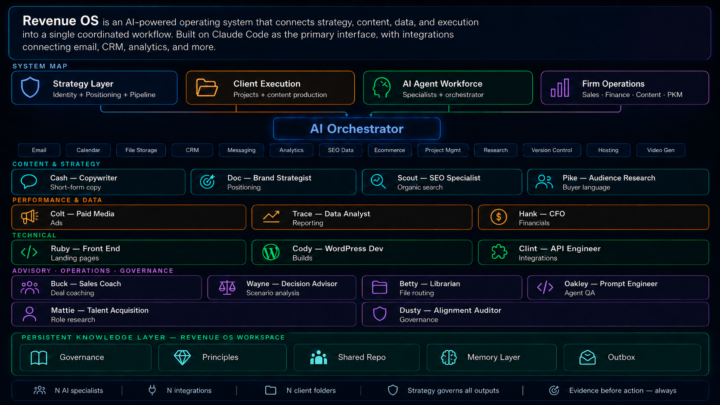
The Folder System Became My Agency
Twenty-four days ago I posted about Jake's folder system video. This is what happened next. Same foundation — markdown files, orchestration prompts, clear roles. I just kept building. Fifteen named specialists. Each one with a soul file, guardrails, and a playbook. Duke orchestrates. Cash writes. Trace pulls the data. Hank runs the financials. Clint handles the MCP integrations. Behind each one is either a human counterpart doing the real work alongside them — or a role I can't afford to hire yet. Katie who's been with me for 18 years, now has her own orchestrator running the same system. Twenty-seven client folders. Twelve live MCP integrations. One shared repo. The folder system isn't replacing my agency. It becoming my agency. Jake gave me the unlock. This is how it's going.
1 like • Jun 13
@Curtis Hays This makes sense as all the action happens in your ICM
1 like • Jun 13
@Curtis Hays Your reasoning makes complete sense. You're keeping a solid separation of concerns. I definitely learned something from your explanation.

👑
Mar 2 •
Who's here? Drop your intro.
Tell us three things: 1. What you do (job, industry, student, career-changer, whatever) 2. What brought you to Clief Notes 3. One thing you're trying to figure out right now related to computing or AI I'll respond to every single one. And read each other's intros too because the person who's stuck on the same problem as you might already be in this thread. I'll go first I am Jake, I have been working in tech for 15 Years, building with Generative AI for 3 Years straight now! Excited to teach and learn! That's it. Simple, scannable, gives you data on who's joining and what they need, and keeps the feed clear for content that retains people past week one.
2 likes • May 15
I'm Curtis. I'm a cybersec/software guy discovering your AI workflows idea and loving it!
1-4 of 4

@curtid-slone-1520
Semi-serious engineer building with AI!
10+ years systems engineering, software development, and cyber security for defense contracts.
Active 9d ago
Joined May 11, 2026
Powered by