Activity
Mon
Wed
Fri
Sun
Aug
Sep
Oct
Nov
Dec
Jan
Feb
Mar
Apr
May
Jun
Jul
What is this?
Less
More
Memberships
Smart Saver Society
1.7k members • Free
72 contributions to AI Pixels to Profit by Bailey

Jul '25 •
Am I allowed to post about a shop that copies designs 100%?
I've discovered a shop that has like 100% of its designs copied from other shops (and some from my own shop, as well). I have submitted an Etsy report in general and several mini ones on each of the copied listings, but the problem is that I can't really do anything about it as I can't register my designs as intellectual property. Can I disclose it here for others to look at and potentially report it as well? I know sharing Etsy shop links isn't usually allowed, but in this case the copying is blatant, and they even have a Labubu glass can wrap, so they're not just copying small creators, but also brands. **I know everyone draws inspiration from other creators, but I’m talking they put the image in ChatGPT or MyDesigns and they generate an identical image and put it up for sale!**
Apr '25 •
GPSR Compliance for Digital Sellers
Hi everyone, I was wondering if you are doing something in particular about the GPSR requirement - most of my sales come from North America, but I have had a few from EU countries. Since these are digital-only files, I was wondering if it would be enough for me to include safety information in my shop description, maybe even in every product listing description as well and not turn off selling to the EU. How are you going about this? I do not have the money to hire an EU representative; I would like to not have to stop selling to these countries but if it's safer, I probably would. Fortunately, for the time being, since I am not registered as a business (I definitely don't make enough money to have to get incorporated or become a business in the country I am based in), I am not considered a 'trader' so I might be safe. I'd like some honest opinions on this... thank you in advance!

Mar '25 •
Listings
I'm putting listings in my shop, but under Digital files, I'm only allowed up to 5. Is that how it is for beginners? Please enlighten me.
3 likes • Mar '25
That's how it is for everyone, not just beginners - 5 files max, 20mb max each.
Feb '25 •
Hello
Hi all, new member here 👋 I joined this community to learn and try this digital business thing! I have a sticker shop on Etsy that I started late last year, using mostly my designs or a combination of paid for clipart. I’ve opened a second shop for digital downloads. My main concern and frustration with AI art is the little details that don’t make sense, like an additional toe or elements that doesn’t fit with the rest of the design, or weird squiggly lines, etc. I’ve bought PNG’s that looked great in a thumbnail, but once enlarged is full of little things that would need to be fixed in order to be usable. I can draw, I use Procreate and Illustrator, but I know making the same kind of artwork would take me hours. Am I just OCD? Are most people ok with little imperfections? Sorry for the long post, please share your thoughts:)
4 likes • Feb '25
I think it depends a lot on the type of designs you make. For certain types of sublimation, these little imperfections are not going to be noticeable. For example, if you make a mug wrap, unless the character is especially large, the toes aren't even going to be that visible. Also, AI differs a lot in terms of quality (and these errors too) from one generator to the next. Kittl, Dall-e3 and the free Bing Image Generator are the best (in my opinion) at producing error-free images. Ideogram does a good job as well and sometimes even Flux, but these two maybe work only for print on demand - for sublimation they are extremely unimpressive. At the same time, clipart has the downside that it's always isolated on a white/transparent background, so if people really want to find something wrong with your design, they'll find the defect a lot easier, especially if it's overlaid on the white. I have almost completely stepped away from clipart and PNG designs (for t-shirts and so on). It can be practically impossible to produce a perfect image for that purpose, unless you want to use Photoshop 100 times a day. Plus, when you sell them with a transparent background, if the background remover doesn't do a good job, you either go back and generate extra images until you come up with one whose background is easy to remove or you can spend hours upon hours in an editing software manually fixing the imperfections. To answer your other question, I think most people are ok with imperfections so long as they don't use the image for a large item where the imperfection becomes this huge, horrible thing. I started out my shop with PNGs for t-shirts and SVGs and I gradually switched to sublimation crafting for multiple full-color, full-background items - tumblers and more. Very, very rarely do I post something with a transparent background these days or made for printing/sublimation on a large item.
3 likes • Feb '25
@Melanie Parent well, I literally didn't notice the things you pointed out until you did. In my honest opinion, the first image looks adorable and would pass as a great one to Etsy buyers as well - perhaps the hat might've been something to fix, but even the tail looks absolutely adorable. With these pseudo-antropomorphic animals or glittery animals that have something to do with a holiday more than they do with their anatomical or historical accuracy, I believe you can bend a lot of rules. I am pretty picky myself, but if you look at some hugely successful sellers on Etsy, you'll find errors in designs that have sold hundreds of times and people haven't even noticed that there's a SPELLING error in there (which I think would be far more unforgivable than a hat that's slightly weird). :) so I think that you're doing great and that stuff that bugs you will most likely not be noticed by the majority of buyers.

Feb '25 •
Spam or a real order?
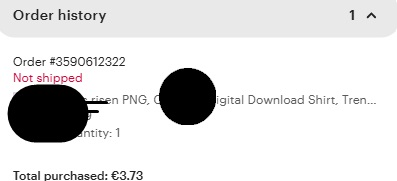
This day I received this message: -- I paid for the item, check your ...@gmail.com, there should be a message about payment, you need to complete some steps. If you don't find it, check your junk folder. Messages related to the purchase sometimes end up in there.-- My question: Is this real or spam? When I looked up my listing I see that the digital file was sold. A few minutes later the sale at the listing was removed. I see nothing in orders. In my dashboard I saw one order sold. But this was disappeared too a few minutes later. When I see my email I see what I attached here. But it seams not legit... Could you help me out?
2 likes • Feb '25
Did they reference the order number? Look in your "Orders", in the "Completed" section to see if you can find the purchase there.
1-10 of 72

Active 142d ago
Joined Sep 23, 2024