Activity
Mon
Wed
Fri
Sun
Jul
Aug
Sep
Oct
Nov
Dec
Jan
Feb
Mar
Apr
May
What is this?
Less
More
Memberships
Flow Unlock: Procrastination
1.3k members • Free
Imperium Academy™
65.7k members • Free
Thomas Skool Community
2.2k members • $15/month
nidacademy
8k members • Free
The AI Builder Lab
161 members • Free
Sell Smart Websites
269 members • $97
Creators
17.2k members • Free
Robonyx Academy
22.3k members • Free
Adonis Gang
182.6k members • Free
8 contributions to Ooga Booga Game Devs

Aug '24 •
How I actually make games
People keep asking me about my process. It's surprisingly not special. But, in case anyone wants to know what it looks like to ship a game to Steam starting from zero, here is what I actually do. 1. Have gameplay idea. Write it down somewhere or draw some sketches to work through a few ideas. I write down everything that comes to my mind the moment I think of it, and then I curate the list later. Oftentimes, ideas I kill end up coming back in some way later. 2.Make some sprites to communicate the basic gameplay idea. The shapes need to be readable, and they need to relate to the gameplay. The player needs to have the perception that they are looking at something interactable. There should be no decorative art this early. Art should only relate to gameplay. 3. Get the sprites/UI into the game, just making sure I can draw them in the game where they are supposed to be. Whatever rendering logic you need to write to make this happen, write it. Don't support anything more than what you need to draw the art. There is no generic "renderer." There's just specific things you need to draw. Don't plan for a future which doesn't exist yet. 4. Once things can be drawn, I then make them interactable by doing things like click areas, movement, etc. This is specific to your game idea. You actually have to make the game playable as a game, using the prototype art. Gameplay doesn't come later once you have the "engine." The "engine" gets developed as a *consequence* of making the game work. There is no separation between the two. The engine is the game and vice versa. 5. As I make more and more similar things, I just extract to a function to reuse bits and pieces of what I have to do the next thing. I'm not particularly obsessive about this, trying to remove every bit of duplication. It's more like I casually notice some repeated patterns and then clean it up. Remember you are making a *game*, not raking a zen garden for personal satisfaction. 6. Over a long period of time, a "game engine" starts to emerge. But that's nothing special. It's just leftover code. The more you do this, your skill and knowledge base grows. Even if you don't have the code lying around, you will remember how you approached certain kinds of problems. Half of the "engine" is inside your head. It's your experience solving real problems.

2 likes • Aug '24
@Ted Bendixson Yo, hold up. Look, I get where you're coming from with the whole "planning is death" thing, but let's be real for a sec: 1. Chaos isn't always king, ya know? Sometimes a bit of planning saves your ass. 2. That "Enterprise OOP with Java bullshit" you're hating on? It's powering stuff you use every day. Your banking app, streaming services. It ain't all bad. 3. Big corps might seem soul-sucking, but they're also where a ton of innovation happens. Think about the engines and tools you use. Unity? Unreal? A lot of that tech came from big teams with big budgets. 4. "Leaving no dent in the universe" is kinda harsh. Not everyone needs to be the next Notch or Carmack. 5. Those inflation-matching raises? At least they're stable. Indie game dev is a rollercoaster, man. One hit wonders and studio closures everywhere. 6. Some of the best game devs out there did time in the corporate world. It's where they learned their chops before going indie.
1 like • Aug '24
@Ted Bendixson haha i got you! so Let's ooga booga together then

Aug '24 •
“Advanced C” tutorial by Charles Cabergs
I came across this C tutorial series on YouTube today, seems valuable to me as someone who is learning C for the first time and the videos are quite direct and to the point. https://youtube.com/playlist?list=PL71Y0EmrppR0KyZvQWj63040UEzKQU7n8&si=JjQoyWkwhWKPLuhK
0 likes • Aug '24
beautiful find bro! tnx
Aug '24 •
Following along on RayLib
I just finished day 4 the Tile System, have been following along via raylib instead as I daily drive a Mac and my PC's not always available to me (hey we make do with the cards we have right?). General feel is that RayLib feels mostly the same to what I see on Ooga Booga. So definitely no issues following along. Has been a great exercise for me so far! Anyways, just wanted to point out that because RayLib uses source and destination Rectangles to draw the sprites, the destRect itself is already kinda like a range in itself. So you don't actually need to write range.c, and can just use the CheckCollision functions (https://www.raylib.com/cheatsheet/cheatsheet.html). The bounding range data itself is kinda encapsulated in the destRect already. Also GetMousePosition defaults to (0,0) even if the mouse isn't even active yet. So I did a 0,0 check (since it'll 99.999% not be 0,0 again once you start moving it cause floats) and cached that as a bool to check against for all the range or collision checks with the mouse. That way you don't have things highlighted in the top left corner of the window everytime you launch. Also, say hi if you're working on a Mac! So we can connect and help each other troubleshoot as we follow along! Esp if you're using raylib to follow along.
1 like • Aug '24
maaan this is the stuff that throw me off! i am still struggling with C and to hear there is an easier way, like sure i feel the urge to check it out, but for some reason i have a nice intuition about this road of pure caveman C i know that i am looking at an 8 months minimum of pure fuckery but Fuck it i will stick to it this time.
0 likes • Aug '24
@Rayner Tan ooga booga likey nice people

Aug '24 •
"All in"
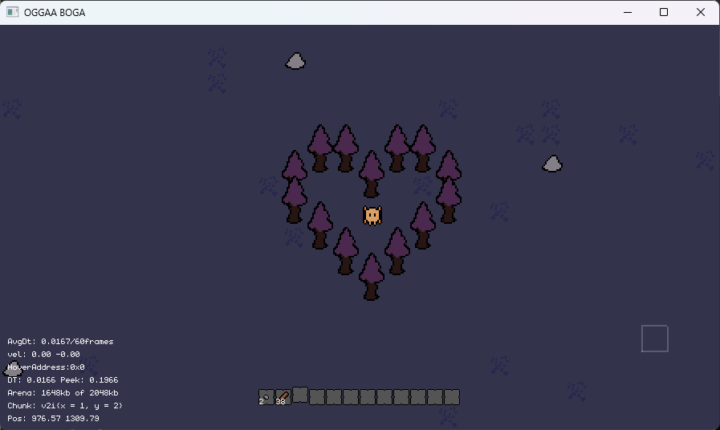
Randy just announced that he opened a discord for people who are all in making and shipping the 90-day challenge game. This is cool, but one of the requirements is: - Share your "Ooga Booga engine" fork It may just be me, but I'm "all in" without the fork since I'm using a homemade engine written in Odin and using OpenGL for Graphics. I understand that the course revolves around the C engine developed by Charlie, which may be the reason why sharing the fork is required. In conclusion, by turning the stack into a requirement you might remove some of the 1% mentioned in the video. Keep up the good work.
0 likes • Aug '24
@Marco Santos you recommend?
0 likes • Aug '24
@Marco Santos haha thank you! btw what music genre goes with C? DOOM hard beats or horror soundtracks? haha

Aug '24 •
DOOMgabooga
Hi! I'm working on a port of DOOM using oogabooga: https://github.com/g0mb4/DOOMgabooga It lacks a lot of things, but it is playable. I'm not sure if I'll have time to polish it, but the journey is quite fun.
0 likes • Aug '24
DOOM in C, shiit that's cold!
1-8 of 8

Active 2d ago
Joined Aug 9, 2024