Activity
Mon
Wed
Fri
Sun
Aug
Sep
Oct
Nov
Dec
Jan
Feb
Mar
Apr
May
Jun
Jul
What is this?
Less
More
Memberships
Claude Code Club
6.9k members • $9/month
Samin's Free AI Resource Hub
17.5k members • Free
Skool Events Daily
367 members • Free
AI Accelerator
19.7k members • Free
The AI MBA
2k members • Free
Local Newsletter Launchpad
1.5k members • Free
Woodworker Jumpstart
21.1k members • Free
Voice AI Alliance
3.8k members • Free
useful AI
23.4k members • Free
1 contribution to AI Accelerator

23d •
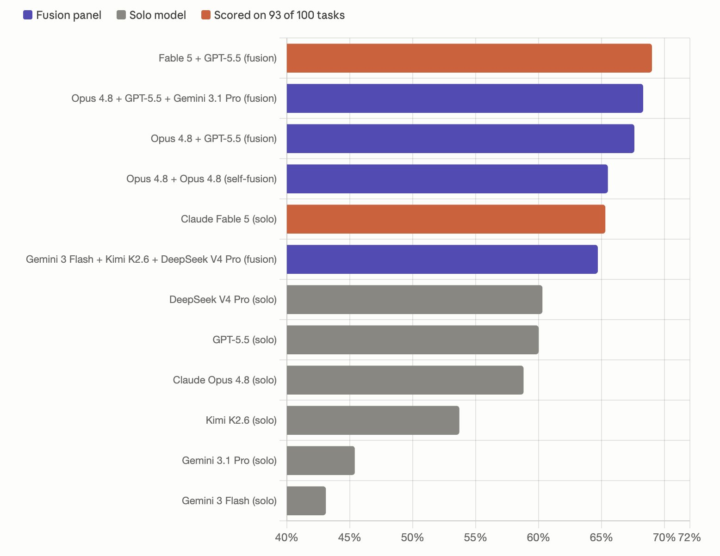
OpenRouter just shipped "ask 5 AIs and merge the best answer" as a single API — and it beats Fable 5
This is the most underrated launch of the week, and it maps almost exactly onto something I already use. Let me break it down 👇 What OpenRouter Fusion does: Instead of sending your prompt to one model, Fusion fires it at a panel of 3–5 models in parallel, then a "judge" + synthesis model merges all their outputs into one optimized answer. You call it as a single slug — openrouter/fusion — and it layers on top of the 400+ models OpenRouter already routes to. No rebuild. The results are what make it interesting: → A Fable 5 + GPT-5.5 panel, synthesized by Opus 4.8, hit ~69% on Perplexity's DRACO research benchmark — beating solo Fable 5 at ~65%. → The budget play is the real story: a cheap panel (Gemini 3 Flash + Kimi K2.6 + DeepSeek V4 Pro) matched Fable-level quality at roughly HALF the cost. The one stat everyone should sit with: OpenRouter says ~75% of the performance gain comes from the synthesis step — how the outputs get merged — and only ~25% from using different models. The intelligence isn't in running more models. It's in how you combine them. My take on why this matters: If you've seen me talk about the LLM Council approach — running a question past multiple AI advisors, having them critique each other, then synthesizing a verdict — this is that exact idea shipped as production infrastructure. The era of "pick the one best model" is quietly ending. The edge is moving to orchestration: who can combine models intelligently. For builders and operators, two takeaways: One — you no longer have to bet your whole workflow on one model. Panel the frontier ones for hard reasoning, panel cheap ones when budget matters. Especially relevant this week, when frontier models can apparently get switched off overnight. Multi-model isn't just better — it's insurance. Two — the honest tradeoff: you pay for every model in the panel (4 models = 4 completions) and it adds latency. So this is for high-value tasks where a better answer is worth the spend — deep research, complex analysis — not your everyday quick prompts.

3 likes • 23d
I am ready to try out the multi mode!
1-1 of 1

Active 4h ago
Joined Jun 3, 2026
Virginia
Powered by