Activity
Mon
Wed
Fri
Sun
Aug
Sep
Oct
Nov
Dec
Jan
Feb
Mar
Apr
May
Jun
Jul
What is this?
Less
More
Memberships
Optimum Wellness Institute
54 members • Free
15 contributions to Optimum Wellness Institute

Dec '25 •
People Kill Me
People pop pills every day. Doctor got them on 13 medications, soon as you recommend a herb to them, they want to know what's all in it, what it do?How does it work? Where did it grow at... people kill me.


0 likes • Dec '25
The truth
Dec '25 •
How to C**e digestive disease such as GERD
Here are some Herbs that will help your journey! Make teas or use glycerin base tinctures if you're very sensitive. 1. Slippery Elm (Ulmus rubra) - Forms a soothing, protective mucilage layer on irritated esophageal and stomach lining. - Often consumed as tea, capsules, or powder. - Good for soothing heartburn and inflammation. 2. Deglycyrrhizinated Licorice (DGL)- CAUTIAN can raise blood pressure - Licorice root with glycyrrhizin removed (to reduce side effects). - Helps increase mucus production that protects stomach and esophagus. - Often taken as chewable tablets before meals. 3. Ginger (Zingiber officinale) - Anti-inflammatory and digestive support properties. - Can help soothe the GI tract and calm nausea or bloating. - Often taken as tea, capsules, or fresh root. - Note: In some people, ginger can trigger heartburn if taken in high amounts. 4. Chamomile - Mildly anti-inflammatory and calming. - A soothing tea that may help reduce reflux symptoms and digestive irritation. 5. Marshmallow Root - Contains mucilage that can coat and soothe the digestive tract lining. - Often used as tea or supplement for irritation relief. 6. Aloe Vera Juice - Internally-consumed, food-grade aloe may help reduce esophageal inflammation. - Drink small amounts before meals for soothing support. Lifestyle Changes That Work With Herbs Herbal products can be more effective when paired with proven lifestyle measures: ✅ Eat smaller meals, avoid trigger foods- stop being greedy! ✅ Don’t lie down soon after eating✅ Raise the head of your bed✅ Maintain a healthy weight 🚫 Common GERD Trigger Foods- Stop all of these for 3 months (90 days) 🔥 Acid-Increasing / Irritating Foods - Citrus fruits & juices (orange, lemon, grapefruit) - Tomatoes & tomato products (sauce, ketchup, salsa) - Vinegar & pickled foods - Spicy foods (hot peppers, chili powder, cayenne) 🧈 High-Fat Foods (slow digestion & relax LES) - Fried foods - Fast food - Fatty cuts of meat - Bacon, sausage - Cheese (especially full-fat) - Cream, butter, lard - Heavy gravies and creamy sauces
0 likes • Dec '25
Oh well I love grapes and cheese together. My Doctor told me this about cheese. So i've cut back on the cheese .
Dec '25 •
Happy birthday!!
Help me wish a very happy birthday to @Mytrice Sanders have a wonderful day!
0 likes • Dec '25
Happy Belated Bday
0 likes • Dec '25
Cayenne pepper, hibicus, garlic, cinnamon, basil, ginger, celery seed and thyme
Dec '25 •
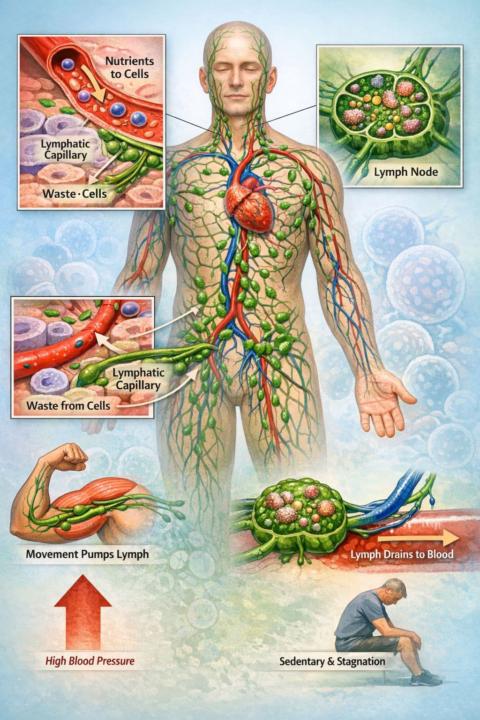
You're not moving Lymph
Understanding The Lymph: What actually happens The lymphatic system is not a minor side system. It is a primary transport and drainage network that sits between the blood and the cells. While the blood circulatory system is a closed loop driven by the heart, the lymphatic system is an open, free-draining system that relies entirely on pressure, density, and movement. Nutrients carried in arterial blood leave the bloodstream at the capillary level due to higher arterial pressure and density. These nutrients move into the surrounding interstitial and lymph fluids, and from there into the cell, driven by osmotic pressure and concentration gradients. Once inside the cell, nutrients are metabolised to support structure, energy, and repair. After metabolism, waste products leave the cell and enter the lymph. This transfer again depends on relative density and pressure. As waste accumulates, the lymph becomes denser. Under ideal conditions, some of this waste passes from the lymph into venous blood, where it can be carried toward organs of elimination. However, when lymph density becomes too high, this transfer is impaired. This is where movement becomes critical. The lymphatic system has no pump. Muscle contraction and joint movement create localised pressure that pushes lymph forward and helps overcome pressure differences between lymph and venous blood. Without movement, lymph stagnates and waste accumulates in tissues. Lymph nodes act as temporary holding and redistribution points, not as disposal sites. When lymph becomes too dense, material may collect in nearby nodes, allowing the surrounding lymph to regain a density that permits onward flow. Most lymph nodes are located near joints for this reason. Movement helps empty them. When vitality is low or movement is restricted, nodes can become swollen or tender as congestion persists. Blood pressure also influences lymph drainage. When diastolic pressure is moderate, pressure differences allow lymph to transfer its contents more easily into venous circulation during movement. When both systolic and diastolic pressures are elevated, higher lymph pressure is required, making efficient drainage more difficult, especially if mobility is reduced. Over time, lymph nodes can shift from short-term holding points to long-term storage areas.
1 like • Dec '25
Wow informative tku Lundie
1-10 of 15

Active 155d ago
Joined Dec 10, 2025