Activity
Mon
Wed
Fri
Sun
Aug
Sep
Oct
Nov
Dec
Jan
Feb
Mar
Apr
May
Jun
What is this?
Less
More
Owned by Catherine
A warm and welcoming sewing and upcycling community where we share ideas, support and successes!
Memberships
AI Visibility Lab
384 members • Free
The Atelier Hub
33 members • Free
The Inner Shift Collective
20 members • Free
🇨🇦 Vancouver IRL
33 members • Free
Skool Scale Camp
4.9k members • Free
Skooly: Tools for Skool
257 members • $9/month
“Your Best Course” Build Lab
148 members • $27/month
The Colour Room
464 members • Free
Skoolers
167.4k members • Free
4 contributions to The Atelier Hub

🔥
10d •
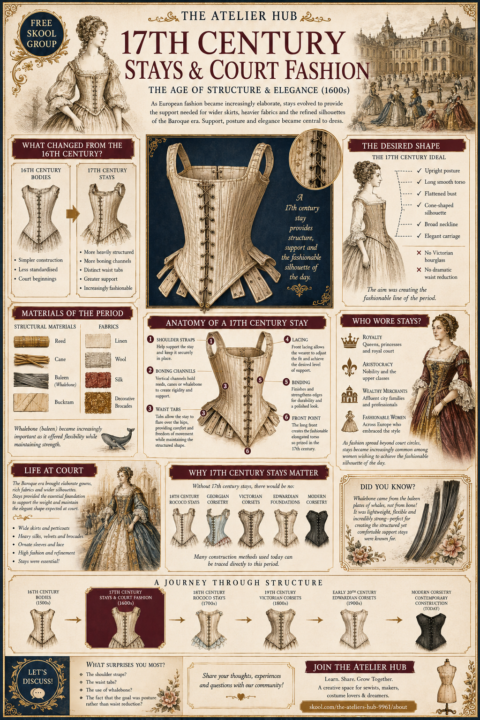
🪡 17th Century Stays, Corsets & Court Fashion 🪡
As we continue our journey through the history of corsetry, we arrive at a fascinating period where structure, elegance and craftsmanship became increasingly intertwined. By the 17th century, the earlier "pair of bodies" had evolved into what we now recognise as stays. These garments were becoming more refined, more structured and increasingly important to fashionable dress throughout Europe. One of the most common misconceptions about historical corsetry is that it was always about creating a tiny waist. In reality, the fashionable silhouette of the 1600s was very different. The goal was a long, smooth torso, upright posture and a cone-shaped silhouette that supported the elaborate gowns of the Baroque period. Rather than emphasising curves, stays helped create a controlled and elegant line beneath clothing. The construction itself was becoming increasingly sophisticated. Makers used materials such as: 🌿 Reed 🌿 Cane 🌿 Buckram 🐋 Baleen (commonly known as whalebone) 🪡 Linen 🪡 Wool 🪡 Silk and decorative brocades One particularly important development was the growing use of baleen. Despite its name, whalebone wasn't actually bone at all. It was a flexible material taken from the baleen plates of whales, offering the perfect balance between strength and movement. This made it ideal for creating the support required by increasingly elaborate garments. The 17th century also saw the widespread use of features we still associate with corsetry today: ✨ Boning channels ✨ Lacing systems ✨ Structured shaping ✨ Waist tabs for movement ✨ Reinforced construction techniques For anyone interested in historical costume, dressmaking, tailoring or couture, studying stays offers valuable insight into how garments achieve shape and support. Many techniques used in modern corsetry can trace their origins directly back to this period. As makers, it's easy to focus on the outer garment, but these hidden foundations are often where the real engineering takes place. I'd love to hear from you:

🔥
1 like • 10d
That’s so interesting! I had always been under the impression that it was all about the tiny waist! Thanks for the interesting info. As a high school sewing teacher, I always tried to find the easiest way for my girls to sew boning into their formal dresses.
🔥
May 28 •
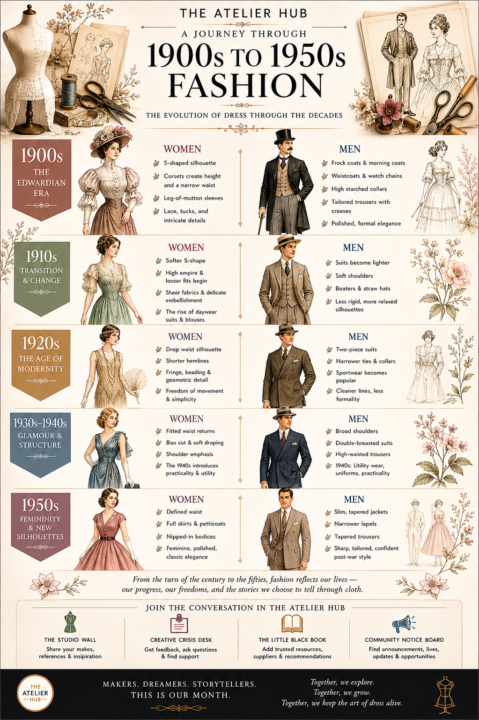
Fashion between the 1900s and 1950s changed everything 🪡
In just five decades, silhouettes softened, corsets disappeared, waists dropped, shoulders sharpened, skirts widened again… and clothing began reflecting freedom, war, rebellion, glamour, practicality, and identity in completely different ways. And honestly? You can still feel traces of every one of these eras in modern sewing today. The bias cut of the 1930s. The structure of the 1940s. The femininity of the 1950s. This is why I love studying historical dress so much, fashion is never just clothing. It tells us what society valued, what people longed for, and how makers solved problems with nothing but fabric, structure, and skill with the changing times within our societies. So now I want to know… 🪡 Which decade pulls you in most, and why? 🪡 If you could sew ONE garment from these decades, what would it be? 🪡 And which period do you think had the most beautiful construction techniques? I've been a busy bee in the background, clearing my storage, designs, costumes and much more, ready to start uploading and sharing next right here in The Atelier Hub, very exciting! I'm building the group in real time, and grateful you're here, sharing this space of sewers 🪡 🥰 So, tell the hub what you think of the 50 years fashion journey 1900-1950's. Drop your thoughts below in comments 👇 Claire Amelia 🌞
🔥
2 likes • May 28
Great post! I also love the history of fashion. Of the decades you mentioned, my favourite has to be the 1930s. Although I could never wear one, those bias cut slinky dresses just take my breath away!
🔥
Apr 29 •
Wat do you call this...
Whilst I'm sewing, my eldest daughter is making an avocado cushion. She's mentioned her stuffing, and my brain just could not remember what it was called!! Just shows, if we don't use a material, haberdashery item, sewing style or discipline for some time, we can forget .. I've made props, costumes, pillow and much more with wadding. So, what do you call it? Drop your answers in comments, let's see f it has a different name in different countries 👇 This is what the group is about, remembering, learning, educating, nurturing our love around sewing 🪡

🔥
2 likes • Apr 29
What a cute video. I'd call it polyester fiberfill. Or, to be honest, I'd probably say stuffing!
🔥
Apr 22 •
Discipline Deep Dives - Share Yours 🪡
Let’s get into the work a little deeper today. Across all disciplines, there are techniques we return to again and again, the ones that quietly define our standard. What’s one technique you feel has truly changed your work over time? Not something basic, but something you’ve refined, reconsidered, or now approach differently with experience. I’d love to hear what’s shaped your hands. 🫶 & A BIG WELCOME to our latest group members @Janine Martin @Suzanne Bowyer I'm building in real time, & grateful you are here 🔥
🔥
5 likes • Apr 22
I've been sewing most of my life but now focus mostly on upcycling. The skill that has become most important to me is being able to see the potential in an unwanted item. I try to cultivate that above all other skills.
1-4 of 4
🔥
@catherine-hay-5591
Sewing project ideas, upcycling, tips, tricks and techniques to help you get gorgeous results!
Active 9h ago
Joined Jun 14, 2026