Activity
Mon
Wed
Fri
Sun
Aug
Sep
Oct
Nov
Dec
Jan
Feb
Mar
Apr
May
Jun
Jul
What is this?
Less
More
Memberships
The Happy Home Community
48 members • $29/month
RISE With Brittnie
24 members • $27/month
FREELANCE with ERICA
630 members • $19/month
Create & Sell with Canva
848 members • $7/month
Canva to Cash: Foundations
910 members • $1/month
Pole Dance Foundations
48 members • Free
Booty Factory Collective
27 members • $8/month
Flexy Bendy Pole
68 members • Free
Club Jolie Dance
141 members • $9/month
1 contribution to ADHD Success Community 🧠

12d •
Lesson 3.1 Discussion — Planning and Organisation 🧠
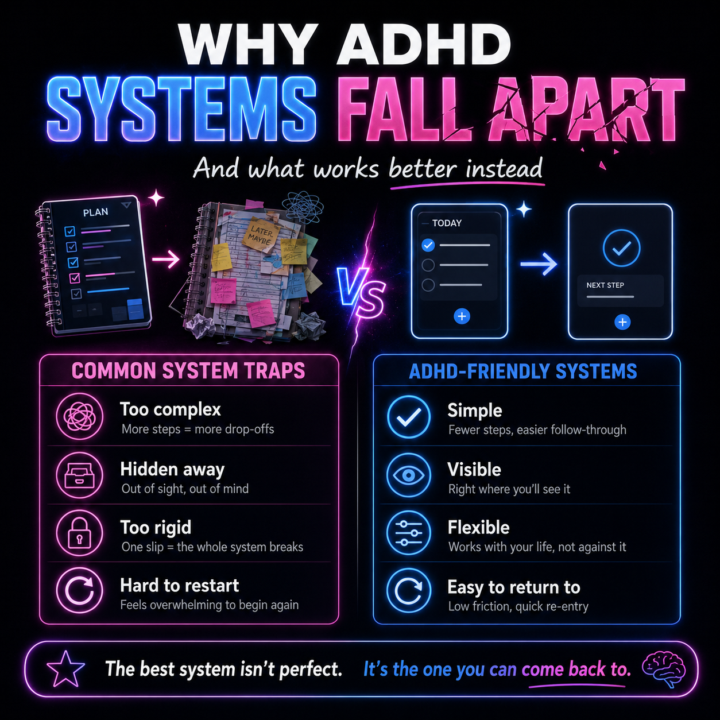
In this lesson, we looked at why planning and organisation systems often start well, then fall apart. This is a huge ADHD pattern. You find a new planner, app, routine, notebook, checklist, or system. At first, it feels exciting. You think: “This is the one.” Then the novelty fades. Life gets busy. You miss a day. The system gets messy. You stop checking it. Then it becomes another thing you feel guilty about. That does not mean you’re hopeless at organisation. It usually means the system was not built for an ADHD brain like yours. A lot of planning systems require consistent attention, memory, time awareness, prioritisation, emotional regulation, and daily maintenance. That is a lot to ask from a brain that already struggles with those exact things. So the goal is not to find the perfect system. The goal is to build something simple, visible, and easy to return to. Not: “I must never fall off.” But: “How do I make it easier to come back?” Your turn 💬 What planning or organisation system have you tried that started well, then fell apart? You could share: - a planner you stopped using - an app you forgot about - a routine that worked for a few days - a colour-coded system that became too much - a to-do list that got overwhelming - a calendar system that didn’t stick - a home organisation system that slowly collapsed Then add one reason you think it stopped working. Example: I tried using a detailed planner, and it worked for about a week. I think it stopped working because it had too many sections, so once I missed a day it felt overwhelming to come back to. Or: I downloaded a task app and spent ages setting it up, but then I stopped opening it. I think it was too hidden and not visible enough for my brain. No shame here. This is not about proving you’re bad at systems. It’s about learning what your brain actually needs from a system. And if someone else mentions a system you’ve abandoned too, reply to them. Most of us have a small graveyard of planners, apps, notebooks, and routines somewhere.

1 like • 12d
I’ve tried just about everything… paper planners, digital planners, apps, notebooks, color-coded systems… they all worked for a little while and then I’d eventually stop using them. I think the biggest reason is that I’d try to make the system too perfect. If I missed a day or fell behind, it felt overwhelming to jump back in, so I’d end up abandoning it altogether. One thing I’m working on now is building simpler systems that I can easily return to instead of expecting myself to be perfect. That mindset shift has been really helpful already. 😊
1 like • 12d
@Mark F Thanks, Mark! 😊 I’m definitely still figuring it out myself, but I’d be happy to share what’s been helping me so far. A few little mindset shifts I’ve been practicing are: • Progress over perfection. Missing a day doesn’t mean I have to start over. • Reduce the number of steps. If something takes too much effort to restart, I probably won’t stick with it. • Give everything a “home base.” Whether it’s my planner, notes, or a checklist, I always want one simple place I can come back to instead of feeling like I have to remember everything. • Start ridiculously small. Even five minutes is better than waiting for the “perfect” time. - Lower the barrier to entry. If I make something too complicated, I’m less likely to come back to it. The easier it is to start, the more consistent I can be. I’m still experimenting and learning, but those have already made getting back on track so much easier.
1-1 of 1
@carrie-elsen-4043
Motivated lifelong learner with a passion for organization and problem-solving. Currently growing my skills in freelancing and digital tools.
Active 23h ago
Joined Jun 19, 2026