Activity
Mon
Wed
Fri
Sun
Oct
Nov
Dec
Jan
Feb
Mar
Apr
May
Jun
Jul
Aug
Sep
What is this?
Less
More
Learn LinkedIn with Alex
1k
$50/m
Capital Raising & Investing.
1.2k
Free
16 contributions to Learn LinkedIn with Alex

Dec '25 •
Reading the Data Through the Lens of Intent
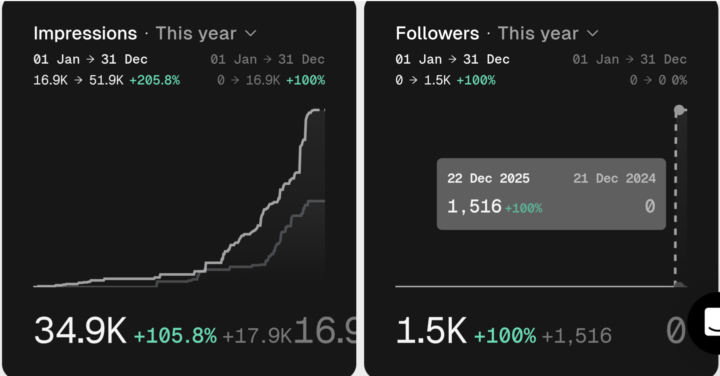
I recently reanalyzed my LinkedIn performance using Shield’s post level data and wanted to share a perspective that may be useful for anyone experimenting with different growth models. I previously used MagicPost (https://www.skool.com/innovator/from-engagement-anxiety-to-authority-compounding-what-my-linkedin-data-actually-showed?p=eb51b20c) which showed trends. Shield revealed the mechanics. Many in this community optimize for volume, reach, and conversion, and that absolutely works when the goal is lead flow, offers, or audience monetization. My goals are a bit different, which led me to look at the data through a different lens. Shield showed something interesting in my case: - Impressions continued to rise even during periods of lower engagement - Follower growth stayed consistent - Posts that interpreted industry or leadership signals were distributed despite modest likes That pattern reflects the audience I am trying to reach. Senior operators, investors, and board level leaders tend to engage quietly. They read, save, and follow more than they like or comment. The takeaway for me was not that one approach is better than another, but that metrics have to match intent. When the goal is credibility, trust, and long term positioning, engagement can lag relevance for quite some time. For Q1, I am simplifying rather than scaling. Fewer posts, clearer themes, and more narrative continuity. That may not be optimal for selling, but it is aligned with my objectives. Sharing this here because it helped me avoid misreading my own data. Curious how others in the group adjust their scorecards when running multiple goals across different audiences.
2 likes • May 26
@Evan Gilbert - Overall, the thesis has held up. Impressions and follower growth continued trending in the right direction even without optimizing for volume or engagement. What’s been most interesting is that the “authority” side compounds slower, but it persists longer. I’m seeing more inbound conversations and recognition from the types of people I hoped to reach, even when individual posts don’t look explosive publicly. I'm still learning, but the Shield data helped me stop overreacting to short term engagement swings.
0 likes • Aug 23
@Andrzej Misiak That's an interesting question. Your're right...InMail shouldn't be the first indicator. The leading indicators I'm watching are the quality of new followers, profile activity after certain posts (particularly who's viewing), repeat engagement from people in the audiences I'm trying to reach, and increasingly, private conversations that originate from or reference the content. I think of it as a progression: exposure → recognition → relationship → opportunity → economic outcome. I'm seeing evidence through the opportunity stage. What I haven't demonstrated yet is the last step: monetization. So I wouldn't claim the thesis is fully validated yet.
Dec '25 •
From Engagement Anxiety to Authority Compounding: What My LinkedIn Data Actually Showed
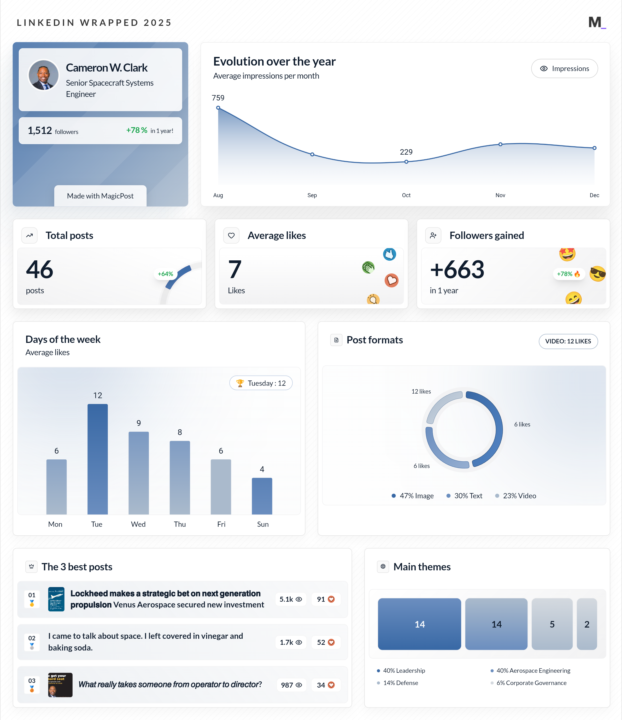
I just finished a deep dive on my LinkedIn performance data using MagicPost and ChatGPT. I'm sharing the real takeaway with this group for feedback and insight. At a glance, the numbers look mixed: - Followers up meaningfully year over year - Impressions climbing steadily - Likes per post down for a stretch before stabilizing If I stopped at engagement, I would have drawn the wrong conclusion. What the data actually shows is a transition phase. I moved from sporadic posting to consistent cadence. From exploratory topics to clearer positioning. From a broad audience to a quieter, more senior one. The result was predictable in hindsight: - Engagement dipped first - Impressions kept rising - Follower growth stayed linear - Then everything began to stabilize and compound October was the inflection point. Lowest likes. Rising impressions. Strongest follower momentum. That was the moment the content stopped being novel and started being understood. My biggest lesson from this analysis: Likes lag authority when your audience is senior, technical, or investor heavy. For 26Q1, I'm optimizing for narrative continuity, not post level performance. One anchor post per week. One supporting post. Clear monthly themes. No experimentation for the sake of activity. Sharing this because I see a lot of people (no one here) abandon strategies right before compounding begins. Curious how others here think about the tradeoff between engagement signals and long term positioning. What metrics do you trust most when the numbers send mixed messages? Notes: - I joined this group in the 2nd-half of September 2025. That's also when I got intentional about LI. - I'm chasing authority. Not lead generation. - The MagicPost 'Evolution over the year's' section has different charts for impressions, followers, and likes. You can't download all of them in one file. I screenshot each of them for my ChatGPT analysis.

Dec '25 •
Inspiration for my friends out there who don't travel!! 🌎
This year, I worked remotely across 28 countries, but it wasn't always like this. A few years back, my dad told me to "travel the world" and see where it takes me. I went from being in my room all day to the complete 360: 35 flights in 2023. 93 flights in 2024. 124 flights in 2025. I went all in on my LinkedIn business, took my laptop, and began traveling the world. 🇺🇸 United States 🇨🇦 Canada 🇨🇷 Costa Rica 🇵🇷 Puerto Rico 🇧🇧 Barbados 🇬🇧 United Kingdom 🇵🇹 Portugal 🇷🇴 Romania 🇱🇹 Lithuania 🇳🇴 Norway 🇩🇰 Denmark 🇸🇪 Sweden 🇫🇮 Finland 🇪🇪 Estonia 🇦🇪 United Arab Emirates 🇸🇦 Saudi Arabia 🇶🇦 Qatar 🇴🇲 Oman 🇯🇴 Jordan 🇮🇳 India 🇸🇬 Singapore 🇹🇭 Thailand 🇮🇩 Indonesia 🇯🇵 Japan 🇲🇾 Malaysia 🇲🇦 Morocco It’s been the biggest year of growth in my life. Your story is 100x more valuable than any other asset to your business. Tell your story! P.S. Apply for our 2026 Cohort, only 3 spots for grabs! alexcolhoun.com/program

1 like • Dec '25
I love this! Going from one extreme (inside your room all day) to the other is a great way to break comfortability and grow new muscle.
Dec '25 •
Give me 10 minutes today to 10x your LinkedIn reach! 👀
Hey guys, I just recorded a 10-minute video to help you 10x your LinkedIn reach. My goal is to prepare you for the start of 2026. The main reason why most people are NOT growing on LinkedIn is because they do not understand how organic content is distributed, same with comments, connections etc. I just recorded a 10-minute video that goes through my findings. Watch it here: https://youtu.be/vDTTeDNTdkg And below this post, let me know if you have any questions on the systems I share. Happy Sunday! Alex
1 like • Dec '25
@Alex Colhoun 224 comments 👀. How many impressions?
0 likes • Dec '25
BTW Folks - I fed this strategy doc into AI and tailored it for myself. I then had AI list 10 ppl I should follow for commenting with purpose.
1 like • Oct '25
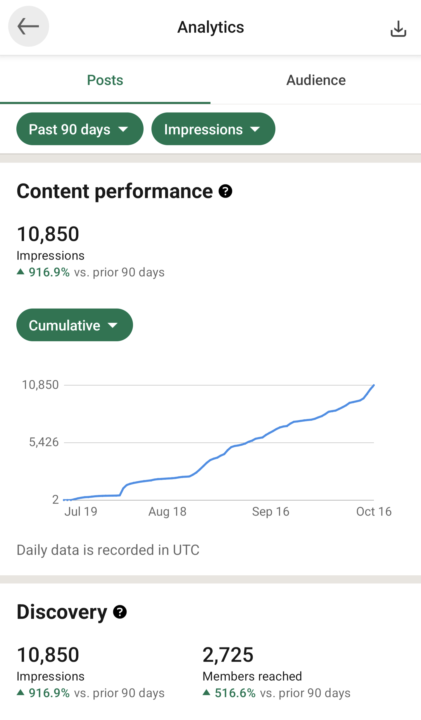
@Alex Colhoun Prior to the last few days...I was posting a mix of thought leadership and board-room insights (i.e., podcast). Now I'm posting market commentary and industry foresight. I'll keep posting my podcast. I'm also warming up the algorithm (i.e., comments and connections) but I'm not very regimented about that.
1 like • Oct '25
I've noticed: - My video posts get less traction than my text posts. - My best post ever was about a talk I gave. However, I didn't gain any followers from it.
1-10 of 16

@cameron-clark-4111
Aerospace engineer guiding satellite design, launch, and ops. Advisor on partnerships and acquisitions, blending tech. insight with business acumen.
Active 3d ago
Joined Sep 19, 2025
INTJ
Los Angeles, CA, USA
Powered by