Activity
Mon
Wed
Fri
Sun
Feb
Mar
Apr
May
Jun
Jul
Aug
Sep
Oct
Nov
Dec
Jan
What is this?
Less
More
Memberships
Peptide Price
8.5k members • Free
Heather Dawn Research Wellness
2.8k members • Free
114 contributions to Peptide Price

🔥
15h •
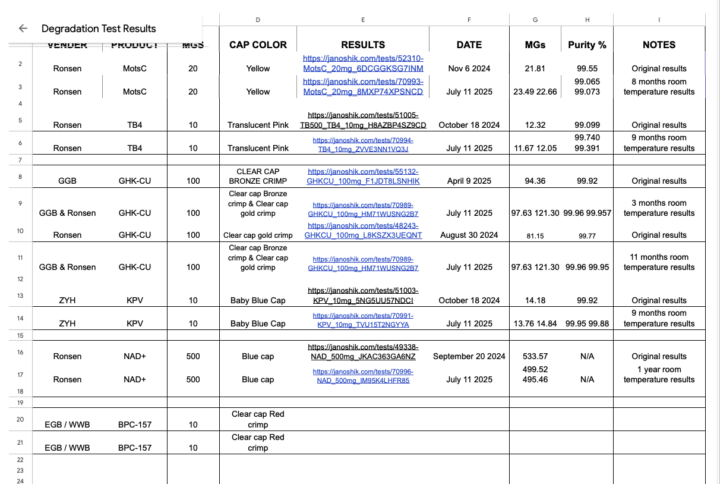
Do Lyophilized Peptides Actually Last at Room Temperature? Real-World Degradation Data 📊
Ever question whether those lyophilized peptides really last for years at room temperature, or do they degrade right away? @Brady Faught shared this little group study from another Telegram group. They took a handful of different peptides, tested them fresh, then left another sample from the batch, let it sit at room temperature and retested months later. There were two lyophilized samples, one tested originally and the other tests n number of months later. Here's what they found: Mots-C (20mg) - Fresh: 99.55% purity at 21.81mg - After 8 months at room temp: 99.07% purity at 22.66mg average - Basically held steady TB4 / TB-500 (10mg) - Fresh: 99.1% purity at 12.32mg - After 9 months at room temp: 99.39% purity at 12.05mg average - No meaningful degradation GHK-Cu (100mg) - Fresh (April): 99.92% purity at 94.36mg - After 3 months: 99.96% at 121.30mg (overfilled vial) - After 11 months: 99.95% at 121.30mg - Rock solid stability KPV (10mg) - Fresh: 99.92% purity at 14.18mg - After 9 months at room temp: 99.88% purity at 14.84mg average - Held up great NAD+ (500mg) - Fresh: N/A purity listed, 533.57mg - After 1 year at room temp: N/A purity, 495.46mg - Some quantity loss but still viable after a full year The takeaway? These peptides showed remarkable stability sitting at room temperature for extended periods. Obviously refrigeration or freezing is still best practice for long-term storage, but if you're worried about a vial that sat out for a few weeks or months, this data suggests you're probably fine. Pretty cool to see actual real-world testing rather than just speculation. - Derek peptideprice.store

2 likes • 15h
That is good news for anyone who might accidentally leave their peptides out overnight. I’ll still keep mine in the refrigerator. If it ain’t broke, don’t fix it.😂
🔥
2d •
Semaglutide vs Tirzepatide vs Retatrutide Poll
Which Peptide Are You Currently Researching With? Bonus: If you've tried multiple, why are you researching with the current one?
Poll
318 members have voted
0 likes • 18h
I’m trying to find out what is a good research. My insurance just excluded Zepbound… Oh well…
🔥
17d •
That GLOW/KLOW Stinging? Here's Why (Mind = Blown 🤯)
Ever researched with GLOW or KLOW and got that nasty stinging effect that makes your eyes water? Yeah, me too. Thought it was just part of the deal. Turns out we've been doing it wrong this whole time. The Phone Call That Changed Everything I was on the phone today with one of the original formulators of these blends. Here's what they told me: These blends were NEVER meant to be in 3ml vials. When GLOW and KLOW first came out, they were always in 5ml vials because you need more BAC water to prevent irritation in research. The peptide concentration in a 3ml vial is just too high. That's what causes the brutal stinging in research protocols. The Fix Backload 10-20 units of BAC water into your syringe before drawing your research dose. Draw your normal dose, then add the extra BAC water on top. This dilutes it right before use in research. More dilution = way less irritation. Simple as that. Some researchers are already doing this and reporting way better research experiences. Why 3ml Then? Great question. Probably, cost savings or the original formulation knowledge just got lost as these blends became more popular. I'm going to reach out to vendors to see if anyone's willing to offer proper 5ml versions and update the price tool accordingly. Your Experience? Have you dealt with the GLOW/KLOW sting in research? Tried the backloading method? Drop your experience below 👇 This is exactly the kind of knowledge that gets lost when we don't talk to the people who actually created this stuff. I learned so much today and wanted to share! ⚠️ RESEARCH USE ONLY | Not for human consumption

0 likes • 16d
I get IV hydrations, and adding zinc helps with the sting for my lab 🐀. Great information, I’ve always thought the vials are too small.
🔥
26d •
🚀 New Site Confirmed For Sunday!!
Stay tuned for Sunday night — I have a new company joining the price tool and all I can say is we're ramping up the quality in 2026! Wait until you see this company: ✅ Professional website ✅ Above and beyond testing ✅ Great customer service ✅ And what we all care about great pricing I just got the FedEx notification that the package has arrived, so once I get back to Denver on Sunday we'll do the launch. As I've done from the start of PeptidePrice.store — I get the product first, making sure everything is reliable and smooth before adding anyone to the site. Super excited for this one. You'll see the standard we're setting for 2026! 🙏

2 likes • 25d
I’ve mainly been using two vendors. Flawless has great sales, and Valor is very transparent, though their discounts with the Derek code aren’t that strong. I’m hoping this new company can offer the best of both worlds, solid transparency and meaningful savings. 😎🤗
🔥
29d •
Skool Promoting Peptides... WTF is Happening?
I've been getting a lot of questions about that recent ad Skool put out, and it seems like they may have shifted their strategy a bit. Let me catch you up on where things stand. If you weren't aware, I was told my community was getting banned for "promoting peptides." I was given a couple of days to delete all my content and clean everything up. So I pushed back: - Show me your guidelines (there were none) - Which specific rule did I break? - How is my community any different from creators X, Y, and Z? I got no real answer. Since then? Radio silence. We've been in this weird limbo where I haven't heard a word. Here's the plan: We'll ride this out and keep the Skool community alive for as long as we can. But community.peptideprice.store is staying up no matter what—because I don't trust any public platform at this point. I've been banned too many times to not have a backup. I spent a lot of time building that space specifically so we'd never lose what we've created here together. Community Reminders: - All posts and recommendations are for research use only - No injection talk or human consumption talk (these will be removed) - Use "RS" (Research Subject) terminology - You accepted when joining that nothing here constitutes medical advice—this is purely for research purposes - Please use the search function—there's probably already a post answering your question Appreciate you all. We'll keep building. 🙏 — Derek

0 likes • 25d
That is crazy!!!
1-10 of 114

@calisa-johnson-6115
My life goal is to build and maintain a healthy gut—because true wellness starts there. Always learning and exploring peptides.
Active 13h ago
Joined Aug 28, 2025