Activity
Mon
Wed
Fri
Sun
Apr
May
Jun
Jul
Aug
Sep
Oct
Nov
Dec
Jan
Feb
Mar
What is this?
Less
More
Memberships
Liberty Politics Discussion
3.8k members • Free
10 contributions to Liberty Politics Discussion

Jan 13 •
The Importance of Remembering the Fog of War as Events Unfold
As reports begin to surface about the upcoming Iran operation, it is critical for the public to pause, breathe, and remember one enduring truth of conflict: the fog of war is real, unavoidable, and often misleading—especially in the earliest stages. In moments like these, information moves faster than understanding. Social media fills gaps before facts are confirmed, analysts speculate in real time, and emotionally charged narratives take hold long before reality has a chance to emerge. This is precisely when caution matters most. What Is the “Fog of War”? The term fog of war refers to the uncertainty, confusion, and incomplete information that surrounds military operations and conflicts. Coined by military theorist Carl von Clausewitz, it describes the reality that no participant—commanders, governments, journalists, or the public—has a complete or perfectly accurate picture while events are unfolding. Even those directly involved often operate with fragmented intelligence. For outside observers, the fog is exponentially thicker. Take Everything With a Grain of Salt In the opening hours and days of any operation, nearly all information should be treated as provisional, not definitive. Early reports may be: - Incorrect - Incomplete - Out of context - Intentionally misleading - Based on assumptions rather than confirmation This does not mean journalists, analysts, or observers are acting in bad faith—it means they are working inside the fog. Accuracy tends to improve with time, corroboration, and declassification, not immediacy. Factors That Will Increase the Fog in This Conflict Several elements are likely to intensify confusion and misinformation surrounding this operation: 1. Language Barriers Primary-source information may emerge in Persian (Farsi), Arabic, Hebrew, or regional dialects. Nuance can be lost or distorted in translation, especially when rushed for headlines or social media. 2. Interpreters and Secondary Sources Much of what the public receives will be filtered through interpreters, stringers, or intermediaries. Each layer adds the potential for misunderstanding or emphasis shifts.
1 like • Jan 19
@Jenilee Bader-Ben Shimon EXACTLY!! 👏🏼👏🏼👏🏼👏🏼👏🏼
0 likes • Jan 20
@Jenilee Bader-Ben Shimon What’s a PAO and when/how would we learn when they post something?
Jan 18 •
USAF ON THE MOVE
OK. Since you do not believe me, here is another move in the right direction. 12 F-15 fighter jets of the US Army took off today from the Lakehenith base in Britain to a base in Jordan 🇯🇴. In total, 18 F-15 fighter jets of the US army were transfered to Jordan last week. In addition, Israel 🇮🇱 received 3 new F-35 jets from the US as part of their order. I should also add that Iran's center is right across Iraq 🇮🇶 from Jordan 🇯🇴

0 likes • Jan 18
I believe you!! I saw them myself. I also sent them to Armin on Twitter.
0 likes • Jan 18
One of the ones today diverted to Greece.


2 likes • Jan 17
I am going to send you a DM. Please read it.
Jan 16 •
January 16, 47 Years Ago Today
Today, January 16th, marks exactly 47 years since the Shah’s exile. 47 years of hell.
2
0
Jan 16 •
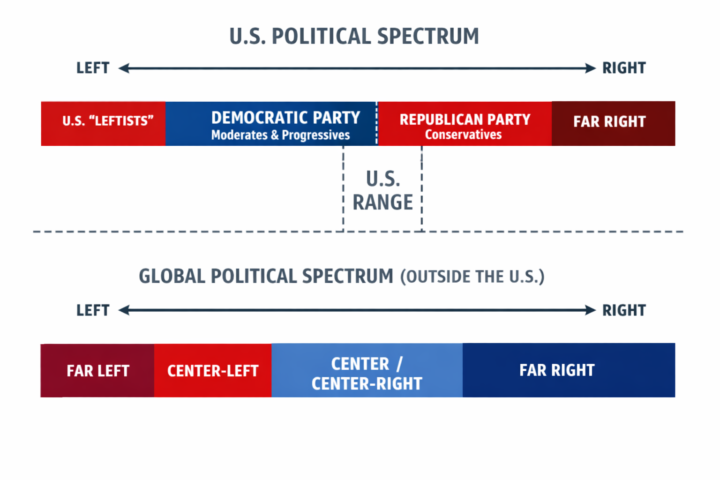
When “Leftist” Means the Wrong Thing: How Global Mislabeling Is Undermining U.S. Support
Quick summary: Much of the frustration over U.S. “leftist” support for the Iranian revolution is rooted in a basic mistake: American Democrats are not leftists by global standards. Misusing these labels distorts expectations, weakens solidarity, and obscures why support appears uneven. ————— As global conversations increasingly cross borders through journalism and social media, political language plays a powerful role in shaping understanding—and misunderstanding. One area where this is particularly evident is in how the terms “leftist” and “Democrat” are used by commentators outside the United States when referring to American politics. The issue is not one of intent, but of alignment. The U.S. political spectrum is structured differently from that of many other countries, and political labels that translate easily elsewhere do not always map cleanly onto the American system. When these differences are overlooked, confusion can arise—sometimes with real consequences for international engagement and cooperation. In much of the world, “leftist” is primarily an economic designation. It often refers to political movements or parties that support expansive social welfare systems, strong labor protections, and a more active role for the state in ensuring economic equity. These positions are common and well-established within left-wing politics internationally. In the United States, however, the term carries a narrower and more specific meaning. Most members of the Democratic Party do not identify as leftists in this global sense. Economically, many U.S. Democrats would be considered centrist—or even center-right—by international standards. The American political left, as understood elsewhere, exists within the U.S. but represents a relatively small segment of the broader political landscape. This distinction is important because expectations often flow from terminology. When international observers assume ideological alignment between U.S. Democrats and left-wing parties abroad, they may reasonably expect similar policy positions, rhetoric, or strategic priorities. When those expectations are not met, the gap can be misinterpreted as reluctance, inconsistency, or lack of support.
1 like • Jan 16
@Markus Zeitlhofer I couldn’t agree more! I vote based on issues, not along party lines. While many of my views align with those just left of center, I do not consider myself a democrat. I also tend to lean right of center on other topics. For those reasons, I refer to myself as an independent- independent of any party. However, supporting the Iranian revolution isn’t a left or right issue—it’s a human rights issue.
1-10 of 10